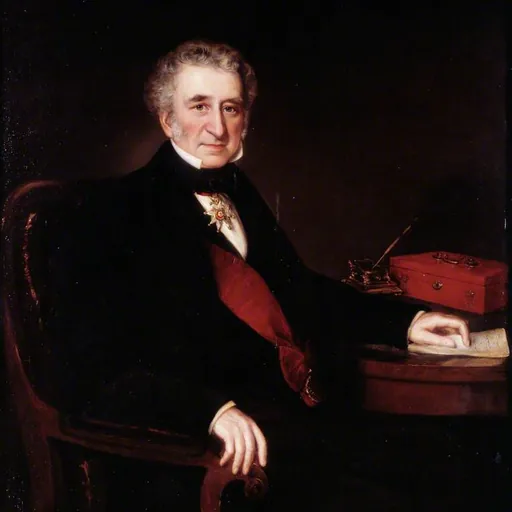
John Fane, 11th Earl of Westmorland
British Army general
About John Fane, 11th Earl of Westmorland
Lived 1784 – 1859 (aged 75). John Fane, 11th Earl of Westmorland was a British diplomat, composer, military officer, politician, military personnel and soldier.
John Fane, 11th Earl of Westmorland, (3 February 178416 October 1859 ), styled Lord Burghersh until 1841, was a British soldier, politician, diplomat, composer and musician.
Background Styled Lord Burghersh from birth, he was born at Sackville Street, Piccadilly, London, the son of John Fane, 10th Earl of Westmorland, by his wife Sarah Child, daughter and heiress of the wealthy banker Sir Robert Child, builder of Osterley Park. His sister was the social hostess Sarah Villiers, Countess of Jersey, and his uncle was William Lowther, 1st Earl of Lonsdale, a Tory magnate from northern England. He was educated at Cheam School and then at Harrow from 1797 to 1799. Burghersh was admitted to Trinity College, Cambridge on 28 January 1802 and received an M.A. in 1808.
He succeeded his father in the earldom in 1841.
Military career On 9 May 1803, Burghersh was appointed a deputy lieutenant of Northamptonshire, and after the breakdown of the Peace of Amiens, he was commissioned a lieutenant in the Northampton Militia on 30 June 1803. On 5 January 1804 he transferred to the 7th Foot as a lieutenant and on 3 May 1805 he transferred to the 23rd Foot as a captain. He exchanged on 1 November to the 3rd Dragoon Guards, and served as aide-de-camp to Sir George Don when the latter led reinforcements to Hanover. and lieutenant colonel on 9 May when he was himself sent to Portugal, This exceedingly rapid promotion, over the heads of many senior officers, drew the attention of William Shipley, member for Flint and recently retired as a lieutenant colonel. He moved that Burghersh's promotion was in violation of Army regulations, and the resolution was carried by the House of Commons. Lord Westmorland was compelled to ask the King not to sign Burghersh's commissions, In July, Burghersh was actively engaged at the Battle of Talavera. He soon after replied to a letter of his father's on his abortive promotion in May, telling him that "the military is a profession which I most sincerely love," but expressing his frustration at not occupying a situation more equal to his education and qualities. then transferred to the half-pay of the 91st Foot on 21 March. On 10 December 1811 he exchanged back into the 7th Foot and later the same year purchased a lieutenant-colonelcy in the 63rd Foot. On 4 June 1814, he was appointed an extra aide-de-camp to the Prince Regent and promoted to colonel in the Army. He was an extra aide-de-camp to the Duke of Wellington (his wife's uncle) and fought at Talavera and Busaco during the Peninsular War. He was promoted major general on 27 May 1825. Made a KCB on 25 February 1838, he was promoted lieutenant general on 28 June 1838 and general in 1854 and was appointed Colonel of the 56th Foot in 1842.
Political and diplomatic career Lord Westmorland sat as a Member of Parliament (MP) for Lyme Regis between 1806 and 1816. He served as Minister to Tuscany between 1814 and 1830, as Envoy Extraordinary and Minister Plenipotentiary to Prussia between 1841 and 1851 and as Ambassador to the Austrian Empire between 1851 and 1855. In Vienna, he was one of the British representatives at the congress of 1855.
During the Revolutions of 1820 he was accused by the Austrian Government of actively supporting the Revolution in Naples, and was urged by his own Government to show more discretion. Westmorland defended his conduct by arguing that while he was "no Jacobin" and had no sympathy with the revolutionaries, he was concerned that the Austrians would put down the revolution with such brutality that further political disturbance was inevitable.
He was appointed a Companion of the Order of the Bath in 1815, a Knight Grand Cross of the Royal Guelphic Order (KCH) in 1817, a Knight Commander of the Order of the Bath (KCB) in 1838 and a Knight Grand Cross of the Order of the Bath (GCB) in 1846 and was sworn of the Privy Council in 1822. :
Bajazet (1821) Fedra (1824) L'Eroe di Lancastro (1827) Il Torneo (1828) Lo Scompiglio Teatrale (1829) L'assedio di Belgrado (1830). This opera was also performed in London under the title Catherine or the Austrian Captive.
Family Lord Westmorland married Priscilla Anne Pole-Wellesley, daughter of the Honourable William Wellesley-Pole, later first Baron Maryborough and third Earl of Mornington and Katherine Elizabeth Forbes, on 26 June 1811. They had seven children: Lady Rose Sophia Mary Fane who married Henry Weigall and whose sons included the cricketer Gerry Weigall and the diplomat Archibald Weigall Hon. John Arthur Fane (12 February 181629 August 1816) George Augustus Frederick John Fane, Lord Burghersh (18 June 181929 April 1848) Maria Louisa Priscilla Fane (24 May 1822 - 25 March 1837) Ernest Fitzroy Neville Fane, Lord Burghersh (7 January 182422 June 1851) Francis Fane, 12th Earl of Westmorland (1825–1891) Hon. Julian Henry Charles Fane (10 October 182719 April 1870)
He died in October 1859, aged 75, and was succeeded in the earldom by his fourth but eldest surviving son, Francis. Lord Westmorland's fifth and youngest son Julian Fane was a poet and diplomat. The Countess of Westmorland died in February 1879.
Arms
Don’t just read it —
keep it.
Full-length biographies made to live with: read them, listen on the way to work, watch them tonight.
- E-book
- Audio
- Video
Instant download · yours to keep · every purchase keeps this site free
Important facts
Family & relationships
People in John Fane, 11th Earl of Westmorland's life
Named in this biography and alive at the same time


Related people
Same field, nearest in time
Contemporaries
People whose lives overlapped John Fane, 11th Earl of Westmorland's
Frequently asked questions
Who was John Fane, 11th Earl of Westmorland?
British Army general
When was John Fane, 11th Earl of Westmorland born?
John Fane, 11th Earl of Westmorland was born on 2 February 1784 in London.
When did John Fane, 11th Earl of Westmorland die?
John Fane, 11th Earl of Westmorland died on 16 October 1859 in London.
What was John Fane, 11th Earl of Westmorland's occupation?
John Fane, 11th Earl of Westmorland was a diplomat, composer, military officer, politician, military personnel and soldier.
What nationality was John Fane, 11th Earl of Westmorland?
John Fane, 11th Earl of Westmorland was British.
Sources & further reading
· Wikipedia: John Fane, 11th Earl of Westmorland
· DBpedia: John Fane, 11th Earl of Westmorland
Cite this page
APA: Biography.guide. (2026). John Fane, 11th Earl of Westmorland. https://biography.guide/john-fane-11th-earl-of-westmorland/
MLA: "John Fane, 11th Earl of Westmorland." Biography.guide, https://biography.guide/john-fane-11th-earl-of-westmorland/.
Chicago: "John Fane, 11th Earl of Westmorland." Biography.guide. https://biography.guide/john-fane-11th-earl-of-westmorland/.
Data last updated: 2026-09-26 · Spot an error? Report a correction.
Portrait: Wikimedia Commons · author & licence
Page generated 2026-10-04 11:25 UTC