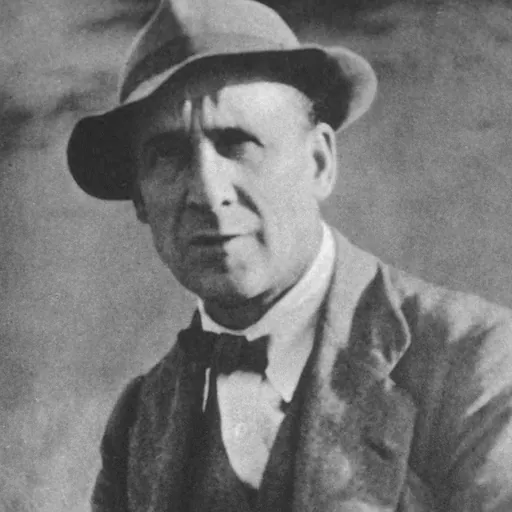
About John Duncan Fergusson
Lived 1874 – 1961 (aged 86). John Duncan Fergusson was a British painter, sculptor and visual artist.
John Duncan Fergusson (9 March 1874 – 30 January 1961) was a Scottish artist and sculptor, regarded as one of the major artists of the Scottish Colourists school of painting.
Early life
Fergusson was born in Leith, Edinburgh, the first of four children.
Painting career Paris In 1898, Fergusson took his first trip to Paris to study at the Louvre. In addition, he and his friend Samuel Peploe regularly painted together at Paris Plage (Le Touquet) and other places along the coast between 1904–9. It was at this period too that he began his relationship with the American illustrator Anne Estelle Rice (1879–1959), whom he encouraged to take up painting. She had been sent to Paris to provide drawings for articles on theatre, ballet, opera and race meetings published in the North American magazine and was to figure in many of Fergusson's canvases.
He had his first one-man-show in the Baillie Gallery in London, immediately before going to Paris. He did have his second show until 1923.
Post WWI career
By the outbreak of World War I, Fergusson was considered to be at the forefront of modern British painting. During the war years, however, he achieved little artistically and it was only towards the end of the war that he regained the momentum in his work.
In the 1920s Fergusson settled in a studio in London. His first solo exhibition was organised by Alexander Reid in September 1923 at La Societe des Beaux Artes in Glasgow, reshown at Aitken & Dott's Gallery in Edinburgh (also through Reid) in October 1923. Reid also organised a four man exhibition including Fergusson at the Galerie Barbazanges in Paris in February 1924. In 1928 he and his partner, the dancer Margaret Morris, moved to Paris, where they lived until the spectre of war once again loomed over Europe, prompting the couple to move to Glasgow in 1939 where they were to remain for the rest of their lives. A member of Glasgow Art Club, Fergusson exhibited a portrait in the club's exhibition, April 1939.
In 1940 Fergusson founded the New Art Club, out of which emerged the New Scottish Group of painters of which he was the first president. In 1943 he published his book on "Modern Scottish Painting".
Death and legacy Fergusson died on 30 January 1961. His partner Margaret Morris presented fourteen of his paintings to the University of Stirling when it was founded in 1968.
Don’t just read it —
keep it.
Full-length biographies made to live with: read them, listen on the way to work, watch them tonight.
- E-book
- Audio
- Video
Instant download · yours to keep · every purchase keeps this site free
Important facts
People in John Duncan Fergusson's life
Named in this biography and alive at the same time



Related people
Same field, nearest in time

Contemporaries
People whose lives overlapped John Duncan Fergusson's

Frequently asked questions
Who was John Duncan Fergusson?
British artist (1874-1961)
When was John Duncan Fergusson born?
John Duncan Fergusson was born on 9 March 1874 in Leith.
When did John Duncan Fergusson die?
John Duncan Fergusson died on 30 January 1961 in Glasgow.
What was John Duncan Fergusson's occupation?
John Duncan Fergusson was a painter, sculptor and visual artist.
What nationality was John Duncan Fergusson?
John Duncan Fergusson was British.
Sources & further reading
· Wikipedia: John Duncan Fergusson
· DBpedia: John Duncan Fergusson
Cite this page
APA: Biography.guide. (2026). John Duncan Fergusson. https://biography.guide/john-duncan-fergusson/
MLA: "John Duncan Fergusson." Biography.guide, https://biography.guide/john-duncan-fergusson/.
Chicago: "John Duncan Fergusson." Biography.guide. https://biography.guide/john-duncan-fergusson/.
Data last updated: 2026-09-20 · Spot an error? Report a correction.
Page generated 2026-09-27 05:10 UTC