
About John Dumbleton
Lived 1310 – 1349 (aged 38–39). John Dumbleton was an English mathematician and university teacher.
John of Dumbleton (Latin Ioannes De Dumbleton; c. 1310 – c. 1349) was a member of the Dumbleton village community in Gloucestershire, a southwestern county in England. Although obscure, he is considered a significant English fourteenth-century philosopher for his contributions to logic, natural philosophy, and physics. Dumbleton’s masterwork is his Summa Logicae et Philosophiae Naturalis (Summary of Logic and Natural Philosophy), likely to have been composed just before the time of his death.
Life John of Dumbleton is recorded to have become a fellow at Merton College, Oxford (ca. 1338–9) and to have studied with the likes of William Heytesbury, Thomas Bradwardine, and Richard Swineshead. These four medieval scholastics held a common bond in that their study interests were in a similar field, but the method of study which brought these fellows into the same sphere of learning was of a more esoteric bent than modern university methods. They were interested in mathematics and logical analysis for the purposes of natural philosophy, theology, and an a priori type of mathematical physics (not to be confused with modern, empirical, experimental physics). Thus, the physics postulations and conjectures made by Dumbleton and his Oxford contemporaries were primarily done without any application of physical experimentation. Dumbleton, along with the other three Merton philosophers, received the moniker 'Calculators' for their adherence to mathematics and logical disputation when solving philosophical and theological problems. After being named a fellow at The Queen's College, Oxford (1340) and making a return to Merton College (1344–45) Dumbleton is recorded to have studied theology in Paris (ca. 1345–47) for a brief period before returning to finish his studies at Merton College (1347–1348). The fact that no extant copy of Dumbleton's Summa Logicae et Philosophiae Naturalis is complete (nor edited) leads one to wonder if his death (ca. 1349) abruptly terminated the possibility of its completion.
Philosophical contributions Though there was a considerable reverence for Platonism in Oxford during the fourteenth century, the rebirth of Aristotelianism held sway in the higher Parisian learning circuits. Dumbleton, who studied in Paris for a brief time, was not immune to this spell. In fact, his compendium Summa Logica et Philosophiae Naturalis, has an overview of many principles found in Aristotle's Physics. The Summa is broken into ten different sections. The ninth section is uncompleted in all extant manuscripts. The tenth section, which, according to Dumbleton, was supposed to examine "universals and signification," shows no evidence of ever being worked on. Though the idea of molecules was not theorized at this time, Dumbleton’s speculation helped to tame the view that bodies have infinitely divisible parts.
Dumbleton was one of the first to express functional relationships in graphical form. He gave a proof of the mean speed theorem stating that "the latitude of a uniformly difform movement corresponds to the degree of the midpoint" and used this method to study the quantitative decrease in intensity of illumination, stating that it was not linearly proportional to the distance, but was unable to expose the Inverse-square law, which was postponed nearly 250 years until its discovery by Johannes Kepler in 1604.
Criticism It is difficult to determine what methodology the Oxford 'Calculators' used when they were conjecturing and postulating theorems by way of abstraction (i.e., without empirical investigation). This criticism is not expressly made toward Dumbleton's conjectures but more broadly aimed at the methodology of the whole group of Mertonian physicists. One suggestion is that they may have been trying to create a mathematical picture of the Aristotelian world-view. If this were true, it would show why empirical investigation was not their modus operandi. In other words, the Oxford Calculators' works show respect for quantitative reasoning; opposed to a posteriori evaluations. Regardless of whether they opted against empirical investigation for theological reasons or simply because the debut of the scientific method was not ready to be revealed, one ought to regard John of Dumbleton and his contemporaries as exemplary pioneers in mathematics, physics, and logical discourse.
Writings Summa Logica et Philosophiae Naturalis (c. 1349; There are at least twenty extant manuscripts) Compendium Sex Conclusionum Expositio Capituli Quarti Bradwardini de Proportionibus (1332; Exposition of the Fourth Chapter of Bradwardine's De Proportionibus)
Don’t just read it —
keep it.
Full-length biographies made to live with: read them, listen on the way to work, watch them tonight.
- E-book
- Audio
- Video
Instant download · yours to keep · every purchase keeps this site free
Important facts
People in John Dumbleton's life
Named in this biography and alive at the same time

Related people
Same field, nearest in time



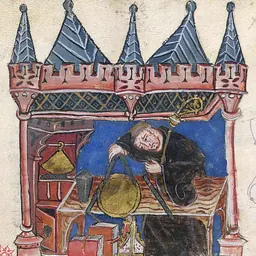

Contemporaries
People whose lives overlapped John Dumbleton's


Frequently asked questions
Who was John Dumbleton?
British mathematician
When was John Dumbleton born?
John Dumbleton was born in 1310.
When did John Dumbleton die?
John Dumbleton died in 1349.
What was John Dumbleton's occupation?
John Dumbleton was a mathematician and university teacher.
What nationality was John Dumbleton?
John Dumbleton was English.
Sources & further reading
Cite this page
APA: Biography.guide. (2026). John Dumbleton. https://biography.guide/john-dumbleton/
MLA: "John Dumbleton." Biography.guide, https://biography.guide/john-dumbleton/.
Chicago: "John Dumbleton." Biography.guide. https://biography.guide/john-dumbleton/.
Data last updated: 2026-09-20 · Spot an error? Report a correction.
Page generated 2026-09-27 05:24 UTC