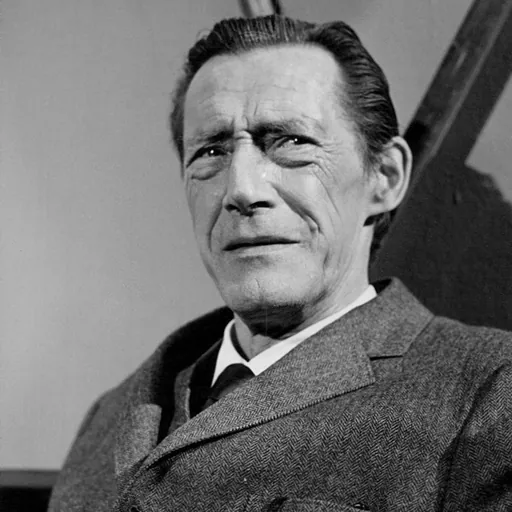
About John Carradine
Lived 1906 – 1988 (aged 82). John Carradine was an American film actor, character actor, stage actor, television actor, voice actor and painter.
John Carradine ( ; born Richmond Reed Carradine; February 5, 1906 – November 27, 1988) was an American character actor, who was considered one of the greatest in American cinema. He was a member of Cecil B. DeMille's stock company and later John Ford's company, known for his roles in horror films, Westerns, and Shakespearean theater, most notably portraying Count Dracula in House of Frankenstein, House of Dracula (1945), Billy the Kid Versus Dracula (1966), and Nocturna: Granddaughter of Dracula (1979). Among his other notable roles was "Preacher Casy" in John Ford's The Grapes of Wrath. In later decades of his career, he starred mostly in low-budget B-movies.
Carradine was married four times, had five children, and was the patriarch of the Carradine family, including four sons and four grandchildren who are or were also actors. In total, he holds 351 film and television credits, making him one of the most prolific English-speaking film and television actors of all time.
Early life Carradine was born in New York City the son of William Reed Carradine, a correspondent for the Associated Press, and his wife, Genevieve Winnifred Richmond, a surgeon. William Carradine was the son of evangelical author Beverly Carradine. The family lived in Peekskill, New York and Kingston, New York. William Carradine died from tuberculosis when his son John was two years old. Carradine's mother then married "a Philadelphia paper manufacturer named Peck, who thought the way to bring up someone else's boy was to beat him every day just on general principle." Carradine attended the Christ Church School in Kingston He traveled for a time, supporting himself painting portraits. "If the sitter was satisfied, the price was $2.50," he once said. "It cost him nothing if he thought it was a turkey. I made as high as $10 to $15 a day."
By 1936, Carradine had become a member of John Ford's stock company and appeared in The Prisoner of Shark Island. In total, he made 11 pictures with Ford, including his first important role, as Preacher Casy in The Grapes of Wrath (1940).
Carradine did considerable stage work, much of which provided his only opportunity to work in a classic drama context. He toured with his own Shakespearean company in the 1940s, playing Hamlet and Macbeth. His Broadway roles included Ferdinand in a 1946 production of John Webster's The Duchess of Malfi, the Ragpicker in a 13-month run of Jean Giraudoux's The Madwoman of Chaillot, Lycus in a 15-month run of A Funny Thing Happened on the Way to the Forum, and DeLacey in the expensive one-night flop Frankenstein in 1981. He also toured in road companies of such shows as Tobacco Road and Cat on a Hot Tin Roof, in which he was properly emaciated as the cancer-ridden Big Daddy, a part, he said, which Tennessee Williams wrote for him. He often played eccentric, insane, or diabolical characters, especially in the horror genre with which he had become identified as a "star" by the mid-1940s. He occasionally played a heroic role, as in The Grapes of Wrath, in which he played Casy, the ill-fated "preacher", and he occasionally played a sympathetic role, as in Son of Fury: The Story of Benjamin Blake, in which he played Blake's shipmate, who escapes with him to a tropical island full of riches.
He appeared in dozens of low-budget horror films from the 1940s onwards, to finance a touring classical theater company. He also played a small but important role in the very-high-budget comedy The Court Jester, which was at the time of its release the most expensive comedy film ever made. He played a mad scientist in Woody Allen's Everything You Always Wanted to Know About Sex* (*But Were Afraid to Ask). He sang the theme song to one film in which he appeared briefly, Red Zone Cuba. Carradine also made more than 100 acting appearances on television over a period of 39 years. His first performance on the "small screen" was on the DuMont Television Network in 1947, when he played Ebenezer Scrooge in a broadcast presentation of A Christmas Carol. His final role on television was in 1986 as Professor Alex Stottel on a revival of the classic series The Twilight Zone, in an episode segment titled "Still Life." Some examples of other television series on which he appeared include My Friend Flicka, Johnny Ringo (as The Rain Man), and Place the Face, NBC's Cimarron City as the foreboding Jared Tucker in the episode "Child of Fear" and on William Bendix's Overland Trail in the 1960 episode "The Reckoning," on Harrigan and Son starring Pat O'Brien in the episode "A Matter of Dignity," Maverick in "Red Dog" starring Roger Moore and Lee Van Cleef, Sugarfoot, The Rebel, and The Legend of Jesse James, on the syndicated adventure series Rescue 8 with actor Jim Davis and in two episodes of the western TV series Bonanza ("Springtime" and "Dead Wrong"). John Carradine also appeared in 1959 as the mind reader in The Rifleman episode of the same name.
Carradine also made recurring appearances as the mortician Mr. Gateman on the television comedy series The Munsters. He appeared as well in both of Irwin Allen's classic 1960s science-fiction television series Lost in Space and Land of the Giants. In 1975 he was in an episode of Sid and Marty Croft's, "Far Out Space Nuts" with Chuck McCann and Bob Denver. In 1985, Carradine won a Daytime Emmy Award for his performance as an eccentric man who lives by the railroad tracks in the Young People's Special Umbrella Jack.
In 1982, he supplied the voice of the Great Owl in the animated feature The Secret of NIMH. Also, he played the voice of the villainous Wizard in the English-dubbed version of Aladdin and the Magic Lamp by Sync, Ltd. One of Carradine's later appearances was Peggy Sue Got Married in 1986. Carradine's last released film credit was Jack-O, released in 1995, seven years after his death.
Carradine's deep, resonant voice earned him the nickname "The Voice". He was known as the "Bard of the Boulevard" due to his idiosyncratic habit of strolling Hollywood streets while reciting Shakespearean soliloquies, something he always denied.
They divorced in 1944 when David was seven years old. Carradine left California to avoid court action in the alimony settlement. After the couple engaged in a series of court battles involving child custody and alimony, which at one point landed Carradine in jail,
In 1945, immediately following his divorce from Ardanelle, Carradine married Sonia Sorel (May 18, 1921 – September 24, 2004), who had appeared with him in the 1944 film Bluebeard. Sonia, who had adopted the stage name of Sorel, was the daughter of San Francisco brewer Henry Henius, granddaughter of biochemist Max Henius, and a great-niece of the historian Johan Ludvig Heiberg. Together, Carradine and Sonia had three sons, Christopher, Keith, and Robert. Their divorce in 1957
Eventually, Carradine won custody of the children. For the next eight years, Sonia was not permitted to see the children. Robert Carradine said that he was raised primarily by his stepmother, his father's third wife, Doris (Rich) Grimshaw, and believed her to be his mother until he was introduced to Sonia Sorel at a Christmas party when he was 14 years old. He told a journalist, "I said, 'How do you do?' Keith took me aside and said 'That's our real mother.' I didn't know what he was talking about. But he finally convinced me."
When John Carradine married Doris (Erving Rich) Grimshaw in 1957, she already had a son, Dale, from a previous marriage, and a son, Michael, from a later relationship. Both Dale and Michael, along with Sonia Sorel's son, Michael Bowen, are sometimes counted among John Carradine's eight sons. She was a one-time studio typist who typed the script to The Treasure of the Sierra Madre and who played a few roles in film and television. Doris died in 1971 in a fire in her apartment in Oxnard, California. The fire was caused by a burning cigarette. She had been rescued from a similar fire two weeks earlier. At the time of her death, Carradine and she were separated. Carradine was married a fourth time, from 1975 to his 1988 death, to Emily Cisneros in Oxnard, California.
Semi-retired by the late 1980s, Carradine suffered from painful and crippling rheumatoid arthritis in the years before he died from heart and kidney failure at the in Milan, Italy on November 27, 1988, at the age of 82. Hours before he was stricken, he had climbed the 328 steep steps of Milan's Gothic cathedral, the Duomo. According to David Carradine, his father had just finished a film (Buried Alive) in South Africa and was about to begin a European tour. David was with him, reading Shakespeare to him in his hospital bed, when he succumbed to his condition. By the time David and Keith Carradine had arrived at their father's bedside at the hospital, he was unable to speak. "I was told that his last words were, 'Milan: What a beautiful place to die.'" David recalled, "But he never spoke to me or opened his eyes. When he died, I was holding him in my arms. I reached out and closed his eyes. It's not as easy as it is in the movies." In 2003, he was inducted into the Western Performers Hall of Fame at the National Cowboy & Western Heritage Museum in Oklahoma City, Oklahoma.
Four of Carradine's five sons became actors: David, Robert, Keith, and Bruce. David had a prolific career, amassing 227 movie and television credits by the time of his death in 2009. He also had a brief Broadway career and produced and directed a number of independent projects. His success often led to work for other members of his family, including his father. The two appeared together in a few films, including The Good Guys and the Bad Guys (1969) and Boxcar Bertha (1972), produced by Roger Corman and directed by Martin Scorsese.
David's television series Kung Fu featured his father John and half-brother Robert in the episode "Dark Angel". John appeared as the same character, the Reverend Serenity Johnson, in two more episodes: "The Nature of Evil" and "Ambush". David's brothers Bruce and Keith appeared in the series, with Keith playing David's character as a teenager for a brief period. David, Keith, and Robert appeared together in a humorous cameo on The Fall Guy, on an episode titled "October the 31st", in which their father co-starred.
Robert appeared with his father in an episode of the first Twilight Zone revival television series in 1986. The episode segment titled "Still Life" featured Robert as a photographer who discovers an unusual camera and his father as a college professor who helps him discover the camera's secret.
Filmography
Television roles The following are only a few examples of the many roles John Carradine performed on television between 1947 and 1986:
My Friend Irma, CBS comedy (1952–1954) as Mr. Corday An Evening with Hamlet, CBS comedy (1954) as Cameron Whitfield Cheyenne, TV western (1957); episode: "Decision at Gunsight" as Delos Gerrard The Restless Gun; episode: "More Than Kin" as Arch The Rifleman, TV western (1959); episode: "The Photographer" as Abel Goss, and as the mentalist James Barrow McBride in S1 E40 "The Mind Reader" Gunsmoke, TV western (1959) as Kader The Twilight Zone (1959); episode: "The Howling Man" (1960) as Brother Jerome Maverick; episode: "Red Dog" (1960) starring Roger Moore, Lee Van Cleef and Sherry Jackson The Rebel, TV western (1961) as Elmer Dodson Lawman, TV western (1962); episode: "The Actor" as Geoffrey Hendon The Beverly Hillbillies (1966); episode: "The Great Jethro" as Marvin Bagby/Marvo the Magnificent The Munsters (1964–1966) as Mr. Gateman (Herman's boss) Lost in Space (television series 1965–1968); episode: "The Galaxy Gift" (April 26, 1967) Land of the Giants (television series 1968–1970); episode: "Comeback" (November 23, 1969) as Egor Daughter of the Mind (ABC Movie of the Week 1969) as Bosch (December 9, 1969) Night Gallery; episode: "Big Surprise/Quoth the Raven/Prof. Peabody's Last Lecture", 1971 Kung Fu (three episodes: 1972, 1974 and 1975); as Preacher Serenity Johnson, John played opposite his son David, who was the star of the series. The Night Strangler (1973) as Llewelyn Crossbinder The New Adventures of Wonder Woman (1978) as Harlow Gault The Fall Guy; episode: "October the 31st" (1984) as Preston Deauville The Twilight Zone (1985); episode: "Still Life" (1985) as Professor Stottel
Gallery
Don’t just read it —
keep it.
Full-length biographies made to live with: read them, listen on the way to work, watch them tonight.
- E-book
- Audio
- Video
Instant download · yours to keep · every purchase keeps this site free
Important facts
Family & relationships
People in John Carradine's life
Named in this biography and alive at the same time





Related people
Same field, nearest in time


Contemporaries
People whose lives overlapped John Carradine's

Frequently asked questions
Who was John Carradine?
American actor (1906-1988)
When was John Carradine born?
John Carradine was born on 5 February 1906 in New York City.
When did John Carradine die?
John Carradine died on 27 November 1988 in Milan.
What was John Carradine's occupation?
John Carradine was a film actor, character actor, stage actor, television actor, voice actor and painter.
What nationality was John Carradine?
John Carradine was American.
Sources & further reading
Cite this page
APA: Biography.guide. (2026). John Carradine. https://biography.guide/john-carradine/
MLA: "John Carradine." Biography.guide, https://biography.guide/john-carradine/.
Chicago: "John Carradine." Biography.guide. https://biography.guide/john-carradine/.
Data last updated: 2026-09-20 · Spot an error? Report a correction.
Portrait: Wikimedia Commons · author & licence
Page generated 2026-09-27 04:58 UTC