About John Carl Warnecke
Lived 1919 – 2010 (aged 91). John Carl Warnecke was an American landscape architect and architect.
Association with Kennedys
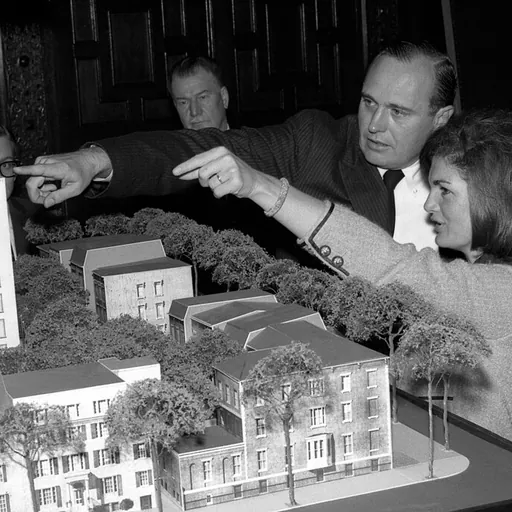
Lafayette Square Northeast corner of Lafayette Square. The Howard T. Markey National Courts Building (in red) stands behind the historic Cutts-Madison House (yellow) and former Cosmos Club (tan). Warnecke's reputation as an architect received a substantial boost when he was asked by the administration of President John F. Kennedy to save the historic buildings surrounding Lafayette Square. The Park Commission's proposals, which came to be known as the "McMillan Plan", proposed that all the buildings around Lafayette Square be razed and replaced by tall, Neoclassical buildings clad in white marble for use by executive branch agencies. Little action was taken on these proposals over the next 50 years. However, plans were made in the late 1950s to raze all the buildings on the east side of Lafayette Square and replace them with a white modernist office building which would house judicial offices. Opposition to the demolition of the Cutts-Madison House and other buildings on Lafayette Square began forming shortly after the decision to raze the structures was announced. The newly elected Kennedy administration indicated in February 1961 that it was anxious to retain the existing historic homes on Lafayette Square.
In February 1962, First Lady Jacqueline Kennedy lobbied the General Services Administration to stop the demolition and adopt a different design plan. "The wreckers haven't started yet, and until they do it can be saved", she wrote. to create a design which would incorporate the new buildings with the old. Warnecke conceived the basic design over that weekend, The design was presented to the public and the Commission of Fine Arts (which had approval over any plan) in October 1962, and with Jacqueline Kennedy's backing the Commission adopted the revised Warnecke design proposal.
Warnecke's design for the square was based on the architectural theory of contextualism. Warnecke's design build the first modern buildings on Lafayette Square and they were the first buildings in the city to utilize contextualism as a design philosophy.
Warnecke was appointed to an important federal post and received two important commissions from the Kennedy family in 1963. On June 21, 1963, President Kennedy appointed Warnecke to the U.S. Commission of Fine Arts. Warnecke's first important commission from the President was the design for a presidential library. Plans and sites were discussed in May, and on October 19, just 34 days before his assassination, President Kennedy (with Warnecke by his side) chose a site next to the Harvard Graduate School of Business Administration. As Warnecke and Kennedy had only discussed general themes for the design, I. M. Pei was selected by the Kennedy family to be the library's actual architect.
Kennedy grave site
President Kennedy was assassinated on November 22, 1963, and Warnecke was chosen by Jacqueline Kennedy to design John F. Kennedy's tomb six days later on November 28. Coincidentally, the President and Warnecke had visited the site which was to become Kennedy's tomb in March 1963, and the President had admired the peaceful atmosphere of the place. On November 24, Jacqueline Kennedy told friends that she wanted an eternal flame at the gravesite.
Warnecke visited the grave with Jacqueline Kennedy and Attorney General Robert F. Kennedy on Wednesday, November 27, to discuss themes and plans for the grave. A few days later, Warnecke agreed that, although it was not required, he would submit the design for the permanent Kennedy grave site to the U.S. Commission of Fine Arts. An extensive research project was conducted in which hundreds of famous tombs (such as the Mausoleum of Halicarnassus and Grant's Tomb) as well as all existing presidential burial sites. Warnecke discussed design concepts with more than 40 architects, sculptors, painters, landscape architects, stonemasons, calligraphers, and liturgical experts —including the sculptor Isamu Noguchi, architectural model maker Theodore Conrad, and the U.S. Commission of Fine Arts. In the course of the research and conceptualization effort, Warnecke considered the appropriateness of structures or memorials at the site (such as crosses, shafts, pavilions, etc.), the history of Arlington National Cemetery, the vista, and how to handle ceremonies at the site. The downslope side of the elliptical plaza would be enclosed by a low wall inscribed with quotes from Kennedy's speeches. The eternal flame would be placed in the center of the grassy plot in a flat, triangular bronze sculpture intended to resemble a votive candle or brazier. The U.S. Department of Defense formally hired Warnecke to design the approaches (although this was a fait accompli).
Slate headstone and Eternal Flame marking the grave of John F. Kennedy. Prior to construction, which formally began in the spring of 1965, several design changes were made to the Kennedy grave site. The retaining wall behind the grave was removed, and the hill landscaped to allow an unobstructed view of Arlington House. Concerned that the grass on the burial plot would wither in Washington's hot summers, in the fall of 1966 the decision was made to replace the grass with rough-hewn reddish-gold granite fieldstone set in a flagstone pattern. The ceremony, which took 20 minutes, was attended by President Lyndon B. Johnson, Jacqueline Kennedy, and members of the Kennedy family.
According to Warnecke (and others), during the design work on the Kennedy gravesite he became romantically involved with Jacqueline Kennedy. At one point, the couple contemplated marriage. They ended their involvement in December 1966.
Warnecke's term on the U.S. Commission of Fine Arts ended in July 1967, and he was not reappointed after President Johnson expressed his desire to have his own preferred architects on the board.
Later career, retirement, and death Warnecke opened an office in New York City in 1967, hiring architects Eugene Kohn in 1967 and Sheldon Fox in 1972. By 1977, his company, John Carl Warnecke & Associates, was the largest architectural firm in the United States. taking vice-president and designer William Pedersen, manager Sheldon Fox, and a large number of clients with him and founding Kohn Pedersen Fox (KPF). Several Warnecke associates subsequently joined KPF, and when Warnecke's company subsequently languished, he began reducing his active involvement in his architectural practice.
1963 College Heights campus, College of San Mateo San Mateo, California
1966 J. Henry Meyer Memorial Library, Stanford University Stanford, California 1969 Nathan Cummings Art Building, Stanford University Stanford, California low-slung, reinforced concrete building demolished 2015
1973 Nimitz Library, United States Naval Academy Annapolis, Maryland co-designed with George M. Ewing Company, the master plan and several buildings
1977 South Terminal (now Terminal B), Logan International Airport Boston, Massachusetts
1982 Hart Senate Office Building Washington, D.C. He received more than 13 honors and awards from the American Institute of Architects (AIA) by 1964. He was a Senior Fellow of the Design Futures Council.
Don’t just read it —
keep it.
Full-length biographies made to live with: read them, listen on the way to work, watch them tonight.
- E-book
- Audio
- Video
Instant download · yours to keep · every purchase keeps this site free
Important facts
People in John Carl Warnecke's life
Named in this biography and alive at the same time







Related people
Same field, nearest in time




Contemporaries
People whose lives overlapped John Carl Warnecke's


Frequently asked questions
Who was John Carl Warnecke?
American architect (1919-2010)
When was John Carl Warnecke born?
John Carl Warnecke was born on 24 February 1919 in Oakland.
When did John Carl Warnecke die?
John Carl Warnecke died on 17 April 2010 in Healdsburg.
What was John Carl Warnecke's occupation?
John Carl Warnecke was a landscape architect and architect.
What nationality was John Carl Warnecke?
John Carl Warnecke was American.
Sources & further reading
· Wikipedia: John Carl Warnecke
Cite this page
APA: Biography.guide. (2026). John Carl Warnecke. https://biography.guide/john-carl-warnecke/
MLA: "John Carl Warnecke." Biography.guide, https://biography.guide/john-carl-warnecke/.
Chicago: "John Carl Warnecke." Biography.guide. https://biography.guide/john-carl-warnecke/.
Data last updated: 2026-09-22 · Spot an error? Report a correction.
Portrait: Wikimedia Commons · author & licence
Page generated 2026-09-27 05:03 UTC