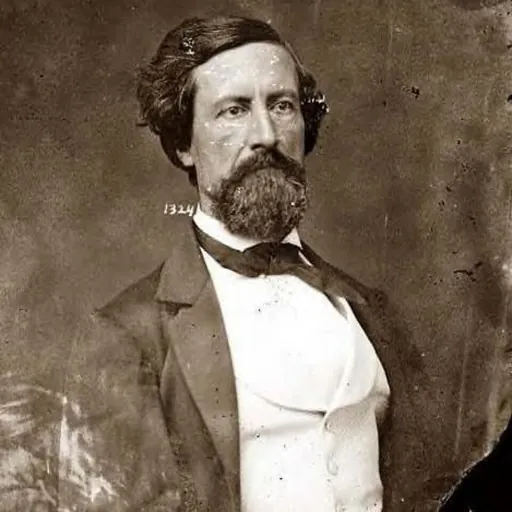
About John C. Pemberton
Lived 1814 – 1881 (aged 66). John C. Pemberton was a military personnel.
John Clifford Pemberton (August 10, 1814 – July 13, 1881) was an American military officer who served in the United States Army during the Seminole Wars and the Mexican–American War. He resigned his commission and served as a lieutenant-general in the Confederate States Army during the American Civil War. He led the Army of Mississippi from December 1862 to July 1863 and was the commanding officer during the Confederate surrender at the Siege of Vicksburg.
Early life and career Pemberton was born on August 10, 1814, in Philadelphia, Pennsylvania, the second child of thirteen to John and Rebecca Clifford Pemberton. His ancestor, Phineas Pemberton, traveled to the Colony of Pennsylvania from Lancashire, England, along with William Penn in 1682. John entered the United States Military Academy in 1833 and was a roommate and close friend of George G. Meade. He graduated in 1837, standing 27th in his class out of 50 cadets. He was commissioned a second lieutenant in the 4th U.S. Artillery Regiment on July 1, 1837. He participated with the 4th during the U.S. Army actions against the Seminole Indian tribe during the Second Seminole War in 1837 and 1838, fighting in Florida at the Battle of Loxahatchee on January 24, 1838.
Pemberton and the 4th Artillery served in garrison duty at Fort Columbus, Governors Island, New York, from 1838 to 1839, and then at the Camp of Instruction located near Trenton, New Jersey, in 1839. He then served along the northern U.S. frontier during the brief Canadian Border Disturbances of the Aroostook War. Pemberton and the 4th were next stationed in Michigan, serving at Detroit in 1840, at Fort Mackinac in the upper Great Lakes in Michigan in 1840 and 1841, and at Fort Brady in 1841. He then served in Buffalo, New York, from 1841 to 1842, and was promoted to first lieutenant on March 19, 1842. Pemberton and the 4th returned to garrison duty at Fortress Monroe, in Hampton Roads harbor on coastal Virginia in 1842, then were stationed at the U.S. Army Cavalry School at Carlisle Barracks, Pennsylvania, in 1842 and 1843, and returned to Fort Monroe from 1844 to 1845. for his performance at Molino del Rey on September 8. He then was part of the storming of Chapultepec Castle on September 13, and the Battle for Mexico City that day and the next, He was appointed a lieutenant colonel in the Army of the Confederate States of America (ACSA) on March 28, and was made assistant adjutant general of the forces around and in the Confederate capital of Richmond, Virginia, on April 29, the date of his resignation from the U.S. Army. He was promoted to colonel on May 8. On May 9, Pemberton took a commission as a lieutenant colonel in the Artillery of the Provisional Army of Virginia. Upon the absorption of the Provisional Army of Virginia into the PACS, Pemberton was appointed a major of artillery, a line field commission, on June 15, 1861, and was quickly promoted to brigadier general two days later. His first brigade command was in the Department of Norfolk, Virginia, leading its 1st Brigade from June to November.
Pemberton was promoted to major general on January 14, 1862, and given command of the Confederate Department of South Carolina and Georgia, an assignment lasting from March 14 to August 29, with his headquarters in Charleston, South Carolina. As a result of Pemberton's abrasive personality, his public statement that if he had to make a choice, he would abandon the area rather than risk the loss of his outnumbered army, and the distrust of his free-state birth, the governors of both states in his department petitioned President of the Confederate States of America Jefferson Davis for his removal. Davis needed a commander for a new department in Mississippi and also a command for Gen. P.G.T. Beauregard, so he sent Pemberton west and assigned the more popular Beauregard to Charleston.
Vicksburg
On October 10, 1862, Pemberton was promoted to the rank of lieutenant general, and assigned to defend the fortress city of Vicksburg, Mississippi, and the Mississippi River, known as the Department of Mississippi and East Louisiana. Davis gave him the following instructions regarding his new assignment: "... consider the successful defense of those States as the first and chief object of your command." Pemberton arrived at his new headquarters in Jackson, Mississippi, on October 14.
His forces consisted of fewer than 50,000 men under the command of Maj. Gens. Earl Van Dorn and Sterling Price, with around 24,000 in the permanent garrisons at Vicksburg and Port Hudson, Louisiana. Pemberton resolved to defend Vicksburg and led his defeated men back into its defenses on May 18. In the process, he gave up the high ground on Hayne's Bluff, which Sherman had failed to take in December. Johnston had advised him that if this ground ever fell, Vicksburg would be untenable and that he should escape with his army of 31,000, sacrificing the city. Pemberton refused to take this advice. He held firm for over six weeks while soldiers and civilians were starved into submission. (Pemberton, well aware of his reputation as a Northerner by birth, was probably influenced by his fear of public condemnation as a traitor if he abandoned Vicksburg.)
On the evening of July 2, 1863, Pemberton asked in writing his four division commanders if they believed their men could "make the marches and undergo the fatigues necessary to accomplish a successful evacuation" after 45 days of siege. With four votes of no, the next day, Pemberton asked the U.S. soldiers for an armistice to allow time for the discussion of terms of surrender, and at 10:00 a.m. on July 4, he surrendered the city and his army to Grant. The written terms (which in the first talks were simply unconditional surrender) were negotiated so that the Confederate soldiers would be paroled and:
...be allowed to march out of our lines, the officers taking with them their side-arms and clothing, and the field, staff, and cavalry officers one horse each. The rank and file will be allowed all their clothing, but no other property.
I thought and still think that you did right to risk an army for the purpose of keeping command of even a section of the Mississippi River. Had you succeeded none would have blamed; had you not made the attempt, few if any would have defended your course. He commanded the artillery of the defenses of Richmond until January 9, 1865. He was appointed inspector general of the artillery as of January 7, and held this position until he was captured in Salisbury, North Carolina, on April 12. Along with Pemberton and his 14 remaining guns, the U.S. soldiers rounded up about 1,300 men and nearly 10,000 small arms. There is no record of his parole after his capture.
Postbellum life After the war, Pemberton lived on his farm near Warrenton, Virginia, from 1866 to 1876. He carried on a feud with Johnston about the Vicksburg campaign.
A statue depicting Pemberton, sculpted by Edmond Thomas Quinn, was erected in the Vicksburg National Military Park. His grandson, also John C. Pemberton, in 1942 published a book about his grandfather's defense of Vicksburg, and donated family papers and his research concerning his grandfather to the University of North Carolina, which maintains them in its Special Collections.
Don’t just read it —
keep it.
Full-length biographies made to live with: read them, listen on the way to work, watch them tonight.
- E-book
- Audio
- Video
Instant download · yours to keep · every purchase keeps this site free
Important facts
People in John C. Pemberton's life
Named in this biography and alive at the same time




Related people
Same field, nearest in time

Contemporaries
People whose lives overlapped John C. Pemberton's





Frequently asked questions
Who was John C. Pemberton?
Confederate Army officer (1814–1881)
When was John C. Pemberton born?
John C. Pemberton was born on 10 August 1814 in Philadelphia.
When did John C. Pemberton die?
John C. Pemberton died on 13 July 1881 in Lower Gwynedd Township.
What was John C. Pemberton's occupation?
John C. Pemberton was a military personnel.
What nationality was John C. Pemberton?
John C. Pemberton's recorded nationality: Confederate States of America.
Sources & further reading
· Wikipedia: John C. Pemberton
Cite this page
APA: Biography.guide. (2026). John C. Pemberton. https://biography.guide/john-c-pemberton/
MLA: "John C. Pemberton." Biography.guide, https://biography.guide/john-c-pemberton/.
Chicago: "John C. Pemberton." Biography.guide. https://biography.guide/john-c-pemberton/.
Data last updated: 2026-09-20 · Spot an error? Report a correction.
Page generated 2026-09-27 05:09 UTC