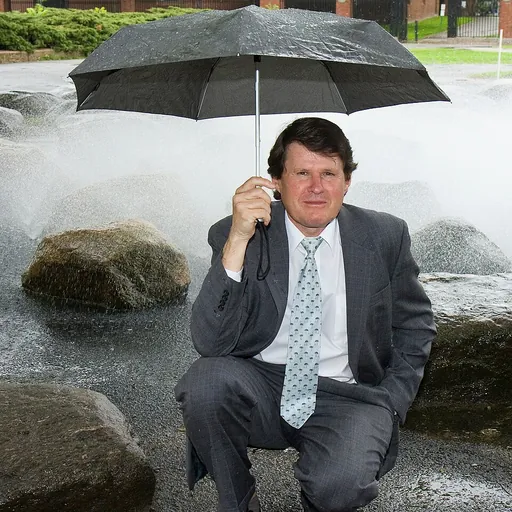
About John Briscoe
Lived 1948 – 2014 (aged 66). John Briscoe was a South African epidemiologist and environmental engineer.
John Briscoe (July 30, 1948 – November 12, 2014) was a South African-born environmental engineer who was visiting professor of the Practice of Environmental Health in the Department of Environmental Health at Harvard School of Public Health. He was known as "Mr. Water" to environmental economists. At Harvard, Briscoe also held appointments at the Harvard School of Engineering and Applied Sciences (SEAS) as Gordon McKay Professor of the Practice of Environmental Engineering, and at the Harvard Kennedy School. His career focused on efforts on the developing world to successfully manage and preserve water as a precious resource. In early 2014, he received the Stockholm Water Prize - the “Nobel Prize of Water" - for "unparalleled contributions to global and local management of water - contributions covering vast thematic, geographic, and institutional environments-that have improved the lives and livelihoods of millions of people worldwide.”
He spoke English, Afrikaans, Bengali, Portuguese, and Spanish.
Chronology
1948 - Born in South Africa 1969 - B.Sc., Civil Engineering, University of Cape Town, Cape Town, South Africa 1976 - Ph.D., Environmental Engineering, Harvard University Government water agencies of South Africa and Mozambique, Engineer Cholera Research Center, now ICDDR,B, Bangladesh, Epidemiologist University of North Carolina, Professor of Water Resources 1989-2009 - World Bank (20 years): He helped oversee projects in water resources, irrigation, hydropower, and sanitation at the World Bank and consulted on water issues for nonprofits, governments, nongovernmental organizations, and businesses 1989-2009 - World Bank, country director for Brazil: Briscoe's role in affecting the evolution of the World Bank was the subject of Chapter 13 in Sebastian Mallaby's definitive history, “The World’s Banker,” Penguin 2006. 2009-2014 - Professor of Environmental Health, Harvard School of Public Health, Boston, MA 2014 - Stockholm Water Prize - "Nobel Prize of Water”
Early life John Briscoe was born in, and grew up in, South Africa. His mother Thelma ran a day-care center and orphanage in the black township of Soweto. His nation's extremes of poverty and wealth were seen in the social and ecological landscape, the lush coastal regions contrasted with the dry but economically important interior, where massive mineral mining operations were carried out. He described realizing that understanding water was fundamental to understanding the development of South African resources and the many social and economic inequalities of the continent. He continued developing these views while living in the interior of Bangladesh, where he witnessed how water projects and flood-protection and electrification could improve human lives greatly. He spent the rest of his career controlling water, whether for environmental or human purposes, and crusading.
A native of South Africa, John earned a bachelor's degree in civil engineeringat the University of Cape Town in 1969, an M.S. in environmental engineering in 1972, and a Ph.D. in environmental engineering at Harvard University in 1976. Before coming to Harvard, he worked as an engineer in the government water agencies of South Africa and Mozambique; an epidemiologist at the Cholera Research Center, now ICDDR,B in Bangladesh; a professor of water resources at the University of North Carolina; and, for 20 years, at the World Bank, where he helped oversee projects in water resources, irrigation, hydropower, and sanitation. He has consulted on water issues for nonprofits, governments, nongovernmental organizations, and businesses.
At Harvard, John launched the university-wide Harvard Water Security Initiative, which focuses on major challenges in countries around the world, including the ability to provide people with safe drinking water and food, to produce energy and sustain economic growth, and to enhance environmental quality. He taught popular undergraduate and graduate courses on water and was nominated for major teaching and mentoring awards. In addition, he led groups of students from across the university in collaborative research on water management in the Colorado, Indus, Mississippi, Murray-Darling, and Sao Francisco basins.
Education 1965: Matriculated at St Patrick's Christian Brothers’ College Kimberley [Christian Brothers’ College] 1965-1969: B.Sc. (first class honours) in Civil Engineering, University of Cape Town, Cape Town, South Africa, conferred 1969 1970-1972: M.S. in Environmental Engineering, Harvard University, conferred 1972 1972-1976: Ph.D. in Environmental Engineering, Harvard University, conferred 1976 Major field: Water Resources Engineering; Minor fields: economics and demography 1993: Leadership Course at Center for Creative Leadership, Greensboro, North Carolina 1998: Executive Development Program—Harvard and Stanford Graduate Schools of Business
Publications John Briscoe has published widely in journals from many disciplines, including public health, nutrition, epidemiology, water resources, demography, anthropology, political science and economics. His publications include over 120 articles in refereed professional journals and eight books:
Briscoe, John, Richard G. Feachem and Mujibur M. Rahaman, Evaluating Health Impact: Water Supply, Sanitation and Hygiene Education, IDRC Press, Ottawa, Canada, 80 pages, 1986. Briscoe, John and David de Ferranti, Water for Rural Communities: Helping People Help Themselves, World Bank, Washington DC, 32 pages, 1988. John Briscoe, Brazil: The New Challenge of Adult Health, World Bank, Washington DC, 133 pages, 1990 (in English and Portuguese). (Brazil/World Bank Country Partnership Strategy) The World Bank (Main author), The Water Strategy of the World Bank, Washington DC, February 2003. John Briscoe and RPS Malik, India's Water Economy: Bracing for a Turbulent Future. Oxford University Press, 2006. John Briscoe and RPS Malik (editors), Handbook on Water Resources Development and Management in India, Oxford University Press, 2007. John Briscoe and Usman Qamar, Pakistan's Water Economy: Running Dry, Oxford University Press, 2007. The World Bank (Main author), Country Partnership Strategy for Brazil, 2007-2010, Washington DC, 2007. (World Bank's Water Sector Strategy)
Service Served on the Water Science and Technology Board of the National Academy of Sciences Founding member of the major global water partnerships World Water Council Global Water Partnership World Commission on Dams Global Agenda Council, World Economic Forum High-Level Advisory Committee, Murray Darling Basin Authority Council Member, Distinguished Water Professionals, International Water Association Senior Water Advisor, McKinsey and Company
Consultancies World Bank Asian Development Bank US National Intelligence Council National Water Commission of Australia
Awards
1965: Alan Spiers Memorial Bursary 1965: Max Michaelis Scholarship 1965: Barney Barnato Scholarship 1966-69: Electricity Supply Commission Bursary 1967: University Medal in Mathematics 1968: University Medals in Hydraulics, Hydrology, Transportation, Highways, Soil Mechanics and Thesis 1968: City of Cape Town Gold Medal as Best Graduating Engineering Student at the university 1968: South African Steel Institute Award for Best Structural Design 1968: E. Oliver Ashe Scholarship for Post-Graduate Study 1968: Cape Town City Scholarship for Post-Graduate Study
Harvard University: 1970-74: Harvard University Fellowship 1974: Clemons Herschel Prize (awarded annually to the outstanding graduating student in Environmental Engineering) As an employee of the World Bank was prohibited from receiving awards. Since leaving the World Bank has: Been Nominated by Harvard University students for Harvard's Joseph Levenson Award to recognize exceptional teaching of undergraduates Received the Grande Medalha de Inconfidencia, one of Brazil’s highest civilian honors (2009). 2009: International Water Association, The President’s Award
2009: Grande Medalha da Inconfidência, one of Brazil's highest awards Stroud Prize for Excellence in Water Hauser Grant for Innovation in Learning and Teaching, Harvard University 2014: Stockholm Water Prize - "Nobel Prize of Water”
Death Briscoe died at age 66 after a -year struggle with cancer.
Don’t just read it —
keep it.
Full-length biographies made to live with: read them, listen on the way to work, watch them tonight.
- E-book
- Audio
- Video
Instant download · yours to keep · every purchase keeps this site free
Important facts
People in John Briscoe's life
Named in this biography and alive at the same time



Related people
Same field, nearest in time



Contemporaries
People whose lives overlapped John Briscoe's

Frequently asked questions
Who was John Briscoe?
South African environmental engineer (1948-2014)
When was John Briscoe born?
John Briscoe was born on 30 July 1948 in South Africa.
When did John Briscoe die?
John Briscoe died on 12 November 2014 in Poolesville.
What was John Briscoe's occupation?
John Briscoe was an epidemiologist and environmental engineer.
What nationality was John Briscoe?
John Briscoe was South African.
Sources & further reading
· DBpedia: John Briscoe (water engineer)
Cite this page
APA: Biography.guide. (2026). John Briscoe. https://biography.guide/john-briscoe/
MLA: "John Briscoe." Biography.guide, https://biography.guide/john-briscoe/.
Chicago: "John Briscoe." Biography.guide. https://biography.guide/john-briscoe/.
Data last updated: 2026-09-23 · Spot an error? Report a correction.
Portrait: Wikimedia Commons · author & licence
Page generated 2026-09-27 05:05 UTC