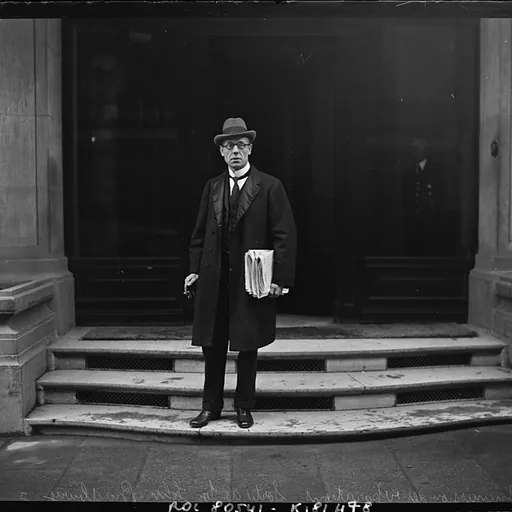
John Bradbury, 1st Baron Bradbury
British economist and public servant
About John Bradbury, 1st Baron Bradbury
Lived 1872 – 1950 (aged 77). John Bradbury, 1st Baron Bradbury was a British civil servant and politician.
John Swanwick Bradbury, 1st Baron Bradbury (23 September 1872 – 3 May 1950) was a British economist and public servant.
Bradbury was born in Crook Lane, Winsford, Cheshire, the son of John Bradbury and Sarah Cross. He was educated at Manchester Grammar School, The King's School, Chester and Brasenose College, Oxford, and joined the Civil Service in 1896. He served as Private Secretary to the Chancellor of the Exchequer H. H. Asquith from 1905 to 1908, as Principal Clerk in the Treasury and First Treasury Officer of Accounts from 1908 to 1911, as Joint Permanent Secretary to the Treasury from 1913 to 1919 and as the Principal British Delegate to the Reparations Commission in Paris from 1919 to 1925. During the First World War he was the government's chief economic adviser.
He was appointed Companion of the Order of the Bath (CB) in 1909, Knight Commander of the Order of the Bath (KCB) in 1913, and Knight Grand Cross of the Order of the Bath (GCB) for his services as Principal Reparations Commissioner in the 1920 New Year Honours. In the 1925 New Year Honours, he was raised to the peerage as Baron Bradbury, of Winsford in the County of Chester.
Lord Bradbury married Hilda Maude Kirby, daughter of William Arthur Kirby, in 1911. He died in May 1950, aged 77, and was succeeded in the barony by his eldest son John.
Treasury notes signed with Bradbury's name have been known as "Bradburys" (e.g., as early as 1921 in PG Wodehouse's updated edition of Love Among the Chickens) or "Bradbury Pound".
The Bradbury pound was introduced in 1914 at the outbreak of the First World War. The Government at the time needed to preserve its stock of bullion so asked the Bank of England to cease paying out gold for its notes. Instead the Treasury printed and issued 10 shilling and £1 notes (so called Bradbury pounds). The gold standard was then partially restored in 1925 and the Bank of England was again obliged to exchange its notes for gold, but only in multiples of 400 ounces or more. Britain left the gold standard in 1931 and the note issue became entirely fiduciary, that is wholly backed by securities instead of gold.
Arms
Footnotes
Don’t just read it —
keep it.
Full-length biographies made to live with: read them, listen on the way to work, watch them tonight.
- E-book
- Audio
- Video
Instant download · yours to keep · every purchase keeps this site free
Important facts
People in John Bradbury, 1st Baron Bradbury's life
Named in this biography and alive at the same time


Related people
Same field, nearest in time



Contemporaries
People whose lives overlapped John Bradbury, 1st Baron Bradbury's


Frequently asked questions
Who was John Bradbury, 1st Baron Bradbury?
British economist and public servant (1872-1950)
When was John Bradbury, 1st Baron Bradbury born?
John Bradbury, 1st Baron Bradbury was born on 23 September 1872.
When did John Bradbury, 1st Baron Bradbury die?
John Bradbury, 1st Baron Bradbury died on 3 May 1950.
What was John Bradbury, 1st Baron Bradbury's occupation?
John Bradbury, 1st Baron Bradbury was a civil servant and politician.
What nationality was John Bradbury, 1st Baron Bradbury?
John Bradbury, 1st Baron Bradbury was British.
Sources & further reading
· Wikipedia: John Bradbury, 1st Baron Bradbury
· DBpedia: John Bradbury, 1st Baron Bradbury
Cite this page
APA: Biography.guide. (2026). John Bradbury, 1st Baron Bradbury. https://biography.guide/john-bradbury-1st-baron-bradbury/
MLA: "John Bradbury, 1st Baron Bradbury." Biography.guide, https://biography.guide/john-bradbury-1st-baron-bradbury/.
Chicago: "John Bradbury, 1st Baron Bradbury." Biography.guide. https://biography.guide/john-bradbury-1st-baron-bradbury/.
Data last updated: 2026-09-22 · Spot an error? Report a correction.
Portrait: Wikimedia Commons · author & licence
Page generated 2026-09-27 05:01 UTC