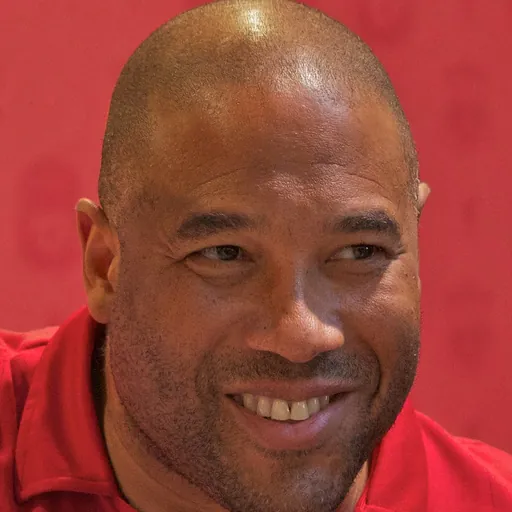
John Barnes
Association football player and manager (born 1963)
About John Barnes
Born 1963. John Barnes is a British and Jamaican association football player, musician, association football coach and sports commentator.
John Charles Bryan Barnes (born 7 November 1963) is a former professional football player and manager. Often considered one of the greatest England players of all time and one of Liverpool's greatest ever players, Barnes works as an author, as well as a commentator and pundit for ESPN and SuperSport. Initially he was a quick and skilful left winger, then he moved to central midfield later in his career. Barnes won two League titles and two FA Cups with Liverpool. He also earned 79 international caps for England.
Barnes was born and raised in Jamaica as the son of a military officer from Trinidad and Tobago and a Jamaican mother. He moved to London, England, with his family when he was 12 years old. He joined Watford aged 17 in 1981, before playing 296 competitive games for them, scoring 85 goals. He debuted for England in 1983, and in 1987 joined Liverpool for £900,000. In his ten seasons there, Liverpool won the then-top-flight First Division twice and the FA Cup twice. He scored 106 goals in 403 matches. By the time of his last cap, in 1995, he had more caps than any other black England player. After two years at Newcastle United, he ended his playing career at Charlton Athletic in 1999. Barnes had eight months as Celtic head coach when his former Liverpool manager Kenny Dalglish was director of football. He has since managed the Jamaica national team, in 2008–09, and English club Tranmere Rovers, for four months in 2009.
Barnes was the PFA Players' Player of the Year once (in 1987–88) and the Football Writers' Association Footballer of the Year twice (in 1987–88 and 1989–90). In 2005, he was inducted into the English Football Hall of Fame. In 2006, in a poll of Liverpool fans' favourite players, Barnes came fifth; a year later, FourFourTwo magazine named him Liverpool's best all-time player. In 2016, The Times readers voted him England's greatest-ever left-footed player.
Barnes has published two books: John Barnes: The Autobiography (1999), which was followed by The Uncomfortable Truth About Racism (2021), both of which were met with a largely positive reception. In 2022, he returned to Liverpool as an official Club Ambassador.
Early life Barnes was born in Jamaica to Roderick Kenrick "Ken" Barnes (a Trinidadian) and Frances Jeanne Hill (a Jamaican). Ken Barnes hailed from Port of Spain, Trinidad and Tobago emigrating to Jamaica in 1956 as a member of the West India Regiment. He joined the Jamaica Defence Force when formed after the nation's 1962 independence when he was initially commanding officer of the 1st Battalion Jamaica Regiment. In 1973, he was promoted to colonel remaining in the army until retiring in 1989. While in the army, he was a semi-professional footballer for a Jamaica National Premier League club and also captained the Jamaica national football team. Barnes spent his early childhood living in Jamaica's biggest military base, playing football and living a disciplined life. His father was president of the Jamaica Amateur Swimming Association and later formed Jamaica's first bobsleigh team. Ken Barnes, who was promoted to Colonel in 1973, when he was 12 years old. He attended the rugby-playing St Marylebone Grammar School then a short stint at Haverstock School, Camden Town. While at school he played four years of youth football at the Stowe Boys Club in Paddington.
Barnes mother, Frances Jeanne Hill, was the daughter of journalist, politician and trade unionist, Frank Hill, who had been imprisoned by the Jamaican governor, Sir Arthur Richards in 1942, along with his brother Ken, after being accused of trying to overthrow the government. Jeanne herself was arrested in 1964 when she took part in a demonstration against political bias at the Jamaica Broadcasting Corporation. Following a successful trial game in Watford's reserves, Barnes signed on 14 July 1981 for the fee of a set of kits. Barnes debuted aged 17 as a substitute on 5 September 1981 in a Football League Second Division 1–1 home draw with Oldham Athletic. With manager Graham Taylor, Watford were eight months away from completing a five-year rise from the Fourth Division to the First. Barnes quickly established himself as a regular player and scored 12 Second Division goals as Watford were promoted, as runners-up to fierce rivals Luton Town to the top flight of English football at the end of season 1981–82. Watford finished runners-up for the League title to Liverpool the season after.
Watford lost the 1984 FA Cup final as under-dogs 2–0 to Everton. Watford lost a 1986–87 FA Cup semi-final to Tottenham Hotspur. At the end of the 1986–87 season, Taylor called time on his 10-year spell as Watford manager to take charge at Aston Villa. His successor, Dave Bassett, resigned to losing Barnes to a bigger club, gave Alex Ferguson the chance to sign Barnes for Manchester United. Ferguson rejected the offer still having faith in United's left winger Jesper Olsen. Ferguson later admitted that he regretted not signing Barnes, especially as Barnes helped extend Liverpool's dominance in England by three seasons, while Olsen fell out of favour at Old Trafford and had left by the end of 1988, with his successors Ralph Milne and Danny Wallace failing to live up to expectations. Ferguson's United waited until 1990 to win a major trophy and 1993 to win the league title. Barnes left Watford after scoring 65 goals in 233 league appearances.
Liverpool
Barnes arrived at Kenny Dalglish's Liverpool in the same close season as England teammate Peter Beardsley and linked up with new signings John Aldridge and Ray Houghton. He signed for the club on 9 June 1987. He debuted for the Reds along with Beardsley on 15 August in the 2–1 league win at Arsenal at Highbury. After nine minutes, Barnes and Beardsley combined to set up Aldridge to score. Barnes' first Liverpool goal was on 12 September beating Oxford United 2–0 at Anfield.
Barnes' plinth outside Anfield marking his ten years with Liverpool. The inscription commemorates his performance in the 5–0 win over Nottingham Forest in April 1988. In Barnes' first Liverpool season, they won the League title, remaining undefeated for the first twenty-nine games of the season. Barnes' fifteen Liverpool league goals in his first season there was second only to John Aldridge. The 2–1 defeat at Nottingham Forest on 2 April was the last of only two league defeats that season. Eleven days later, Barnes, Beardsley, Houghton and Aldridge were instrumental in Liverpool's 5–0 home win over Forest described by Tom Finney as "One of the finest exhibition I've seen the whole time I've played and watched the game. You couldn't see it bettered anywhere, not even in Brazil." The double however was thwarted by Lawrie Sanchez' Wimbledon goal beating Liverpool 1–0 in the 1988 FA Cup final. Barnes was a key performer on the "Anfield Rap"; the club's cup final song that UK charted at number 3. In recognition of his stellar displays throughout the season, Barnes was voted PFA Player of the Year, finishing ahead of his Liverpool teammate Steve McMahon.
In the summer of 1988, Ian Rush re-signed for Liverpool. Following the death of 96 Liverpool fans in April 1989 as a result of the Hillsborough disaster, Barnes attended several funerals and visited the injured in hospital. He pulled out of an England international friendly in order to fulfil these public duties. Liverpool won the 1989 FA Cup final with a 3–2 victory over Merseyside rivals Everton, with Barnes creating goals from the left wing for Rush. In the 1988–89 title decider at Anfield, Arsenal's Michael Thomas' 92nd minute, league winning goal occurred in their counter-attack 17 seconds after Barnes lost ball possession attempting to dribble past Kevin Richardson.
quote="His blend of power and poise made him hard to pigeonhole. He wouldn't just run. He'd dangle the carrot and wait for the bite, before gliding away and then slowing down again to weigh up his options and play the perfect ball into the box. He was a forward physicality and cerebral brilliance in equal measure." — —Barnes' dribbling ability and creativity from the wing. Beardsley has since said Barnes at the end of the 1980s was "The best player I ever played with, bar none. For three or four years at the end of the '80s, John was possibly the best player in the world."
Barnes continued to play regularly for Liverpool and England into the 1990s. In the 1990–91 season, he scored 16 league goals. Arsenal were league champions in the season of Dalglish's resignation and his replacement by Graeme Souness as manager. Liverpool had qualified for the 1991–92 UEFA Cup, being readmitted to European competitions a year after the ban on all other English clubs in European competitions since the Heysel disaster in 1985 had been lifted. This was the first time Barnes had played in European competitions since Watford's 1983–84 UEFA Cup campaign.
Barnes missed most of the 1991–92 season due to a succession of injuries and played just 12 league games, scoring once, as Liverpool finished sixth in the league – their lowest finish in two decades and the first time since 1981 that they had failed to finish champions or runners-up. In April he assisted Rush's opener in Liverpool's 2–0 win against their arch rivals Manchester United at Anfield that confirmed Leeds as champions. Liverpool won the 1992 FA Cup final with Barnes having played a crucial role in getting the team to Wembley with a free-kick four minutes from the end of the semi-final against Portsmouth which hit the post and rolled along the goal line from which teammate Ronnie Whelan equalised for Liverpool, a saviour act from Barnes which the club's site described as "one moment of brilliance to keep Liverpool's FA Cup dreams alive", but Barnes missed the final through injury. The next month in June he was injured playing for England in Helsinki in a warm up game before Euro 1992. Barnes was out injured for five months. He never recovered his explosive burst of speed that had been a key element of his play. He was now past his playing peak. Barnes also once had to make a public apology to Souness after he gave an interview criticising the tactics employed by the manager before an important match. Young teammate Robbie Fowler also said in his autobiography that Souness felt at the time Barnes was past his best, but in Fowler's (and others') opinion he still had a lot to offer and was still one of the most talented players at the club.
Souness later stated in his autobiography that Barnes, due to his injuries, was now taking a "less demanding" central midfield playmaker's role as opposed to a goalscoring winger. Despite the effects of the injuries, Barnes was still regarded as one of the club and country's best players and Souness noted that Barnes "Retained his quality on the ball, using it well and rarely losing possession". Liverpool's Spice Boys team of this era drew stinging criticism for wearing matching cream Armani suits to the latter final. On the final day of the 1994–95 season, Barnes scored the equaliser followed by Redknapp's late winner for Liverpool against league leaders Blackburn, the latter goal greeted by "near silence at Anfield", in a game that could have handed the league title to bitter rivals Manchester United had they also won their game. Barnes later reflected: "As professionals we certainly wanted to win the game and of course we did just that. However, we did not want Manchester United to win the league, so fortunately West Ham did Blackburn a favour by drawing with United."
By the mid-1990s, Barnes had been moved from the left wing to the position of a holding midfielder. He often captained the side in 1995–96 when regular captain Rush lost his place to the club's new record signing Stan Collymore. When Rush departed to Leeds United at the season's end Barnes became full-time captain. Barnes created the final goal after a dribble and passing movement for Collymore during Liverpool's 4–3 win against Newcastle at Anfield, which is often considered as being arguably the greatest game in Premier League history.
Jamie Carragher debuted for the Liverpool first team in January 1997 and said that despite the 33-year-old Barnes now being past his peak, he was still the best player at the club. Carragher: "Technically, he's the best player I've ever trained or played with, he was great with both feet, they were both exactly the same. I'd say he's the best finisher I've ever played with (including Torres, Fowler, Owen). Barnes never used to blast his shots – they'd just get placed right in the corner. You speak with the players from those great Liverpool sides and ask them who the best player they played with was and they all say John Barnes".
On 13 August 1997, three months before his 34th birthday, after 10 years at Liverpool with 407 appearances, 108 goals, and five major trophies, Barnes left on a free transfer. He had missed just three Premier League games in his final season at Anfield, scoring four goals (including a memorable late winner against Southampton just after Christmas) as they had led the table for much of the first half of the season before being overhauled by eventual champions Manchester United at the end of January and having to settle for a fourth-place finish. Paul Ince, with a completely contrasting combative style, was signed from Inter Milan to replace Barnes in central midfield. Former Liverpool colleague Ian Rush and England colleague Stuart Pearce were also drafted in for the 1997–98 season. Pearce has since stated in his autobiography, Psycho, that he felt Barnes was overweight by the time he joined Newcastle and that both Barnes and Rush had less desire than himself to win at that stage in their careers as they had already won everything, and that they could have had more of an edge to them.
Newcastle (the previous season's Premier League runners-up) endured a disappointing league campaign and finished 13th, although they did reach the 1998 FA Cup final, and Barnes went onto the field for the fourth FA Cup final of his career as the club finished runners-up. Additionally, Barnes played in the UEFA Champions League, including in the club's 3-2 victory over Barcelona. Following the sacking of Dalglish early in the 1998–99 season, he was left isolated and shunned along with a number of Dalglish and Keegan era players including Pearce and Rob Lee. Barnes with many others was dropped from the first team by new manager Ruud Gullit and spent several months in the reserves despite, in his opinion, "excelling in training" and showing he had lost none of his quality if some of his pace. He felt that himself and others were deliberately being cold shouldered to make it known Gullit wanted his own players in; Barnes had worked briefly with Gullit during the 1998 World Cup ITV commentary team, and they had played numerous international matches played against each other in the 1980s and 1990s, but they were not friends. Barnes knew it was the last straw when even his MBE from the Queen was overlooked by Gullit after a presentation had been given to Pearce for receiving one – this was in the winter of 1998 and he knew he was unwanted. He made a further 11 league appearances that season, mostly as a substitute, and did not score any goals. As well as being abused by opposition players, on occasions Barnes reported overhearing teammates making racist remarks towards other black players in opposition teams. One instance of racial abuse by a section of Everton supporters in the Merseyside derby at Anfield led to Everton chairman Philip Carter disowning the offending supporters, branding them "scum". International career
Although born in Jamaica, Barnes had no intention of representing Jamaica at international level as the "Reggae Boyz had not yet made a significant mark on world football and he was eager to get to the game's biggest stage". At the time of Barnes' international career, FIFA's national team eligibility criteria allowed British passport holders to represent one of the British football associations if they had no blood ties to the United Kingdom. Barnes had already planned to represent England where he had lived since the age of 12. Barnes said: "the only reason I played for England was because they were the first to ask ... if Scotland had asked [first] ... You go and play for Scotland." Blissett was the fifth and Barnes the seventh black full England football internationals. England failed to qualify for the 1984 European Championships, so instead toured South America. On 10 June 1984, against Brazil, Barnes dribbled through several Brazilian defenders and rounded Roberto Costa to score in a friendly match at Rio de Janeiro's Estádio do Maracanã. In his early England days, he and fellow black player Mark Chamberlain were subjected to threats from racist groups. Barnes was abused by supporters of the far-right National Front on the plane back from South America in June 1984; with the group claiming that England had only won 1–0 against Brazil because Barnes' goal "didn't count". A 2002 Channel 4 poll saw Barnes' goal against Brazil ranked number 75 in the list of the 100 Greatest Sporting Moments.
quote="When he did get pulses racing in an England shirt it came in the form of brief cameos, such as the game-changing display as a substitute in the World Cup quarter-final against Argentina in 1986, when both he and Chris Waddle were brought on to chase the game with England 2–0 down. Barnes terrorised the three-man Argentina defence, dragging them out of position and creating Lineker's 81st-minute goal. In 15 minutes Barnes showed that he could influence a game every bit as much as Diego Maradona. But that Barnes and Waddle – two of the England squad's most creative and skilful players (Glenn Hoddle being the other) – were afforded such scant time on the pitch, showed the lack of proactive thinking that would dog Barnes's international career." — —The Guardian on England's use of Barnes and other creative players of the era. Barnes pulled out of England's first international game after the Hillsborough disaster due to grief he felt at the time and the game coinciding with a funeral. In his absence, England won the World Cup qualifier against Albania 5–0 at Wembley on 26 April 1989. In the lead up to the 1990 World Cup, Barnes played several times as a forward alongside Lineker, and in a warm up game against Uruguay played well and scored a half volley from a Stuart Pearce cross. Barnes again rapped this time in New Order's UK Number 1, "World in Motion", tie-in song. At the World Cup, he injured his groin against Belgium, shortly after his volleyed goal was wrongly disallowed for offside. Gregg Bakowski in The Guardian writes: "Barnes, rather than David Platt, could have been England's hero against Belgium, having had a perfectly good volleyed goal disallowed. But soon after he sustained a groin injury that ended his tournament".
In June 1992, in England's last warm up game (against Finland in Helsinki) before the 1992 European Championships, Barnes tore his achilles tendon. He was injured for five months. In his absence England were eliminated at the group phase. On his return he had lost his explosive burst of speed and was now past his peak. In a Wembley 1994 World Cup qualifier against San Marino, Barnes was booed by an entire section of England fans after the whole team played poorly. Barnes later believed an article attributed to Jimmy Greaves in the Daily Mirror, which cited his supposed support for the West Indies cricket team and questioned his loyalty to the England team, had influenced the crowd to boo.
quote="At Liverpool he could receive the ball over 20 to 30 times in a match from team-mates who were schooled to draw players and pass short. In a statuesque England team, where he was chained to the left wing, it could be as few as six or seven. The chances to impact the game were few and far between, with a lack of movement inhibiting Barnes's inclination to play a one-two to get on the move in the first place and then let the magic follow some simple but effective buildup play." — —The Guardian on the rigidity of the England team Barnes played for in contrast to Liverpool. Barnes was in the top ten most capped players list for eleven years until David Beckham and then Gary Neville edged him from ninth to 11th. In 1999, Tony Adams picked Barnes to be in his England dream team in his book Addicted, citing that Barnes "could pass, move, dribble, had Brazilian style movement... what more could you want?" He also backed Barnes's view that England at times used rigid systems.
Managerial career Celtic In a "dream ticket" style move, Barnes was appointed head coach of Celtic on 8 June 1999, working under Kenny Dalglish as director of football. After his appointment he later re-registered himself as a player but never played a competitive game for Celtic. He was sacked 8 months into his tenure following a home 3–1 1999–2000 Scottish Cup defeat by First Division club Inverness Caledonian Thistle in February. The result led to the newspaper headline "Super Caley go ballistic, Celtic are atrocious". Dalglish took over first-team duties until the end of the season. Although Dalglish won the League Cup in the process, his contract was not renewed and the board decided to replace him with Martin O'Neill.
Jamaica Barnes entered discussions with the Jamaica Football Federation in September 2008 regarding the possibility of him managing the Jamaica national team. On 16 September 2008, Barnes was appointed as manager of Jamaica announcing Mike Commane as his assistant. Barnes guided his new Jamaican charges to a first-place finish in the 2008 Caribbean Championships, qualifying as the top Caribbean side for the 2009 CONCACAF Gold Cup. In February 2009, Barnes told Sky Sports that he wanted to return to club management if the opportunity arose. It was reported in May 2009 that Barnes contacted English League Two side Port Vale to see whether he could replace out-going manager Dean Glover.
Tranmere Rovers The potential move to Port Vale did not happen. On 14 June 2009, he confirmed that he was to be appointed manager of League One side Tranmere Rovers. Barnes was officially named as manager of Tranmere Rovers on 15 June 2009, with Jason McAteer assisting him. He got off to a disastrous start, with Tranmere only winning three of their first fourteen games. On 9 October 2009, Barnes was sacked by the club six days after a 5–0 defeat at Millwall and a run of just two wins from eleven league games.
Accolades Former England international Tom Finney remarked that "players like John Barnes come along just once in a lifetime." Twice in his career, Barnes was voted Football Writers' Association Footballer of the Year. He also won the PFA Players' Player of the Year. Barnes was voted England's "greatest left foot" by readers of The Times in 2016, ahead of Chris Waddle and Jimmy Greaves. was emphasised when he finished in the top 5 of the poll 100 Players Who Shook The Kop which was conducted by the official Liverpool Football Club website in the summer of 2006. More than 110,000 supporters worldwide voted for their 10 favourite players of all time, Barnes finished 5th behind Robbie Fowler (4th), Ian Rush (3rd), Steven Gerrard (2nd), and the man that signed him three times (for Liverpool, Newcastle, and Celtic) Kenny Dalglish (1st). He also appears frequently as a selection in FourFourTwo magazine's Perfect XI, a choice in which current and former professional footballers select the best 11 players they have ever seen, played with or against, including selections by Michael Owen, Steve McManaman, Peter Beardsley, Ian Wright, and Jamie Carragher.
Music career
Barnes performed the Keith Allen-penned rap section of New Order's "World in Motion" as well as appearing on the track "Anfield Rap", a Liverpool FA Cup final song, rapping the lyrics "Liverpool FC is hard as hell/United, Tottenham, Arsenal", and performing lead rap in Liverpool's '96 cup final song "Pass & Move (It's the Liverpool Groove)". "World in Motion" reached No. 1 in the charts and spent 18 weeks in the UK top 75 (including re-releases in 2002 and 2010) although Barnes was only paid a flat rate of £200 and received no royalties. "Anfield Rap" reached No. 3 and spent 6 weeks in the top 75, and "Pass & Move" reached No. 4 and spent 4 weeks in the top 75. The rap portion of "World in Motion" is an iconic piece of English football culture in its own right, familiar to subsequent generations of England football fans not yet born by 1990.
Personal life Barnes was first married to and subsequently divorced Suzy, with whom he has two sons and two daughters. Barnes' second wife is called Andrea and they have two daughters and a son. They live in Wirral, Merseyside. With fellow former footballers Les Ferdinand and Luther Blissett, he founded Team48 Motorsport, a team aiming to promote young racing drivers of African-Caribbean background. In 2008, the team entered the British Touring Car Championship, running Alfa Romeos for white Jamaican Matthew Gore and 18-year-old black Briton Darelle Wilson. However, the project never got off the starting line and the team failed to show up for any of the races. A few days after being sacked by Tranmere, Barnes was declared bankrupt. He has described the bankruptcy as a technicality, saying: "The bankruptcy issue is a tax oversight which is being dealt with." Barnes' claims of the bankruptcy being a "tax oversight" proved true and the order was quickly overturned.
Media, charity work and politics As a sporting icon in England in the early 1990s Barnes appeared in a commercial for the energy drink Lucozade, launching their Lucozade Sport drink. Barnes became a pundit on ITV and a presenter of the football coverage on Five as well as having his own weekly football discussion show on LFC TV called The John Barnes Show, every Thursday. He also worked as an ambassador for Save the Children. In 1994, he featured on an educational video, Hoax Calls Kill, produced in collaboration with the Merseyside Fire Brigade.
Barnes has appeared on several shows and media outlets to promote his charity work, including a notable appearance on Soccer AM in February 2009 performing the "World in Motion" rap and a parody of the mistimed advert by ITV in the previous week's Everton vs. Liverpool FA Cup tie, with Barnes' "Under-11 World Champion Baton-twirling" routine missed by mock commercials. In 2001, Barnes appeared on Lily Savage's Blankety Blank. In 2000, Barnes presented a one off soccer special with Lisa Rogers entitled The Pepsi World Challenge, devised and produced by Nathan Carey and airing on Channel 5 in the UK. The show was edited with local presenters around the world. He was the subject of a This is Your Life programme in 2001, when he was surprised by Michael Aspel.
In 2006, Barnes visited Israel as part of an The Football Association (FA) delegation to help launch a "Kick It Out" anti racism campaign, organised with the Israel Football Association and the New Israel Fund; during the visit he took part in events in the Arab town of Sakhnin highlighting Jewish–Arab coexistence through football.
Barnes competed in the fifth series of Strictly Come Dancing which started in October 2007. His dance partner was Nicole Cutler. They finished in seventh place. He was also the first male celebrity to receive a ten from the judges, which he got for his salsa. After an absence of nearly eight years, Barnes returned to football in late 2007. He agreed to run several coaching clinics across the Caribbean for young players with the possibility of them joining Premier League side Sunderland on trial. He made a guest appearance as himself in episode 10 of Series 6 of Waterloo Road that was aired on BBC One on Wednesday, 27 October 2010.
Barnes has been used as a pundit in ESPN's coverage of the 2009–10 FA Cup, and in SuperSport's coverage of the 2010–11 UEFA Champions League, in South Africa. He appeared on Russell Howard's Good News best bits show on Thursday, 15 December 2011, as his Mystery Guest. In the show he was dressed as Santa Claus and along with Russell Howard he performed his famous rap from New Order's "World in Motion". On 17 October 2012, Barnes featured in series 9, episode 9 of the BBC series Who Do You Think You Are?. Barnes has suggested the Rooney Rule, used in the National Football League (NFL), which requires teams to interview minority candidates for coaching positions, should be adopted by the Premier League.
In 2016 in the run-up to the 2016 EU referendum, Barnes refuted Michael Gove's claim that he wished the United Kingdom to leave the European Union, clarifying that he supports continued UK membership of the EU. In January 2018, Barnes participated as a housemate on the twenty-first series of Celebrity Big Brother. On 21 February 2019, Barnes was a guest on Question Time, commenting on racism and discrimination in society.
Career statistics Club
International Source:
Scores and results list England's goal tally first, score column indicates score after each Barnes goal.
Managerial statistics As of 6 September 2009
Honours Player Watford FA Cup runner-up: 1983–84
Liverpool Football League First Division: 1987–88, 1989–90 FA Cup: 1988–89, 1991–92; runner-up: 1987–88, 1995–96 Football League Cup: 1994–95 FA Charity Shield: 1988, 1989, 1990
Newcastle United FA Cup runner-up: 1997–98
Manager Jamaica Caribbean Cup: 2008
Individual PFA Players' Player of the Year: 1988 FWA Footballer of the Year: 1988, 1990 PFA First Division Team of the Year: 1987–88 First Division, 1989–90 First Division, 1990–91 First Division PFA Team of the Century (1977–1996): 2007 Member of the Order of the British Empire: 1998 Inducted into the English Football Hall of Fame: 2005
Don’t just read it —
keep it.
Full-length biographies made to live with: read them, listen on the way to work, watch them tonight.
- E-book
- Audio
- Video
Instant download · yours to keep · every purchase keeps this site free
Important facts
People in John Barnes's life
Named in this biography and alive at the same time



Related people
Same field, nearest in time




Contemporaries
People whose lives overlapped John Barnes's


Frequently asked questions
Who is John Barnes?
association football player and manager (born 1963)
When was John Barnes born?
John Barnes was born on 7 November 1963 in Kingston.
What is John Barnes's occupation?
John Barnes is an association football player, musician, association football coach and sports commentator.
What nationality is John Barnes?
John Barnes is British and Jamaican.
Sources & further reading
Cite this page
APA: Biography.guide. (2026). John Barnes. https://biography.guide/john-barnes-association-football-player/
MLA: "John Barnes." Biography.guide, https://biography.guide/john-barnes-association-football-player/.
Chicago: "John Barnes." Biography.guide. https://biography.guide/john-barnes-association-football-player/.
Data last updated: 2026-09-21 · Spot an error? Report a correction.
Portrait: Wikimedia Commons · author & licence
Page generated 2026-09-27 05:00 UTC