
About John B. Anderson
Lived 1891 – 1976 (aged 85). John B. Anderson was an American military personnel.
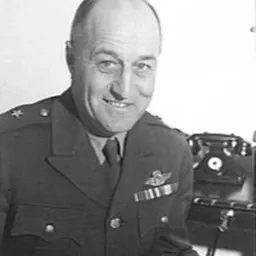
Major General John Benjamin Anderson (March 10, 1891 – September 1, 1976) was a senior United States Army officer who fought in both World War I and World War II. During the latter he served as the first wartime commander of the 102nd Infantry Division and later commanded XVI Corps during the final stages of the war in Europe.
Early life and military career John Benjamin Anderson was born on March 10, 1891, in Parkersburg, Iowa, to Danish immigrants Carl Christian Anderson and Louisa (Simonsen) Anderson. Known to his family and friends from Parkersburg as "Ben", he was the youngest of seven children. Being the son of an immigrant laborer and farmer, young Anderson's early life was not especially easy, consisting mainly of hard labor on the farm, coupled with school, chores, church, and time spent with family. Despite this, he was lucky enough to escape the worst of many childhood diseases, such as diphtheria, polio and tuberculosis, which were always round the corner.
After graduating from Parkersburg High School in 1910, Anderson, determined to pursue a military career, left Parkersburg for the United States Military Academy (USMA) at West Point, New York. A newspaper article at the time, upon hearing about Anderson's appointment, described him as an "exceptionally bright young man and a good student", further stating that "these qualifications count for much with the military authorities in charge of the school.". He was one of just 130 cadet appointments to the academy in 1910.
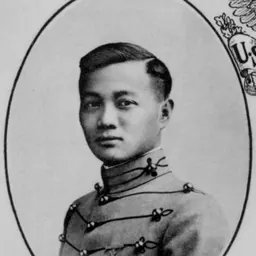
After just over four years, he graduated thirty-third in a class of 107 on June 12, 1914, shortly before World War I broke out in Europe. John J. Pershing, then a brigadier general, was among the guests at the graduation. Anderson was commissioned as a second lieutenant into the Field Artillery Branch of the United States Army on that date. Fellow graduates included men such as William H. Holcombe, James B. Cress, Charles P. Gross, Brehon B. Somervell, Robert W. Crawford, Dabney O. Elliott, Arthur R. Harris, LaRhett L. Stuart, Harry C. Ingles, James L. Bradley, John H. Woodberry, Harold F. Loomis, Carl Spaatz, Harold R. Bull, Charles M. Milliken, Joseph W. Byron, Paul C. Paschal, Francis R. Kerr, Vicente Lim, Sylvester D. Downs Jr., Orlando Ward, Benjamin G. Weir, Ralph Royce, William O. Ryan, Frank W. Milburn, John B. Thompson and Jens A. Doe. All of them would later rise to the rank of brigadier general or higher in their later military careers.
Anderson was subsequently assigned to the 6th Field Artillery Regiment and transferred to El Paso, Texas, with his unit, where he served on the Mexican border during the Pancho Villa Expedition in 1916. John was there upon the American entry into World War I, which occurred on April 6, 1917, with the United States declaring war on Germany.
Battery C, 6th Field Artillery, the regiment with which Anderson was serving as a young officer, fired the first shot for America on the Lorraine front. A shell case flying through the air and a new shell sliding into the breech in the same fraction of a second. Beaumont, France, February 1918.
During the war, Anderson was sent, with the 6th Field Artillery Regiment, part of the newly created 1st Division, to the Western Front, where he served as a regimental adjutant in the Somme sector, scene of much bitter fighting the year before, in France in October and November 1917. He witnessed the first American artillery shot into German lines, a 75mm round from his old unit, Battery C of the 6th Field Artillery. Major General William L. Sibert, the division's commander, ordered that the shell cases of the first eight of the total twenty-four shots fired were to be sent to him. President Woodrow Wilson was immediately sent the first shell casing, which he kept as a souvenir. Soon afterwards, Anderson left his unit to attend the Command and General Staff School established by General Pershing’s command at Langres, France, in January, 1918.
In the spring of 1918, Anderson served with the British Expeditionary Force (BEF) in Belgium at the Ypres Salient, which, he described in his diary on February 19, 1918, "the hottest place along the whole front." He was appointed adjutant of the 1st Field Artillery Brigade. Later, Anderson was transferred back to his 6th Artillery Regiment, where he served as battery commander and briefly commanded a battalion of the 6th Field Artillery Regiment prior to the Battle of Cantigny.
Before the attack, however, and over his objections, and those of both Major General Robert Lee Bullard, the new division commander (who had replaced Sibert many months before), and Brigadier General Charles P. Summerall, commanding the division's 1st Field Artillery Brigade, Anderson was ordered to return to the United States, specifically Washington, D.C., and to report to the Historical Section of the U.S. Army War College. Upon his completion of this, and after a brief leave to his home town of Parkersburg, he was sent to the Firing Center (now the U.S. Army Field Artillery School) at Fort Sill in Oklahoma. The army was still undergoing its huge expansion and officers with Anderson's experience were rare and, therefore, urgently needed. He served in this capacity for the remainder of the war, which came to an end with the signing of the Armistice with Germany on November 11, 1918. This was after he had been promoted, first to major on July 17, 1918, and then again to lieutenant colonel just two months later.
Between the wars After brief occupation duties, Anderson returned to the United States in 1919 and was posted to the Fort Sill, Oklahoma, where John was appointed instructor at the local U.S. Army Field Artillery School. John also attended the Advanced Course at this institution during the years 1922 and 1923. John Benjamin Anderson also received some foreign decorations (see below).
John Benjamin Anderson was succeeded in the command of XVI Corps by Major General Thomas D. Finley in October 1945 and John subsequently returned to the United States. John retired from the army the following year, on June 30, 1946, after a 33-year military career, due to a disability.
John Benjamin Anderson died on September 1, 1976, at the age of 85 in Washington, D.C., and is buried, together with his wife, Sue Palmer Anderson (1901–1991), at Arlington National Cemetery, Virginia.
Decorations Anderson's ribbon bar:
Don’t just read it —
keep it.
Full-length biographies made to live with: read them, listen on the way to work, watch them tonight.
- E-book
- Audio
- Video
Instant download · yours to keep · every purchase keeps this site free
Important facts
People in John B. Anderson's life
Named in this biography and alive at the same time






Related people
Same field, nearest in time





Contemporaries
People whose lives overlapped John B. Anderson's
Frequently asked questions
Who was John B. Anderson?
United States Army general (1891-1976)
When was John B. Anderson born?
John B. Anderson was born on 10 March 1891 in Parkersburg.
When did John B. Anderson die?
John B. Anderson died on 1 September 1976 in Washington, D.C..
What was John B. Anderson's occupation?
John B. Anderson was a military personnel.
What nationality was John B. Anderson?
John B. Anderson was American.
Sources & further reading
· DBpedia: John B. Anderson (United States Army officer)
Cite this page
APA: Biography.guide. (2026). John B. Anderson. https://biography.guide/john-b-anderson-military-personnel/
MLA: "John B. Anderson." Biography.guide, https://biography.guide/john-b-anderson-military-personnel/.
Chicago: "John B. Anderson." Biography.guide. https://biography.guide/john-b-anderson-military-personnel/.
Data last updated: 2026-09-20 · Spot an error? Report a correction.
Page generated 2026-09-27 05:22 UTC