
About John Arrowsmith
Lived 1602 – 1659 (aged 56). John Arrowsmith was a theologian.
John Arrowsmith (29 March 1602 – 15 February 1659) was an English theologian and academic.
Early life John Arrowsmith was born near Gateshead; his father has been identified tentatively by Chad Van Dixhoorn as Thomas Arrowsmith (died 1632). It is known from his own will that his father left him a Geneva Bible. That identification agrees with the will of Thomas Arrowsmith given in Boyle's Vestiges of Old Newcastle and Gateshead.
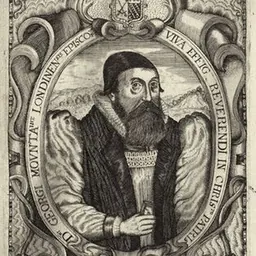
Arrowsmith entered St John's College, Cambridge, in 1616. In 1623 he was elected to the fellowship of St Catherine Hall, Cambridge. He was ordained both deacon and priest in 1624, by George Montaigne.
In 1631 Arrowsmith resigned his fellowship and married. He became vicar at St Nicholas Chapel, King's Lynn, Norfolk.
Cambridge academic Arrowsmith was of presbyterian views. At the period of the Parliamentary visitation of the University of Cambridge, he was elected as Master of St John's College, Cambridge, on 11 April 1644, with the support of the Edward Montagu, 2nd Earl of Manchester, after William Beale was taken prisoner by Oliver Cromwell's forces. In his college, serious factional strife caused by intrusions began to be resolved by 1649, with the departure of Henry Paman and others, and arrivals such as Matthew Robinson.
In 1651, Arrowsmith was elected Regius Professor of Divinity. In his first lecture, he attacked a Jesuit reading of Genesis for conflation of Eve and the Virgin Mary. In 1653, on the death of Thomas Hill, he became Master of Trinity College.
In reply to polemics of the time against the English universities, Arrowsmith defended both scholastic divinity and humane letters. He replied to "criticism from religious radicals"; Dell began in the 1650s to preach sermons in Cambridge against divinity degrees and humane learning, opposing Sidrach Simpson, Master of Pembroke Hall, Cambridge.
In 1655 Arrowsmith began a series of Orationes Anti-Weigelianæ. In the first, he celebrated the recent expansion of the Cambridge University Library. It had acquired the Lambeth Library in 1647, but that accession was reversed in 1660. In the third oration, he quoted extensively from Wendelin's citations from Weigel. James Bass Mullinger stated that the contemporary application to Dell, Webster and Roger Williams would have been apparent to theologians in his audience.
London and Westminster Arrowsmith preached to the Long Parliament on three occasions, the first being in 1643; and in that year became a member of the Westminster Assembly. In 1645 he became rector of St Martin Pomary, London, when Edward Sparke was deprived of the living.
At the Westminister Assembly, Arrowsmith had significant committee roles, for Revising the Confession of Faith and for the Accommodation of Church Government. The Royalist John Birkenhead satirised him with a play on his glass eye. Robert Baillie, mentioning the loss of his eye in an accident, stated he was "a learned divine, on whom the Assembly put the writing against the Antinomians."
Last years Suffering bad health Arrowsmith resigned his professorship in 1656. He became reclusive, and died on 15 February 1659 in Cambridge. Englands Eben-ezer (1645), sermon to both Houses of Parliament, A Great Wonder in Heaven (1647), fast sermon to Parliament
Posthumous were Armilla Catechetica: Chain of Principles (1659) and Θεάνθρωπος (Theanthropos) (1660, selection published in 1889 by B. B. Warfield).
Don’t just read it —
keep it.
Full-length biographies made to live with: read them, listen on the way to work, watch them tonight.
- E-book
- Audio
- Video
Instant download · yours to keep · every purchase keeps this site free
Important facts
People in John Arrowsmith's life
Named in this biography and alive at the same time





Related people
Same field, nearest in time

Contemporaries
People whose lives overlapped John Arrowsmith's





Frequently asked questions
Who was John Arrowsmith?
English theologian (1602-1659)
When was John Arrowsmith born?
John Arrowsmith was born on 29 March 1602 in Gateshead.
When did John Arrowsmith die?
John Arrowsmith died on 15 February 1659 in Cambridge.
What was John Arrowsmith's occupation?
John Arrowsmith was a theologian.
Sources & further reading
· DBpedia: John Arrowsmith (scholar)
Cite this page
APA: Biography.guide. (2026). John Arrowsmith. https://biography.guide/john-arrowsmith-theologian/
MLA: "John Arrowsmith." Biography.guide, https://biography.guide/john-arrowsmith-theologian/.
Chicago: "John Arrowsmith." Biography.guide. https://biography.guide/john-arrowsmith-theologian/.
Data last updated: 2026-09-20 · Spot an error? Report a correction.
Page generated 2026-09-27 05:32 UTC