
About John Anstis
Lived 1669 – 1744 (aged 74). John Anstis was a British genealogist and politician.
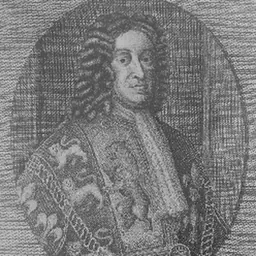
John Anstis (29 August 1669 – 4 March 1744) was an English officer of arms, antiquarian and politician who sat in the House of Commons between 1702 and 1722. He rose to the highest heraldic office in England and became Garter King of Arms in 1718 after years of political manoeuvring.
Early life Anstis was born at St Neot, Cornwall on 29 August 1669. He was the first son of another John Anstis and his wife Mary, the daughter of George Smith. Anstis matriculated at Exeter College, Oxford, on 27 March 1685 and entered the Middle Temple on 31 January 1690. On 23 June 1695 he married Elizabeth, daughter and heir of Richard Cudlipp of Tavistock, Devon. They had eight sons and six daughters. Anstis was called to the bar on 19 May 1699.
Political life In March 1701, Anstis received permission from the Earl Marshal, Henry Howard, 7th Duke of Norfolk, to collect materials from the College of Arms library to assist in the defence of the jurisdiction of the Earl Marshal, which was under attack. Anstis was also elected to Parliament for St Germans in 1702. When the Garter King of Arms, Sir Thomas St George, died in March 1703 Anstis was in a position to advise Lady Howard on how to protect her son's rights from the threat of a royal nomination of a new Garter on the one hand and the assumption of the nomination by the deputy earl marshal. Sir Henry St George was nominated to be Garter and succeeded his brother in June 1703.
Heraldic career Anstis did not stand for election to Parliament in 1705. By the time that Sir Henry St George died in August 1715, the political situation had shifted away from Anstis's political connections: Vanbrugh was nominated to the office and took measures to secure the passage of his grant. In addition, on 30 September 1715 Anstis was arrested on suspicion of involvement in plotting a Jacobite uprising in Cornwall.
A protracted legal battle ensued as Anstis and Vanbrugh both claimed the title of Garter. Anstis eventually emerged victorious in May 1718. In 1724 he obtained an order for publishing, as editor and assisted by Elias Ashmole, the Register of the Most Noble Order of the Garter, From its Cover in Black Velvet Usually Called the "Black Book", which was printed at his own expense. This was a transcript of the Latin "Black Book of the Garter", the earliest surviving register of that order, written in about 1535, now in the Royal Collection at Windsor Castle. In the preface to his work he wrote:
While we, with sensible regret, complain of the loss of these old annals whereby we are deprived of a great treasure, it hath been judged expedient to preserve the remains which have happily escaped this shipwreck. And therefore the eldest register remaining in the archives is now exhibited to publick view, less by the currency of time or any unforeseen accident it might be subject to the same unhappy fate. The original manuscript is a very large pompous volume in folio written in an handsome strong character on vellom, having the initial letters of each paragraph, together with the names of the companions and of the knights nominated in scrutinies, beautifully embellished with gold, placed on squares of gold and azure alternately...It hath been shewn in the introduction when and by whom this register was compiled and from what materials it was collected.
During the course of his research of the Order of the Garter, Anstis rediscovered a forgotten royal honour. Through his friendship with the Duke of Montagu the idea to revive the Order of the Bath came to fruition. This led to his Observations Introductory to an Historical Essay on the Knighthood of the Bath in 1725 and to Anstis's drawing up the statutes for the new order.
It was, perhaps, Anstis's Toryism rather than any genuine failure in heraldic knowledge that led a prominent Whig nobleman (possibly Henry Herbert, 9th Earl of Pembroke or Philip Stanhope, 4th Earl of Chesterfield) to direct at him the rebuke, "Thou silly fellow! Thou dost not know thy own silly business!"
Anstis duly presided over the coronation of George II in 1727. In 1728, he embarked on extensive research to prove that his family was related to Archbishop Henry Chichele, the founder of All Souls College, Oxford. This research could have entitled his son, John Anstis, to a fellowship at the college; which was blocked by Archbishop William Wake, Anstis did have his son made Blanc Coursier Herald in 1727. In 1737 he secured the succession of his office of Garter to John the younger.
Death and legacy Anstis died on 4 March 1744 at Mortlake, Surrey. He was buried at Duloe in Cornwall on 23 March according to his wishes. Anstis was an indefatigable antiquarian whose correspondence with fellow scholars such as Thomas Hearne and Humfrey Wanley testifies to his wide interests. He left a mass of unpublished papers, including over 8,000 pages of notes on English history, Jurisprudence, Chronology, Heraldry, Ecclesiastical and Military Affairs. Many of his papers were sold in 1768 and in 1774 and are now held in the British Library, the Bodleian Library, and All Souls, Oxford.
Arms
Don’t just read it —
keep it.
Full-length biographies made to live with: read them, listen on the way to work, watch them tonight.
- E-book
- Audio
- Video
Instant download · yours to keep · every purchase keeps this site free
Important facts
People in John Anstis's life
Named in this biography and alive at the same time


Related people
Same field, nearest in time



Contemporaries
People whose lives overlapped John Anstis's




Frequently asked questions
Who was John Anstis?
English officer of arms and antiquarian (1669-1744)
When was John Anstis born?
John Anstis was born on 29 August 1669 in St Neot.
When did John Anstis die?
John Anstis died on 4 March 1744 in Mortlake.
What was John Anstis's occupation?
John Anstis was a genealogist and politician.
What nationality was John Anstis?
John Anstis was British.
Sources & further reading
Cite this page
APA: Biography.guide. (2026). John Anstis. https://biography.guide/john-anstis/
MLA: "John Anstis." Biography.guide, https://biography.guide/john-anstis/.
Chicago: "John Anstis." Biography.guide. https://biography.guide/john-anstis/.
Data last updated: 2026-09-20 · Spot an error? Report a correction.
Page generated 2026-09-27 05:28 UTC