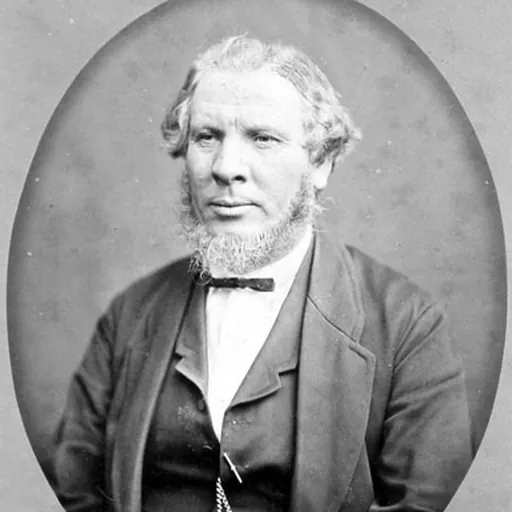
About John Anderson
Lived 1820 – 1897 (aged 76). John Anderson was a businessperson, engineer and politician.
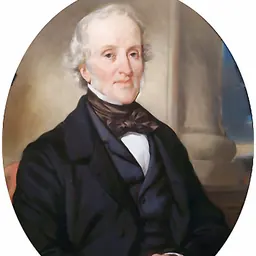
John Anderson (7 November 1820 – 30 April 1897) was the second Mayor of Christchurch in New Zealand 1868–1869, and a successful businessman. He had a close connection with three buildings (his office building, later known as the Guthrey Centre; St Andrew's Church, which is these days located at Rangi Ruru; St Paul's Church) that have later received Category I heritage registrations by Heritage New Zealand. Two of these buildings were demolished following the February 2011 Christchurch earthquake.
His company became even more successful under the leadership of two of his sons, and it existed until 1986.
Early life Anderson was born on 7 November 1820 in Inveresk, near Edinburgh in Scotland. He was the son of Alexander Anderson (a ploughman) and his wife Jean Harper.
He was married to Jane Gibson on 3 June 1845. Before her marriage, his wife was employed by the Dalmahoy family, who later helped their desire of emigrating to New Zealand by advancing £300 for the move. Their first two children, Marion and Alexander, died as infants, and this is believed to have been a stimulus for them to emigrate.
A fourth child, Andrew, was born in 1851. Jean Harper Anderson was born in 1853 and married the Very Rev Dr John Elmslie in 1881.
In February 1852, Anderson moved slightly south to Cashel Street, where he had bought a section.
In 1866, Anderson sent his sons John and Andrew to Edinburgh for schooling at the highly regarded Merchiston Castle School. Both started their working career in Scotland, with John as a mechanical engineer in Glasgow, and Andrew as a civil engineer in Edinburgh. Upon their respective returns to New Zealand in 1873 and 1876, they both worked in their father's business. It was known in later years as the Guthrey Centre and was demolished in August 2011 as a consequence of the February 2011 Christchurch earthquake. The building was listed as a Category I heritage structure with Heritage New Zealand. Another early and outstanding bridge was the Waiteti Viaduct, the northernmost viaduct on the North Island Main Trunk railway a few kilometres south of Te Kūiti. This structure was also completed in 1887. Probably the most significant structure on the North Island Main Trunk Railway is the Makatote Viaduct 12 km south of National Park. At 79 m, it is the highest on this line. It took three years to build and Andrew Anderson moved his family to the construction village, so that he could oversee the work. The viaduct was commissioned in 1908.
For a long time, the company was under family membership, with all employees known to management by name, fostering a good employee / management relationship.
Elections for Christchurch City Council were held annually. He was elected on several subsequent occasions: 1867–1869 and 1871. On 16 December 1868, the city council held its annual general meeting. In those days, the councillors elected one of their group as mayor at an annual meeting, i.e. the position was not elected at large (by the voting public) as is the case today. Councillor Anderson was elected unanimously as the second mayor of Christchurch.
His time as mayor is best remembered for him hosting the visit to Christchurch by the young Prince Albert, Duke of Edinburgh. The welcoming procession march was led by Anderson's foundry staff. As mayor, he presided at the official welcome luncheon. He carried out his duties to such satisfaction that citizens presented him with a silver tea and coffee service afterwards.
Presbyterian Church
The Andersons were one of five Scottish settler families in Canterbury. Anderson was very active in the Presbyterian Church. He made long trips through Canterbury, trying to establish new congregations. In 1854, he was a founding member of the congregation of St Andrew's Church, and a request for a minister was sent to Scotland.
In 1858, Fraser established Addington Cemetery in Addington as a public burial ground. It was often called the 'Scotch Cemetery' because of its links to the Presbyterian Church, but it was open to all denominations and was thus the first 'public' cemetery in Christchurch. The cemetery was eventually taken over by the Christchurch City Council.
When Fraser's more liberal views clashed with those of his congregation, Anderson was the leading person for forming the second congregation, and he laid the foundation stone at the new St Paul's Church. With two others, he travelled to Wanganui, trying and succeeding to attract Rev John Elmslie to St Paul's. Anderson's oldest daughter, Jean, was married to Elmslie in 1881, with the reception at their house Inveresk. The church was damaged in the 2010 Canterbury earthquake, and partially collapsed in the February 2011 Christchurch earthquake. By June 2011, St Paul's had been demolished. St Paul's was listed as a Category I heritage building by the New Zealand Historic Places Trust.
Although Canterbury was an Anglican settlement, the first three mayors were all Presbyterian Scotsmen—William Wilson in 1868, followed by John Anderson in 1869 and Andrew Duncan in 1870.
Death and legacy Jane Anderson died on 20 March 1894, aged 73. The funeral service was held at St Paul's two days later.
Anderson died on 30 April 1897 at his residence Inveresk in Cashel Street in central Christchurch. He was survived by four sons and two daughters. The funeral service for Anderson was held at St Paul's.
Don’t just read it —
keep it.
Full-length biographies made to live with: read them, listen on the way to work, watch them tonight.
- E-book
- Audio
- Video
Instant download · yours to keep · every purchase keeps this site free
Important facts
Family & relationships
People in John Anderson's life
Named in this biography and alive at the same time




Related people
Same field, nearest in time

Contemporaries
People whose lives overlapped John Anderson's





Frequently asked questions
Who was John Anderson?
New Zealand blacksmith and businessman (1820-1897)
When was John Anderson born?
John Anderson was born on 7 November 1820 in Inveresk.
When did John Anderson die?
John Anderson died on 30 April 1897 in Christchurch Central City.
What was John Anderson's occupation?
John Anderson was a businessperson, engineer and politician.
What nationality was John Anderson?
John Anderson's recorded nationality: Colony of New Zealand.
Sources & further reading
· DBpedia: John Anderson (mayor)
Cite this page
APA: Biography.guide. (2026). John Anderson. https://biography.guide/john-anderson-businessperson-1820/
MLA: "John Anderson." Biography.guide, https://biography.guide/john-anderson-businessperson-1820/.
Chicago: "John Anderson." Biography.guide. https://biography.guide/john-anderson-businessperson-1820/.
Data last updated: 2026-09-23 · Spot an error? Report a correction.
Portrait: Wikimedia Commons · author & licence
Page generated 2026-09-27 05:07 UTC