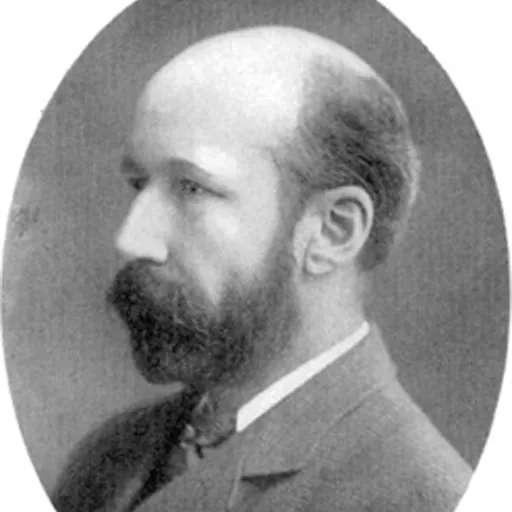
About John Alexander MacWilliam
Lived 1857 – 1937 (aged 79). John Alexander MacWilliam was a physiologist.
John Alexander MacWilliam (31 July 1857 – 13 January 1937), a physiologist at the University of Aberdeen in the late nineteenth and early twentieth centuries, was a pioneer in the field of cardiac electrophysiology. He spent many years studying ventricular fibrillation, and was the first person to propose that ventricular fibrillation was the most common cause of sudden death - and that fibrillation could be terminated (and life potentially saved) by a series of induction shocks to the heart. He was the first to accurately describe the condition of arrhythmia (irregular heartbeat), and he suggested transthoracic pacing to treat transient asystole (cardiac arrest). Although his work was recognised within his lifetime, it was not until many decades later that it laid the foundations for developments in the understanding and treatment of life-threatening heart conditions, such as in the artificial cardiac pacemaker. MacWilliam was appointed Regius Professor of the Institutes of Medicine (later Physiology) at the University of Aberdeen
MacWilliam was born 31 July 1857 at Kiltarlity, near Beauly, Inverness-shire in Scotland, where his father was farmer at Culmill farm. His parents were William McWilliam (1814 - 1888) and his wife Isabella Cumming (1816 - 1887) who had moved around 1850 from the neighbouring parishes of Inveravon (sometimes spelled Inveraven) and Knockando on Speyside to the farm at Culmill. His mother Isabella Cumming was the youngest daughter of John and Helen Cumming, founders of the Cardhu whisky distillery on Speyside.
John Alexander had two siblings. His elder brother, William Lewis McWilliam, was born at Kiltarlity in 1855. He stayed as farmer at Culmill and married Mary Burns. They had no children. William was a respected farmer and an Inverness-shire County Councillor, who was also chairman of the local schools committee and chairman of the Parish Council for over 30 years. He died in 1936, aged 81. His sister, Isabella Helen McWilliam, was born 12.10.1859 and died in infanthood – at the age of just 16 months.
Around the late 1880s, he chose to alter the spelling of his name to MacWilliam rather than McWilliam. His published papers until 1889 are under the McWilliam spelling.
Education and early work
After postgraduate work at the University of Edinburgh and at University College, London, MacWilliam worked with physiologists Hugo Kronecker at Bern, and Carl Ludwig, director of the Physiological Institute at the University of Leipzig.
In the four years from 1883 till 1886 MacWilliam worked primarily at University College London, as demonstrator under Edward Albert Sharpey-Schafer (previously Schäfer), and working closely with eminent contemporaries in physiology there (W.D. Halliburton and Ernest Starling), and with inspiration and guidance from W.H. Gaskell at King's College, Cambridge. In 1886 MacWilliam was appointed Regius Professor of the Institutes of Medicine at the University of Aberdeen – at just 29 years old – succeeding Professor William Stirling. The role was subsequently retitled as Regius Professor of Physiology.
During his time at University College, MacWilliam studied the structure of the muscular fibres of the diaphragm and of the heart. The results of his research were communicated to the Royal Society in a paper "The structure and rhythm of the heart of the eel" – with the results of experiments extending over two years on the origin and conduction of the wave of contraction which sweeps over the eel's heart, the different ways in which the wave could be blocked, and the manner in which its direction could be changed. From 1885 onwards, there followed three more years of systematic investigation. He extended his experiments to the hearts of mammals, most often cats, and found that all he had observed in the heart of the (cold-blooded) eel was also to be seen in the mammalian heart. He studied the condition known then as "Herz-delirium" or "ventricular fibrillation", which became of importance to clinicians in the opening decades of the twentieth century. He sought to explain the manner in which this incoordination in the action of the heart's muscle was brought about and the manner in which normal contraction could be restored. He found that there was a "certain area along the septum" where inhibition of the wave of contraction could be easily produced. He observed the condition which became known as "auricular flutter", and concluded that fibrillation was a disorder of muscle, not of nerve. He also described the basic elements of cardiopulmonary resuscitation - commonly abbreviated as CPR - (ventilation and cardiac compression) in keeping his experimental animals alive.
His contributions to cardiac electrophysiology were not limited to ventricular fibrillation. For example, he described the technique of transthoratic pacing for transient bradycardia (abnormally slow heartbeat), and he proposed stimulating the heart during asystole (cardiac arrest) by causing "artificial excitation" with a series of induction shocks (rather than using constant strong electric currents that could trigger fibrillation). He listed several potential triggers of ventricular fibrillation in individuals with underlying cardiac disease that could lead to a "hypersensitive state" of the heart. These included exertion-related changes in blood pressure and heart rate, digitalis, chloroform, and coronary obstruction.
MacWilliam made many other contributions to cardiac physiology during his career. In 1887, when chloroform anaesthesia was a cause of surgical death, his extensive animal experiments showed that chloroform could affect the heart directly and cause ventricular fibrillation. Between 1912 and 1925 he published articles analyzing the contractile properties of isolated blood vessels, the mechanism of the Korotkoff sounds, the effect of peripheral resistance on blood pressure, and blood pressure measurements in normal and pathological conditions. In 1919 he published The Mechanism and Control of Fibrillation in the Mammalian Heart.
MacWilliam was the first person to describe the action of dreams on the heart rate and blood pressure, having first noticed this in dogs in the late 1800s. Professor Hugh Maclean states that "He lived thirty years before his time" and "It is now obvious that the value of his contributions can hardly be overestimated".
Honours
Don’t just read it —
keep it.
Full-length biographies made to live with: read them, listen on the way to work, watch them tonight.
- E-book
- Audio
- Video
Instant download · yours to keep · every purchase keeps this site free
Important facts
People in John Alexander MacWilliam's life
Named in this biography and alive at the same time




Related people
Same field, nearest in time



Contemporaries
People whose lives overlapped John Alexander MacWilliam's






Frequently asked questions
Who was John Alexander MacWilliam?
Scottish physiologist
When was John Alexander MacWilliam born?
John Alexander MacWilliam was born on 31 July 1857 in Kiltarlity.
When did John Alexander MacWilliam die?
John Alexander MacWilliam died on 13 January 1937 in Edinburgh.
What was John Alexander MacWilliam's occupation?
John Alexander MacWilliam was a physiologist.
Sources & further reading
· Wikipedia: John Alexander MacWilliam
· DBpedia: John Alexander MacWilliam
Cite this page
APA: Biography.guide. (2026). John Alexander MacWilliam. https://biography.guide/john-alexander-macwilliam/
MLA: "John Alexander MacWilliam." Biography.guide, https://biography.guide/john-alexander-macwilliam/.
Chicago: "John Alexander MacWilliam." Biography.guide. https://biography.guide/john-alexander-macwilliam/.
Data last updated: 2026-09-23 · Spot an error? Report a correction.
Portrait: Wikimedia Commons · author & licence
Page generated 2026-09-27 05:08 UTC