
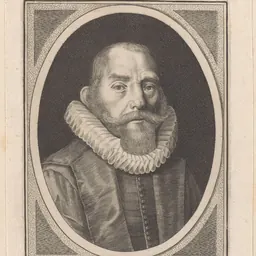
Johannes van Heeck
Dutch astronomer, mathematician and physician
About Johannes van Heeck
Lived 1577 – 1616 (aged 38–39). Johannes van Heeck was an astronomer, mathematician, physician, physicist, naturalist and alchemist.
Johannes van Heeck, (Deventer 2 February 1579 – presumably Sant'Angelo Romano c.1620), (also known as Johann Heck, Joannes Eck, Johannes Heckius, Johannes Eckius and Giovanni Ecchio) was a Dutch physician, naturalist, alchemist and astrologer. Together with Prince Federico Cesi, Anastasio de Filiis and Francesco Stelluti, he was one of the four founding members of the Accademia dei Lincei, the first learned society dedicated to understanding of the natural world through scientific enquiry.
Family background
Johannes van Heeck was one of five children in a family of wealthy merchants. His father was Willem, son of Willem van Heeck, and his mother was Lutgardt, daughter of Gerrit. Between 1587 and 1591 his father, a Catholic, was one of Deventer's political leaders, elected senator and consul in 1589. For this reason, when Protestant forces under Maurice of Nassau took the city in 1591, Willem van Heeck was fined 150 guilders for being a leader of the Catholic party and a collaborator of the hated Philip II of Spain.
Johannes received a humanist education, studying Latin, Greek, theology, astronomy and astrology, and making an exact observation of the comet that appeared in 1591, which he described in one of his later treatises as a bad omen for a life full of bitterness and pain. Under Calvinist rule, the position of his family became more precarious in Deventer and eventually his parents decided to send him to Italy to continue his education.
Early career Van Heeck traveled to Milan, Parma, Ferrara, Venice, Bologna and Rome. He stayed for a while in Spoleto as a guest of Count Gelosi, with whom he maintained a connection throughout his life, and on whose estate was the villa known as the "museum deauratum" where many of his manuscripts were composed. Here he wrote works of a moral literary character, such as his 1596 Epigrammata, as well as medical, magical and astrological topics. Among these was his Liber de Regimine Sanitatis Eorum Qui Studio Litterarum Incumbunt in which, inspired by De Vita Libri Tres ('The Threefold Life') of Marsilio Ficino, he examined the hygiene, diet and amorous habits of the literati. The second part of the work dealt with Ficino's ideas on magic. He discussed the influence of images on the spirit, and the occult virtues of certain plants, approaching his enquiry from the medical point of view rather than from that of the magician. He concluded the treatise with a list of secrets for healing common illnesses by using certain plants, and with a collection of "magic" recipes.
Accademia dei Lincei This close partnership between Cesi, van Heeck and Stelluti soon led to their founding the Accademia dei Lincei, together with Anastasio de Filiis, on 17 August 1603. There is no doubt that van Heeck played a key role in the conception and organization of the academy. He was the most experienced, educated and famous member of the group, and he clearly took the lead in many of its ventures, though he was the second youngest among them. Like all its members, he adopted a pseudonym ("Illuminato"), an emblem (a quarter-moon illuminated by a triangle from the sun) and the motto "A Patre luminum" ('from the father of lights'). It was van Heeck who chose as the academy's patron saint John the Baptist, the apostle of arcane visions. He also drafted its articles of association and devised its ceremonial.
There has been speculation that the connections between the Accademia's members were not confined to the intellectual sphere, and, specifically in the case of the relationship between Federico Cesi and Johannes van Heeck, that they were probably sexual in nature.
Travels in Europe In the spring of 1604, Prince Cesi's father the Duke of Acquasparta was so concerned about the activities of the Accademia dei Lincei and what he considered the nefarious influence of van Heeck over his son that he denounced him to the Roman Inquisition. As well as collecting books, objects and rare plants for the Accademia's collections, van Heeck was also a kind of roving ambassador, telling educated men in each city about the group's work and publicising its activities to win the sympathy of the powerful and the learned. During his travels, he was attacked by robbers and forced to swallow his membership ring of the Accademia in order to prevent it from falling into the hands of his attackers. (His many observations on his travels are held today in the Bibliothèque Interuniversitaire de Montpellier under the title Fructus itineris ad Septentrionales.) He had been patron to Tycho Brahe until the latter's death in 1601, and at the time of van Heeck's arrival, was still patron to Johan Kepler.
The supernova of 1604
In October 1604, a new star was seen. By night, it was the brightest star in the sky, and it was visible during the day as well for more than three weeks, before eventually dimming. Both Lodovico delle Colombe and Kepler published their accounts of the new star in 1606. Van Heeck was ready to publish before them, sending his manuscript of De Nova Stella Disputatio ('Discussion of the New Star') to Federico Cesi in Rome in January 1605.
The critical question for all three writers was whether the new phenomenon could be explained within the generally-accepted model of the universe, known as the Aristotelian model or the Ptolmaic system. This held that the stars were remote, fixed in their positions and unchanging, while movement and variance were associated with the planets, closer to the Earth. An unusual event in the sky might take place close to the earth, and could therefore be explained within the standard cosmological model. However, if it took place beyond the planets, this indicated that the stars, contrary to what was commonly believed, could not be fixed in a 'firmament'. Astronomers (still working with the unaided naked eye at this time) took measurements of parallax to determine whether an object was near the earth or far away from it.
Cesi believed that the Accademia needed to publish something of scientific significance in order to establish its scholarly credibility, and that a book from van Heeck which reaffirmed orthodox Catholic positions would both remove suspicions about the group's activities and pave the way for his return to Rome. Van Heeck's theses however posed a number of problems. He critiqued twelve positions put forward by other astronomers on the origins and location of supernovae. Claiming to use the measurement techniques developed by Tycho Brahe, he concluded that the supernova of 1604 showed no sign of parallax, which meant that the event could not have taken place near the earth, among the planets, but must have been located much further away, among the 'fixed' stars of the firmament or perhaps even further beyond. In this, he agreed with Tycho Brahe and other recent astronomers. However he reconciled this conclusion with the Aristotelian model by arguing that the apparently new star was not new at all; while permanent, like other stars, it was only occasionally visible for special reasons. He went further, accusing those who argued for a fluid heaven of writing contrary to Holy Writ, and attacking Tycho Brahe for his religious beliefs as well as for his purported scientific errors. Broadening his polemic against all erroneous ideas, he attacked Protestantism, thereby drawing Kepler into his argument. The language and tone of van Heeck's text was most intemperate. He berated the 'babbling new Philosophers' for their 'profane ignorance' and 'stupid ostentation' in departing from Aristotle.
Cesi greatly esteemed Kepler, and therefore edited van Heeck's text, removing anything hostile to him or to other astronomers. He also removed much of the defence of the Aristotelian cosmology, as it was important for the Accademia to align itself to new astronomical discoveries and not become entrenched in defending Aristotle. He then had the pamphlet published without the lynx emblem of the Accademia on its frontispiece. Van Heeck was furious at these editorial changes, which had been undertaken without his knowledge or permission. and Cesi invited the elderly and highly esteemed Giambattista della Porta to join in his place. This helped the Accademia to re-establish itself and gave it greatly enhanced respectability after the mistrust it had experienced in its earlier years. The next person to join after Della Porta was Galileo Galilei.
Nothing more is known about him until 26 July 1614, when he made a fleeting appearance in Rome, accompanied by Stelluti, for an academic conference on the Greek and Latin languages. A note, probably from 1615, by the Linceian Theophilus Müller at the end of his book 'De Animalibus' indicates that he visited van Heeck in the abbey of Sant'Angelo in Capoccia. Van Heeck appeared to be in the grip of a persecution mania, and told him that the king of Spain was persecuting him and insisting that he marry his daughter. The very last known reference to him is in a minute from the 24 March 1616 meeting of the Accademia dei Lincei, which records that he was temporarily excluded from meetings until he was once again of sound mind. Nothing further is known about him.
Selected works De nova stella disputatio. Aloisius Zannettus, Rome 1605 Disputatio de peste et quare praecipue grassatur tot ab hinc annis in Belgio, Deventer 1605 ('Discourse on the Plague, From Whence It Came Why It Lasted So Many Years in The Netherlands') Itineraris de septentrionales fructus ('Fruits of a Journey in the North') De mundi pernicie et haereticorum insania, quae in hac mundi senecta apud Belgas maxima est ('On the Destruction of the World and the Mania of Heretics, which in This Age of the World is Greatest in the Netherlands')
Don’t just read it —
keep it.
Full-length biographies made to live with: read them, listen on the way to work, watch them tonight.
- E-book
- Audio
- Video
Instant download · yours to keep · every purchase keeps this site free
Important facts
People in Johannes van Heeck's life
Named in this biography and alive at the same time



Related people
Same field, nearest in time



Contemporaries
People whose lives overlapped Johannes van Heeck's

Frequently asked questions
Who was Johannes van Heeck?
Dutch astronomer, mathematician and physician
When was Johannes van Heeck born?
Johannes van Heeck was born in 1577 in Deventer, Deventer.
When did Johannes van Heeck die?
Johannes van Heeck died in 1616 in Sant'Angelo Romano.
What was Johannes van Heeck's occupation?
Johannes van Heeck was an astronomer, mathematician, physician, physicist, naturalist and alchemist.
Sources & further reading
· Wikipedia: Johannes van Heeck
Cite this page
APA: Biography.guide. (2026). Johannes van Heeck. https://biography.guide/johannes-van-heeck/
MLA: "Johannes van Heeck." Biography.guide, https://biography.guide/johannes-van-heeck/.
Chicago: "Johannes van Heeck." Biography.guide. https://biography.guide/johannes-van-heeck/.
Data last updated: 2026-09-20 · Spot an error? Report a correction.
Page generated 2026-09-27 05:33 UTC