
Giambattista della Porta
Italian alchemist and dramatist
About Giambattista della Porta
Lived 1535 – 1615 (aged 79–80). Giambattista della Porta was an Italian cryptographer, mathematician, physicist, chemist, inventor and playwright.
Giambattista della Porta (; 1535 – 4 February 1615), also known as Giovanni Battista Della Porta, was an Italian scholar, polymath and playwright who lived in Naples at the time of the Renaissance, Scientific Revolution and Counter-Reformation.
Giambattista della Porta spent the majority of his life on scientific endeavours. He benefited from an informal education of tutors and visits from renowned scholars. His most famous work, first published in 1558, is entitled Magia Naturalis (Natural Magic). In this book he covered a variety of the subjects he had investigated, including occult philosophy, astrology, alchemy, mathematics, meteorology, and natural philosophy. He was also referred to as "professor of secrets". Della Porta had a privileged childhood including his education. His father had a thirst for learning, a trait he would pass on to all of his children. He surrounded himself with distinguished people and entertained the likes of philosophers, mathematicians, poets, and musicians. The atmosphere of the house resembled an academy for his sons. The members of the learned circle of friends stimulated the boys, tutoring and mentoring them, under the strict guidance of their father.
In addition to having talents for the sciences and mathematics, all the brothers were also extremely interested in the arts, music in particular. Despite their interest, none of them possessed any sort of talent for it, but they did not allow that to stifle their progress in learning theory. They were all accepted into the Scuola di Pitagora, a highly exclusive academy of musicians.
More aware of their social position than the idea that his sons could have professions in science, Nardo Antonio raised the boys more as gentlemen than as scholars. Therefore, the boys struggled to learn to sing, as that was considered a courtly accomplishment of gentlemen. They were taught to dance, ride, perform well in tournaments and games, and dress well. The training gave della Porta, at least earlier in his life, a taste for the finer aspects of privileged living.
"From approximately 1563 to 1566 Della Porta travels to other parts of Italy, France and Spain, collecting secrets and meeting with learned men. Indeed he presented to Philip II his book on ciphers De Furtivis Literarum Notis (1563). The second edition of his Magia Naturalis (1561) also contains a brief dedication to the Spanish Philip"
Scientific disciplines
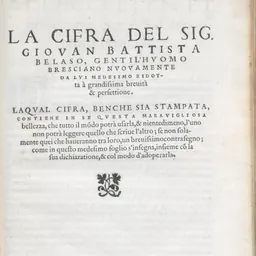
In 1563, della Porta published De Furtivis Literarum Notis, a work about cryptography. In it, he described the first known digraphic substitution cipher. Charles J. Mendelsohn commented:
Della Porta invented a method which allowed him to write secret messages on the inside of eggs. Some of his friends were imprisoned by the Inquisition. At the gate of the prison, everything was checked except for eggs. Della Porta wrote messages on the eggshell using a mixture made of plant pigments and alum. The ink penetrated the eggshell which is semi-porous. When the eggshell was dry, he boiled the egg in hot water and the ink on the outside of the egg was washed away. When the recipient in prison peeled off the shell, the message was revealed once again on the egg white. De Furtivis Literarum Notis also contains one of the earliest known examples of music substitution ciphers.
In 1586 della Porta published a work on physiognomy, De humana physiognomonia libri IIII (1586). This influenced the Swiss eighteenth-century pastor Johann Kaspar Lavater as well as the 19th-century criminologist Cesare Lombroso. Della Porta wrote extensively on a wide spectrum of subjects throughout his life – for instance, an agricultural encyclopedia entitled "Villa" as well as works on meteorology, optics, and astronomy.
In 1589, on the eve of the early modern Scientific Revolution, della Porta became the first person to attack in print, on experimental grounds, the ancient assertion that garlic could disempower magnets. This was an early example of the authority of early authors being replaced by experiment as the backing for a scientific assertion. Della Porta's conclusion was confirmed experimentally by Thomas Browne, among others.
In later life, della Porta collected rare specimens and grew exotic plants. His work Phytognomonica lists plants according to their geographical location. In Phytognomonica the first observation of fungal spores is recorded, making him a pioneer of mycology.
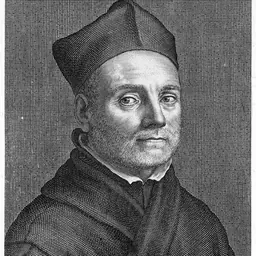
His private museum was visited by travellers and was one of the earliest examples of natural history museums. It inspired the Jesuit Athanasius Kircher to begin a similar, even more renowned, collection in Rome.
Pioneering scientific society Della Porta was the founder of a scientific society called the Academia Secretorum Naturae (Accademia dei Segreti). This group was more commonly known as the Otiosi, (Men of Leisure). Founded sometime before 1580, the Otiosi were one of the first scientific societies in Europe and their aim was to study the "secrets of nature." Any person applying for membership had to demonstrate they had made a new discovery in the natural sciences.
The Academia Secretorum Naturae was compelled to disband when its members were suspected of dealing with the occult. Della Porta was summoned to Rome by Pope Gregory XIII. Though he personally emerged from the meeting unscathed, the Academia Secretorum Naturae disbanded. Despite this incident, della Porta remained religiously devout and became a lay Jesuit brother.
Della Porta joined The Academy of the Lynxes in 1610.
Technological contributions
His interest in a variety of disciplines resulted in the technological advances of the following: agriculture, hydraulics, Military Engineering, instruments, and pharmacology. He published a book in 1606 on raising water by the force of the air. In 1608 he published a book on military engineering, and another on distillation.
Additionally, della Porta perfected the camera obscura. In a later edition of his Natural Magic, della Porta described this device as having a convex lens. Though he was not the inventor, the popularity of this work helped spread knowledge of it. He compared the shape of the human eye to the lens in his camera obscura, and provided an easily understandable example of how light could bring images into the eye.
Della Porta also claimed to have invented the first telescope, but died while preparing the treatise in support of his claim. His efforts were also overshadowed by Galileo Galilei's improvement of the telescope in 1609, following its introduction by Lippershey in the Netherlands in 1608.
In the book, della Porta also mentioned an imaginary device known as a sympathetic telegraph. The device consisted of two circular boxes, similar to compasses, each with a magnetic needle, supposed to be magnetized by the same lodestone. Each box was to be labelled with the 26 letters, instead of the usual directions. Della Porta assumed that this would coordinate the needles such that when a letter was dialled in one box, the needle in the other box would swing to point to the same letter, thereby helping in communicating.
Religious complications A Catholic, della Porta was examined by the Inquisition in the years prior to 1578. He was forced to disband his Academia Secretorum Naturae, and in 1592 his philosophical works were prohibited from further publication by the Church; the ban was lifted in 1598. Porta's involvement with the Inquisition puzzles historians due to his active participation in charitable Jesuit works by 1585. A possible explanation for this lies in Porta's personal relations with Fra Paolo Sarpi after 1579.
Playwright The 17 theatrical works that have survived from a total of perhaps 21 or 23 works comprise 14 comedies, one tragicomedy, one tragedy and one liturgical drama.
Comedies
Lo Astrologo; La Carbonaria; La Chiappinaria; La Cintia; Gli Duoi fratelli rivali; La Fantesca; La Furiosa; Il Moro; L'Olimpia; I Simili; La Sorella; La Tabernaria; La Trappolaria; La Turca
Others
La Penelope (tragicomedy); L'Ulisse (tragedy); Il Giorgio (liturgical drama)
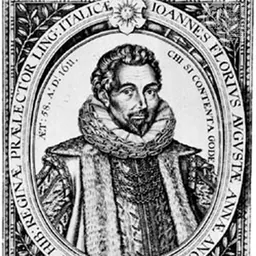
Although they belong to the lesser-known tradition of the commedia erudita rather than the commedia dell'arte - which means they were written out as entire scripts instead of being improvised from a scenario - della Porta's comedies are eminently performable. While there are obvious similarities between some of the characters in della Porta's comedies and the masks of the commedia dell'arte, it should be borne in mind that the characters of the commedia erudita are uniquely created by the text in which they appear, unlike the masks, which remain constant from one scenario to another. Indeed, the masks of the improvised theatre evolved as stylised versions of recurring character types in written comedies. One of Della Porta's most notable stock characters was the or , a gluttonous trickster whose lack of moral scruples enabled him to pull off stunts that initially might risk bringing the plot crashing down, but ended up winning the day in unexpected ways. The term was translated by John Florio in his Italian to English Dictionary first published in 1598 as . Perhaps the best example of this type is Morfeo in the comedy La Fantesca.
Works
Natural Magic (1558) expanded to 20 books in 1589. English translation 1658. Available online at De furtivis Literarum Notis (1563) On secret codes cryptography L'arte del ricordare (1566) Italian treatise on the Art of Memory (remembering) Villa (1583–92) Agricultural encyclopedia De refractione optices (1589) On Optics Elementorum curvilineorum libri duo (1601) Ars reminiscendi (1602) On the Art of Memory. Longer version in Latin of the 1566 treatise. Coelestis Physiogranonia (1603) pub. Naples De occultis literarum notis (1606). Available online at De aeris transmutanionbus (1609) On meteorology De Miracoli & Maravigliosi Effetti dalla Natura prodotti (1665) pub. Venice
Giovanni Battista Della Porta, Phytognomonica, Napoli, Orazio Salviani, 1588.
Don’t just read it —
keep it.
Full-length biographies made to live with: read them, listen on the way to work, watch them tonight.
- E-book
- Audio
- Video
Instant download · yours to keep · every purchase keeps this site free
Important facts
People in Giambattista della Porta's life
Named in this biography and alive at the same time


Related people
Same field, nearest in time


Contemporaries
People whose lives overlapped Giambattista della Porta's




Frequently asked questions
Who was Giambattista della Porta?
Italian alchemist and dramatist (1535-1615)
When was Giambattista della Porta born?
Giambattista della Porta was born in 1535 in Vico Equense.
When did Giambattista della Porta die?
Giambattista della Porta died on 4 February 1615 in Naples.
What was Giambattista della Porta's occupation?
Giambattista della Porta was a cryptographer, mathematician, physicist, chemist, inventor and playwright.
What nationality was Giambattista della Porta?
Giambattista della Porta was Italian.
Sources & further reading
· Wikipedia: Giambattista della Porta
· DBpedia: Giambattista della Porta
Cite this page
APA: Biography.guide. (2026). Giambattista della Porta. https://biography.guide/giambattista-della-porta/
MLA: "Giambattista della Porta." Biography.guide, https://biography.guide/giambattista-della-porta/.
Chicago: "Giambattista della Porta." Biography.guide. https://biography.guide/giambattista-della-porta/.
Data last updated: 2026-09-20 · Spot an error? Report a correction.
Page generated 2026-09-27 05:32 UTC