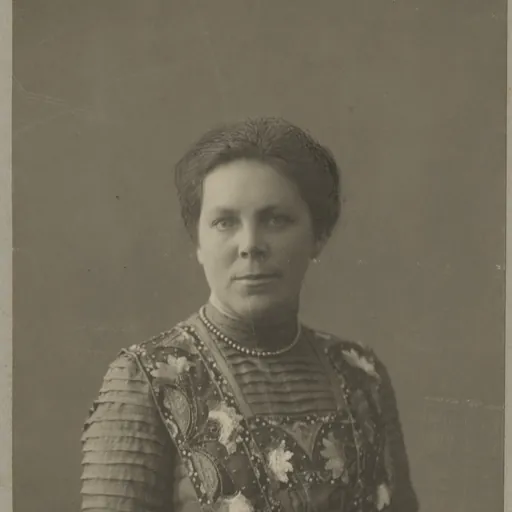
About Johanna Goekoop-de Jongh
Lived 1877 – 1946 (aged 69). Johanna Goekoop-de Jongh was a Dutch art historian and art collector.
Johanna Suzanna Goekoop-de Jongh (20 October 1877 in Kampen – 25 November 1946 in Breda) was a Dutch art historian and archaeologist. She was among the first women in the world to earn a doctorate in art history, and in 1904 became the first female Private lecturer at Utrecht University.
Life and Career Johanna de Jongh was born on 20 October 1877, in Kampen. Her uncle, Gerret Pieter Rouffaer, who studied the architecture of Indonesia among other things, introduced her to art and culture. She studied classical philology in Leiden and archaeology and art history at the École du Louvre in Paris. In 1903, she received her doctorate cum laude from the Humboldt University of Berlin under the renowned Heinrich Wölfflin with her dissertation Holland und die Landschaft. As a foreign national, she was not subject to the restrictions that barred German women from earning doctorates at the time, which made this path more accessible to her than to her German female peers. As a result, she became the first female doctor of art history in Berlin.
Subsequently, in 1904, on her own initiative, she became the first female private lecturer at Utrecht University, where the board saw potential in art history as a scientific discipline (in 1907, Willem Vogelsang became the first professor). She published on, among other things, Jan van Eyck, Rembrandt's Night Watch and the Stained glass in the St. John's Church in Gouda. She became a close colleague of Abraham Bredius and one of her students was Elisabeth Neurdenburg, who would later become the first female professor of art history in the Netherlands. Remarkable (though not unique given the spirit of the times) was her admiration for the proto-fascist philosopher Gerard Bolland, whom she praised in a letter to Lodewijk van Deyssel.
When Johanna married Mr. Adriaan Goekoop (1859-1914) in 1905, she had to give up her job as a private tutor. They had three children in quick succession: Cornelis (1906-1968), Johanna (1907-unknown) and Adriaan (1908-1977), and they lived in the Catshuis in The Hague. In 1906, Adriaan Goekoop bought the heart of the Zorgvliet estate from the building land company Het Park Zorgvliet, of which he was a shareholder. In 1903, the side wings of the Catshuis had already been raised by one storey according to a design by Jan Frederik Raymond van der Wall, and in 1907 Hendrik Jacob Dammerman Jr. designed an extension for the couple. Dammerman raised the rear section between the two wings by an extra storey and designed the garden room with the tower room above it.
Archaeology Adriaan Goekoop was a wealthy amateur archaeologist who sponsored excavations on various Greek islands in an attempt to discover Homer's Ithaca. After his death in 1914, Johanna continued this archaeological research with great enthusiasm under the name Adriaan Goekoop Foundation. The foundation provided large sums of money for excavations in Greece and Italy. Goekoop established contacts with Italian archaeologists such as Giulio Jacoppi and sponsored campaigns in the caves of Sese and Itri, on Ischia, in Artena, in Circeo, in Palermo, and near Satricum.
From 1931 to 1935, she financed excavations on the island of Cephalonia by the Greek archaeologist Spyridon Marinatos. In 1933, she published a book on the theory that the palace described in the Odyssey must be located on this island. Johanna made several archaeological discoveries in Palermo himself and spent a large part of the year in Italy. She showed interest in the regime of Benito Mussolini and, at her own request, was introduced to him at the Palazzo Venezia in Rome.
She donated part of her finds to the Utrecht University as a study collection. From 1921, art history and archaeology formed a joint discipline, and the archaeological collection remained part of the teaching staff of the Institute for Art History until the war.
Goekoop-de Jongh also attempted to establish a chair in classical archaeology at the University of Groningen. She wanted the excavations she had funded to receive a scientific framework at the university where her two sons were studying. From 1931 to 1933, the Adriaan Goekoop Foundation, which she established, made it possible to appoint a special professor of Greek and Near Eastern archaeology, the young Italian archaeologist Count Ranuccio Bianchi Bandinelli (1900-1975).
In 1904, she was appointed a member of the Nederlandsche Vereeniging van Antiquaren, in 1910 a member of the Utrecht Provincial Society of Arts and Sciences, and in 1938 an honorary member of the Archaeological Society of Athens.
Works Holland und die Landschaft: inaugural dissertation for obtaining the doctorate at the Faculty of Philosophy of the Royal Friedrich-Wilhelms-Universität Berlin, submitted and accompanied by theses on January 17, 1903. Berlin: E. Ebering Edition. The Dutch Landscape in Origin and Text. The Hague: Mart. Nijhoff, 1903. Art History as a Teaching Subject: speech at the opening of her classes as private tutor in art history at the State University of Utrecht on Friday, January 29, 1904, The Hague: Nijhoff, 1904. An Old Portrait by Van Eyck’, Onze Kunst. Volume 5 (1906). A Rembrandtianum’, Onze Kunst. Volume 6 (1907). 'Rembrandt and Lastman', Bulletin of the Dutch Archaeological Society 8 (1907), pp. 40-42. Jan van Eyck, Elsevier's Illustrated Monthly Magazine 20 (1910), no. 4, pp. 217-232. Prehistoric burial mounds on the Renkum heath, Bulletin of the Dutch Archaeological Society, second series 5 (1912), pp. 23-31. The man with the magnifying glass, in: Festschrift, presented to Dr. Abraham Bredius on April 18, 1915, pp. 53-60. La Nésos Homérique. Groningen 1933.
Don’t just read it —
keep it.
Full-length biographies made to live with: read them, listen on the way to work, watch them tonight.
- E-book
- Audio
- Video
Instant download · yours to keep · every purchase keeps this site free
Important facts
People in Johanna Goekoop-de Jongh's life
Named in this biography and alive at the same time




Related people
Same field, nearest in time
Contemporaries
People whose lives overlapped Johanna Goekoop-de Jongh's




Frequently asked questions
Who was Johanna Goekoop-de Jongh?
Dutch art historian (1877–1946)
When was Johanna Goekoop-de Jongh born?
Johanna Goekoop-de Jongh was born on 20 October 1877 in Kampen.
When did Johanna Goekoop-de Jongh die?
Johanna Goekoop-de Jongh died on 25 November 1946 in The Hague.
What was Johanna Goekoop-de Jongh's occupation?
Johanna Goekoop-de Jongh was an art historian and art collector.
What nationality was Johanna Goekoop-de Jongh?
Johanna Goekoop-de Jongh was Dutch.
Sources & further reading
· Wikipedia: Johanna Goekoop-de Jongh
· DBpedia: Johanna Goekoop-de Jongh
Cite this page
APA: Biography.guide. (2026). Johanna Goekoop-de Jongh. https://biography.guide/johanna-goekoop-de-jongh/
MLA: "Johanna Goekoop-de Jongh." Biography.guide, https://biography.guide/johanna-goekoop-de-jongh/.
Chicago: "Johanna Goekoop-de Jongh." Biography.guide. https://biography.guide/johanna-goekoop-de-jongh/.
Data last updated: 2026-09-21 · Spot an error? Report a correction.
Portrait: Wikimedia Commons · author & licence
Page generated 2026-09-27 04:59 UTC