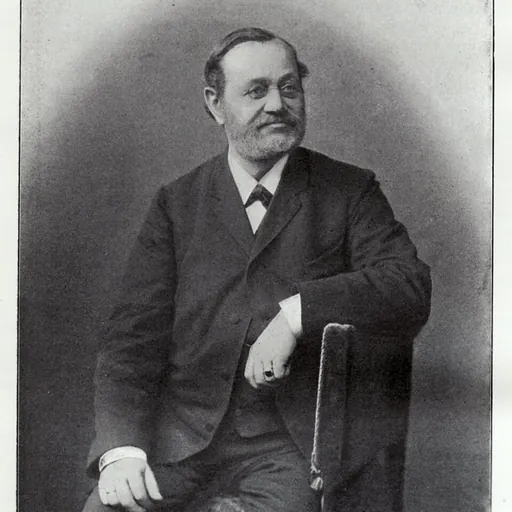
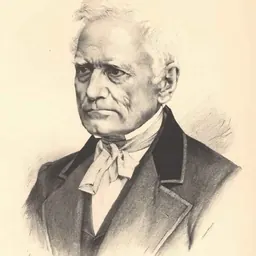
Johann Wilhelm Schwedler
German civil engineer, structural engineer and constructor
About Johann Wilhelm Schwedler
Lived 1823 – 1894 (aged 70). Johann Wilhelm Schwedler was a German civil engineer, structural engineer, design engineer, engineer, university teacher and executive.
Johann Wilhelm Schwedler (23 June 1823, Berlin – 9 June 1894, Berlin) was a German civil engineer and civil servant who designed many bridges and public buildings and invented the Schwedler truss and the Schwedler cupola. He is an author of Schwedler's theorem, a formula defining relation between shear force and bending moment.
Life and career Schwedler was the son of a cabinetmaker who died when he was still in school; his brother, already a construction supervisor, made it possible for him to finish his education at the City Trade School in 1842. After a further required examination in Latin to complete the equivalent of a lower-level Gymnasium education, he spent the next ten years training as a surveyor, studying for examinations in that and in road construction, studying for a year at the Berlin Academy of Construction, and completing the examinations to be a certified building inspector and construction supervisor. One of his practical examinations was waived after he won the international competition to design a road and rail bridge across the Rhine between Cologne and Deutz. He was then required to leave on his Wanderjahre as a wandering journeyman; he did so with his new wife, the daughter of a teacher and organist in Buckow, whom he had met through their shared love of music and become engaged to six years before.
Schwedler began publishing in engineering before he completed his training, beginning with Über die statischen Prinzipien der Konstruktion eiserner Dachgebinde über weite Räume und die Entwicklung der Konstruktionssysteme aus demselben (1846). His "Theorie der Brückenbalkensysteme", published in the first year of the Zeitschrift für Bauwesen (1851), had a revolutionary impact on the construction of steel bridges. But during his journeyman years he did not publish, concentrating instead on building. The City of Cologne employed him to build a stone bridge over the Sieg. He then supervised the first stage of construction of the railway between Cologne and Gießen. In 1848, Barmen, now part of Wuppertal, invited him to become its superintendent of construction, but he instead with some reluctance returned to Berlin to take a post in the Division of Construction of the Prussian Ministry of Trade. During that time he oversaw in some manner every major piece of construction in Prussia and subsequently the German Empire. In 1868 he was promoted to Geheimer Baurat and became the highest ranking construction employee in the Prussian Civil Service. He also returned to publishing, developing with Friedrich August von Pauli, Johann Caspar Harkort, and Heinrich Gerber a complete theory and praxis of steel construction; his Theorie der Brückenbalken-Systeme, volume 1 (1862) and Resultate über die Konstruktion der eisernen Brücken (1865) He was on the editorial board of the Zeitschrift für Bauwesen for many years.
Schwedler had three daughters and a son; however, his youngest daughter and his son died in 1863 and 1864, and his wife in 1867 after a long decline.
Works Among Schwedler's memorable engineering feats were the design of a swinging bridge which was still in use half a century later; the design for the new prayer hall of the Deutscher Dom;
Schwedler truss Schwedler invented the Schwedler truss, which was widely used worldwide in framed bridges and roofs until about 1900. It is a kind of curved chord or bowstring truss with the minimum number of diagonals, which are to bear only tension, not compression; it requires a slight downward curvature in the middle, usually replaced with extra diagonal bracing for appearance and cost saving. Schwedler himself would have preferred it to be used less on aesthetic grounds. for which he won a gold medal at the 1867 Paris International Exposition. One of the last remaining examples is the bridge carrying the Nagold Valley Railway over the Nagold in Unterreichenbach.
Triple-hinged arch Schwedler's work with bridges and calculating the stresses on them led to a further innovation, an arched structure hinged at three points to accommodate differing stresses and changes in temperature, which functionally resembles the roofs of modern stadia. The first of these, and a prototype for the platform halls of late 19th-century stations, was his train shed for the Berlin Ostbahnhof, then known as the Schlesischer Bahnhof (1866); the last surviving example is probably the train sheds of the main station in Frankfurt am Main (1885–87).
Schwedler cupola
Called in by the Imperial Continental Gas Association in 1863 to replace a failed roof over a telescoping gas holder, Schwedler devised a workable solution but thinking further about the problem, in 1866 published an article describing a new type of iron cupola that was simpler, lighter, and as sturdy: it takes the form of an unsupported spheroidal steel vault, rather than beams, and was normally used to span distances of 25–45 m. He used Schwedler cupolas in designing four new gas holders for Berlin's street lighting, of which the one now known as the Fichte-Bunker (1874) survives, and the only deterrent to their use today is the cost of labour. He designed the cupolas on Berlin's New Synagogue (1863) and the Sedan Panorama at Alexanderplatz Station.
Honours The Schwedlerstraße in the Grunewald neighbourhood of Berlin was named for him in 1898; the Schwedlerbrücke, a pedestrian bridge across the railway in the Ostend neighbourhood of Frankfurt, and the Schwedlerstraße leading to it are also named for him.
He was also awarded the following honours in his lifetime: Order of the Red Eagle 2nd Class with oakleaf Gold medal for services in construction (1884) Commander 2nd Class of the Hessian Order of Philip the Magnanimous Commander of the Imperial Austrian Order of Franz Joseph Officer of the Order of the Crown of Italy
Don’t just read it —
keep it.
Full-length biographies made to live with: read them, listen on the way to work, watch them tonight.
- E-book
- Audio
- Video
Instant download · yours to keep · every purchase keeps this site free
Important facts
People in Johann Wilhelm Schwedler's life
Named in this biography and alive at the same time

Related people
Same field, nearest in time


Contemporaries
People whose lives overlapped Johann Wilhelm Schwedler's



Frequently asked questions
Who was Johann Wilhelm Schwedler?
German civil engineer, structural engineer and constructor (1823-1894)
When was Johann Wilhelm Schwedler born?
Johann Wilhelm Schwedler was born on 28 June 1823 in Berlin.
When did Johann Wilhelm Schwedler die?
Johann Wilhelm Schwedler died on 9 June 1894 in Berlin.
What was Johann Wilhelm Schwedler's occupation?
Johann Wilhelm Schwedler was a civil engineer, structural engineer, design engineer, engineer, university teacher and executive.
What nationality was Johann Wilhelm Schwedler?
Johann Wilhelm Schwedler was German.
Sources & further reading
· Wikipedia: Johann Wilhelm Schwedler
· DBpedia: Johann Wilhelm Schwedler
Cite this page
APA: Biography.guide. (2026). Johann Wilhelm Schwedler. https://biography.guide/johann-wilhelm-schwedler/
MLA: "Johann Wilhelm Schwedler." Biography.guide, https://biography.guide/johann-wilhelm-schwedler/.
Chicago: "Johann Wilhelm Schwedler." Biography.guide. https://biography.guide/johann-wilhelm-schwedler/.
Data last updated: 2026-09-20 · Spot an error? Report a correction.
Portrait: Wikimedia Commons · author & licence
Page generated 2026-09-27 04:58 UTC