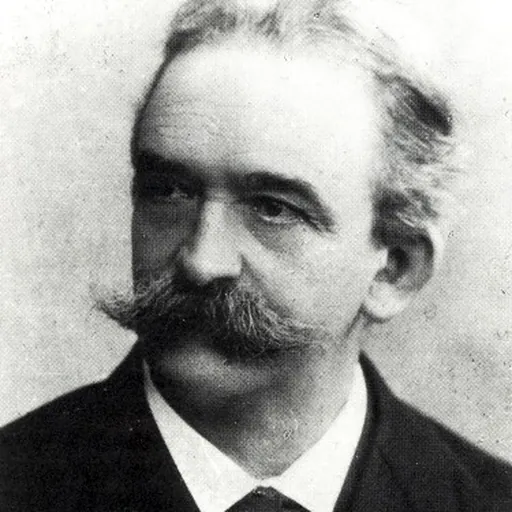
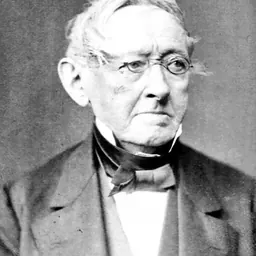
Christian Otto Mohr
German civil engineer
About Christian Otto Mohr
Lived 1835 – 1918 (aged 82). Christian Otto Mohr was a German civil engineer, university teacher and mathematician, known for Mohr's circle, Mohr–Coulomb theory and Moment-area theorem.
Christian Otto Mohr (8 October 1835 – 2 October 1918) was a German civil engineer. He is renowned for his contributions to the field of structural engineering, such as Mohr's circle, and for his study of stress.
Biography He was born on 8 October 1835 to a landowning family in Wesselburen in the Holstein region. At the age of 16 attended the Polytechnic School in Hannover.
Starting in 1855, his early working life was spent in railroad engineering for the Hanover and Oldenburg state railways, designing some famous bridges and making some of the earliest uses of steel trusses.
Even during his early railway years, Mohr had developed an interest in the theories of mechanics and the strength of materials. In 1867, he became professor of mechanics at Stuttgart Polytechnic, and in 1873 at Dresden Polytechnic. Mohr had a direct and unpretentious lecturing style that was popular with his students. In addition to a lone textbook, Mohr published many research papers on the theory of structures and strength of materials.
In 1874, Mohr formalised the idea of a statically indeterminate structure.
Mohr was an enthusiast for graphical tools and developed the method, for visually representing stress in three dimensions, previously proposed by Carl Culmann. In 1882, he famously developed the graphical method for analysing stress known as Mohr's circle and used it to propose an early theory of strength based on shear stress. He also developed the Williot-Mohr diagram for truss displacements and the Maxwell-Mohr method for analysing statically indeterminate structures, it can also be used to determine the displacement of truss nodes and forces acting on each member. The Maxwell-Mohr method is also referred to as the virtual force method for redundant trusses.
He retired in 1900, yet continued his scientific work in Dresden until his death on 2 October 1918.
Don’t just read it —
keep it.
Full-length biographies made to live with: read them, listen on the way to work, watch them tonight.
- E-book
- Audio
- Video
Instant download · yours to keep · every purchase keeps this site free
Important facts
People in Christian Otto Mohr's life
Named in this biography and alive at the same time

Related people
Same field, nearest in time



Contemporaries
People whose lives overlapped Christian Otto Mohr's



Frequently asked questions
Who was Christian Otto Mohr?
German civil engineer (1835–1918)
When was Christian Otto Mohr born?
Christian Otto Mohr was born on 8 October 1835 in Wesselburen.
When did Christian Otto Mohr die?
Christian Otto Mohr died on 2 October 1918 in Dresden.
What was Christian Otto Mohr's occupation?
Christian Otto Mohr was a civil engineer, university teacher and mathematician.
What was Christian Otto Mohr known for?
Christian Otto Mohr was known for Mohr's circle, Mohr–Coulomb theory, Moment-area theorem and Statically indeterminate.
What nationality was Christian Otto Mohr?
Christian Otto Mohr was German.
Sources & further reading
· Wikipedia: Christian Otto Mohr
· DBpedia: Christian Otto Mohr
Cite this page
APA: Biography.guide. (2026). Christian Otto Mohr. https://biography.guide/christian-otto-mohr/
MLA: "Christian Otto Mohr." Biography.guide, https://biography.guide/christian-otto-mohr/.
Chicago: "Christian Otto Mohr." Biography.guide. https://biography.guide/christian-otto-mohr/.
Data last updated: 2026-09-22 · Spot an error? Report a correction.
Portrait: Wikimedia Commons · author & licence
Page generated 2026-09-27 05:01 UTC