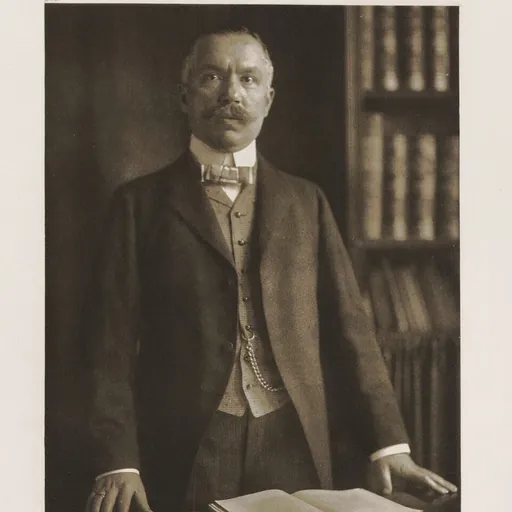
About Johann Stumpf
Lived 1862 – 1936 (aged 74). Johann Stumpf was a German engineer, university teacher, design engineer, mechanical engineer and technician.
Johann Stumpf of Technische Hochschule Charlottenburg (today Technische Universität Berlin) is best known for popularising the uniflow steam engine, in the years around 1909, and his name has always been associated with it. The basic uniflow principle had been invented many years before.
Idea
Stumpf's 'Uniflow' system aroused interest among engine designers in the years before the First World War, at first in his native Germany and later elsewhere. The Uniflow principle was known previously, and Stumpf's work was really its practical application. In Stumpf's system steam was admitted at one end of the cylinder, and the used steam left through a ring of ports at the other end of the cylinder. This allowed the admission end to stay hot, as it was not cooled by the exhaust on its way out, and so improved efficiency. In a double-acting engine the exhaust ports were in the middle of the cylinder.
Almost all uniflow engines were large stationary types, but the system was tried by, among others, the North Eastern Railway in England, as described by Tuplin (see sources). Briefly, the system worked well and obtained a small increase in economy by decreasing fuel consumption, but at the price structure prevailing at that time the extra constructional and maintenance costs were greater than the coal economy. H.W. Dickinson's A Short History of The Steam Engine makes it clear that the concept of the uniflow engine reached back to Montgolfier and Jacob Perkins (who patented the idea) and Leonard Jennett Todd (Patent No. 7801): Dickinson then gives Stumpf of Technische Hochschule Charlottenburg his due citing a paper by T.B. Perry Proc. Inst. Mech. Eng., 1920 (1922?).
Patents
5429/1908 Application (original: 7 March 1908), UK 6 March 1909, Accepted 15 July 1909. Improvements in four-cylinder locomotive engines 25,531/1910 Application 3 November 1910, Accepted 2 March 1911. Improvements relating to manoeuvring and like gear for uni-directional flow steam engines 16,442 /1910 Application (original: 5 March 1910) 9 July 1910, Accepted 23 March 1911. Improvements relating to valves 16,383/1910 Application (original: 18 June 1910) 8 July 1910, Accepted 20 October 1910. Improvements relating to uni-directional flow steam engines
Don’t just read it —
keep it.
Full-length biographies made to live with: read them, listen on the way to work, watch them tonight.
- E-book
- Audio
- Video
Instant download · yours to keep · every purchase keeps this site free
Important facts
Related people
Same field, nearest in time

Contemporaries
People whose lives overlapped Johann Stumpf's




Frequently asked questions
Who was Johann Stumpf?
German engineer (1862–1936)
When was Johann Stumpf born?
Johann Stumpf was born on 4 April 1862 in Mülheim.
When did Johann Stumpf die?
Johann Stumpf died on 18 November 1936 in Berlin.
What was Johann Stumpf's occupation?
Johann Stumpf was an engineer, university teacher, design engineer, mechanical engineer and technician.
What nationality was Johann Stumpf?
Johann Stumpf was German.
Sources & further reading
· DBpedia: Johann Stumpf (engineer)
Cite this page
APA: Biography.guide. (2026). Johann Stumpf. https://biography.guide/johann-stumpf/
MLA: "Johann Stumpf." Biography.guide, https://biography.guide/johann-stumpf/.
Chicago: "Johann Stumpf." Biography.guide. https://biography.guide/johann-stumpf/.
Data last updated: 2026-09-23 · Spot an error? Report a correction.
Portrait: Wikimedia Commons · author & licence
Page generated 2026-09-27 05:07 UTC