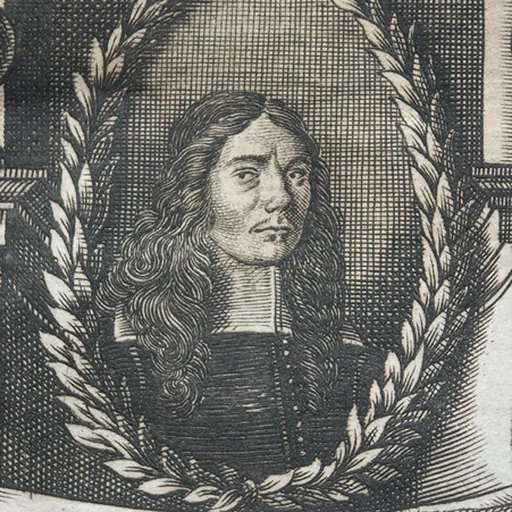
About Johann Sigismund Elsholtz
Lived 1623 – 1688 (aged 64). Johann Sigismund Elsholtz was a German botanist, physician, personal physician, naturalist and writer.
Johann Sigismund Elsholtz (26 August 1623 – 28 February 1688) (some sources mention his day of birth as 28 August, and his death on 19 February) was a German naturalist who was a native of Frankfurt an der Oder.
Biography Johann Sigismund Elsholtz studied at the Universities of Wittenberg, Königsberg and Padua, where he received his doctorate in 1653. He was appointed court botanist, alchemist and physician to Elector Friedrich Wilhelm of Brandenburg (1620-1688), and in 1657 was put in charge of Friedrich Wilhelm's botanical gardens at Berlin, Potsdam and Oranienburg.
In 1654, he published Anthropometria, an early study of anthropometry. This book was written for the benefit of artists and astrologers, as well as for students of medicine and physiognomy. It examines the perceived relationship between proportions of the human body and the incidence of disease.
Elsholtz was a pioneer in the fields of hygiene and nutrition, and in his writings on holistic health, he stressed the importance of clean air and water, healthy food and drink, and also personal cleanliness.
In his 1665 work Clysmatica nova, he investigated the possibilities of intravenous injection. He performed early research of blood transfusions and "infusion therapy", and speculated that a husband with a "melancholic nature" could be re-vitalized by the blood of his "vibrant wife", thus leading to a harmonious marriage.
The botanical genus Elsholtzia is named in his honor. This plant genus includes the species Elsholtzia ciliata.
Selected published works Published in Latin: "Flora Marchica", 1663. "Anthropometria, sive de mutua membrorum corporis humani proportione et nævorum harmonia libellus", 1663. "Clysmatica nova sive ratio qua in venam rectam medicamenta immitti possint", 1667. "Aurum Aurae, Vi Magnetismi universalis attractum per Inventorem anagrammatizomenum", (with Christian Adolf Balduin), 1674. "De phosphoris quatuor observationes", 1676. English translations: "The Curious Distillatory; Or the Art of Distilling Coloured Liquors, Spirits, Oyls...", translated into English by Thomas Shirley (1677). "Clysmatica Nova (1665): Elsholtz' Neglected Work on Intravenous Injection" (1933). "Clysmatica Nova", edited by John W. R. McIntyre; Iwanami Book Service Center, (1995).
Don’t just read it —
keep it.
Full-length biographies made to live with: read them, listen on the way to work, watch them tonight.
- E-book
- Audio
- Video
Instant download · yours to keep · every purchase keeps this site free
Important facts
People in Johann Sigismund Elsholtz's life
Named in this biography and alive at the same time

Related people
Same field, nearest in time




Contemporaries
People whose lives overlapped Johann Sigismund Elsholtz's




Frequently asked questions
Who was Johann Sigismund Elsholtz?
German naturalist and physician (1623-1688)
When was Johann Sigismund Elsholtz born?
Johann Sigismund Elsholtz was born on 26 August 1623 in Frankfurt (Oder).
When did Johann Sigismund Elsholtz die?
Johann Sigismund Elsholtz died on 28 February 1688 in Berlin.
What was Johann Sigismund Elsholtz's occupation?
Johann Sigismund Elsholtz was a botanist, physician, personal physician, naturalist and writer.
What nationality was Johann Sigismund Elsholtz?
Johann Sigismund Elsholtz was German.
Sources & further reading
· Wikipedia: Johann Sigismund Elsholtz
· DBpedia: Johann Sigismund Elsholtz
Cite this page
APA: Biography.guide. (2026). Johann Sigismund Elsholtz. https://biography.guide/johann-sigismund-elsholtz/
MLA: "Johann Sigismund Elsholtz." Biography.guide, https://biography.guide/johann-sigismund-elsholtz/.
Chicago: "Johann Sigismund Elsholtz." Biography.guide. https://biography.guide/johann-sigismund-elsholtz/.
Data last updated: 2026-09-22 · Spot an error? Report a correction.
Portrait: Wikimedia Commons · author & licence
Page generated 2026-09-27 05:01 UTC