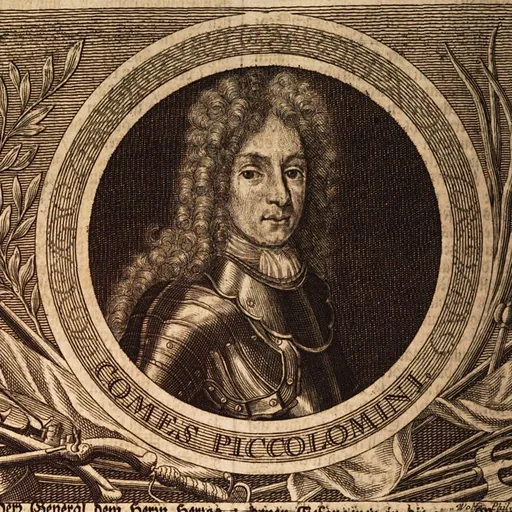
About Johann Norbert Piccolomini
Lived 1651 – 1689 (aged 37–38). Johann Norbert Piccolomini was a military personnel.
Enea Silvio Piccolomini (German: Johann Norbert Piccolomini; Papal States, c. 1650 – Prizren, Ottoman Empire, 9 November 1689) was a Sienese nobleman whose lineage included two popes, and who served in the Habsburg army of Leopold I, Holy Roman Emperor. He is known for leading a campaign against the Ottomans in Bosnia, Macedonia and Kosovo in 1689, and for setting fire to Skopje, the present day capital of the Republic of North Macedonia.
Origins Enea Silvio Piccolomini came from the long-established noble family Piccolomini, which included two popes: Pius II (born Enea Silvio Piccolomini) and Pius III (born Francesco Todeschini Piccolomini), as well as the Generalfeldmarschall Ottavio Piccolomini.
Early career Young nobles left Siena individually and contacted the important Italian lobby in Vienna, hoping to obtain junior positions in some German regiment. In February 1660 Enea Silvio also left Siena to look for a career in Vienna. Enea Silvio's father established him in an apartment in the imperial capital, with a page, two valets, and a groom for his horses, while the youngster sought audiences with the emperor Leopold I, empress, the archduke and important ministers on the credentials of his famous ancestors.
A breakthrough came when he managed to obtain a position in the regiment of the minister Count Rabassa. Enea Silvio's situation, like that of other young German and Italian officers, was precarious. When the emperor dissolved some of his regiments in October 1660, he narrowly escaped complete unemployment and was happy to be a simple comet in his patron's cavalry regiment.
He attempted to conquer the Ottoman territories of Kosovo, Bosnia and Macedonia. During the offensive, the city of Skopje, the present-day capital of the Republic of Macedonia, was plagued by epidemics of cholera. To prevent the outburst of the disease, or, by other accounts, to retaliate for the siege of Vienna, General Piccolomini ordered the city to be burned (see Fire of Skopje). He perished of the plague himself in Prizren on 9th of November 1689. He was buried in the main church of the city, in a ceremony conducted by Bogdani, who was then Archbishop of Skopje. After Piccolomini's death, leaderless, his army was defeated. Many of the Serbs fled into exile, led by the Patriarch Arsenije III Crnojević.
Don’t just read it —
keep it.
Full-length biographies made to live with: read them, listen on the way to work, watch them tonight.
- E-book
- Audio
- Video
Instant download · yours to keep · every purchase keeps this site free
Important facts
People in Johann Norbert Piccolomini's life
Named in this biography and alive at the same time

Related people
Same field, nearest in time




Contemporaries
People whose lives overlapped Johann Norbert Piccolomini's




Frequently asked questions
Who was Johann Norbert Piccolomini?
imperial general
When was Johann Norbert Piccolomini born?
Johann Norbert Piccolomini was born in 1651 in Siena.
When did Johann Norbert Piccolomini die?
Johann Norbert Piccolomini died on 9 November 1689 in Prizren.
What was Johann Norbert Piccolomini's occupation?
Johann Norbert Piccolomini was a military personnel.
Sources & further reading
· Wikipedia: Johann Norbert Piccolomini
· DBpedia: Enea Silvio Piccolomini (general)
Cite this page
APA: Biography.guide. (2026). Johann Norbert Piccolomini. https://biography.guide/johann-norbert-piccolomini/
MLA: "Johann Norbert Piccolomini." Biography.guide, https://biography.guide/johann-norbert-piccolomini/.
Chicago: "Johann Norbert Piccolomini." Biography.guide. https://biography.guide/johann-norbert-piccolomini/.
Data last updated: 2026-09-21 · Spot an error? Report a correction.
Portrait: Wikimedia Commons · author & licence
Page generated 2026-09-27 05:01 UTC