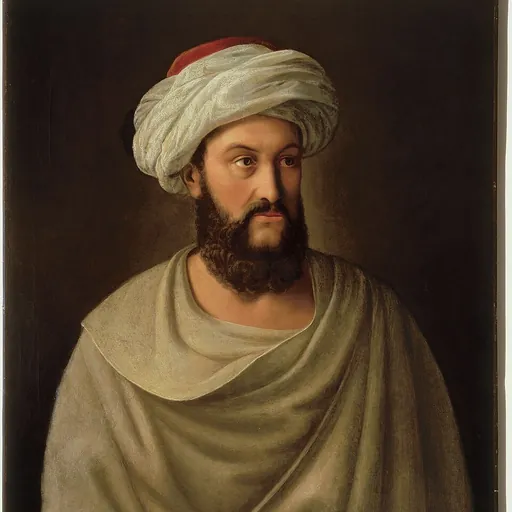
About Johann Ludwig Burckhardt
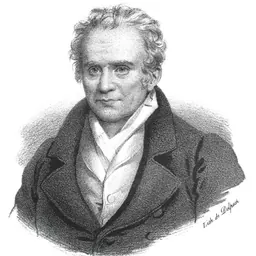
Lived 1784 – 1817 (aged 32). Johann Ludwig Burckhardt was a Swiss explorer, writer, art historian, archaeologist, geologist and intelligence officer.
Johann Ludwig (also known as John Lewis, Jean Louis) Burckhardt (; 24 November 1784 – 15 October 1817) was a Swiss traveller, geographer, and Orientalist. Burckhardt assumed the alias Sheikh Ibrahim Ibn Abdallah during his travels in Arabia. He wrote his letters in French and signed Louis. He is best known for rediscovering two of the world's most famous examples of rock-cut architecture – the ruins of the ancient Nabataean city of Petra in Jordan and the temples of Abu Simbel in Egypt.
Youth and early travels Burckhardt was born on 24 November 1784 in Lausanne, Switzerland to a wealthy Basel family of silk merchants, the Burckhardt family. His father was named Rudolf, son of Gedeon Burckhardt, an affluent silk ribbon manufacturer; his mother, Sara Rohner, was Rudolf's second wife following a brief marriage to the daughter of the mayor of Basel which ended in divorce.
After studying at the universities of Leipzig and Göttingen, he travelled to England in the summer of 1806 with goal of obtaining employment in the civil service. Unsuccessful, he took employment with the African Association with the objective of resolving some of the problems of the course of the Niger River. The expedition called for an overland journey from Cairo to Timbuktu. To prepare for the journey, he attended Cambridge University and studied Arabic, science and medicine. Once in Syria, he adopted the alias Sheikh Ibrahim Ibn Abdallah to hide his true European identity. While in Syria, he investigated local languages and archaeological sites and became the first European discoverer of Hittite or Luwian hieroglyphs. He suffered setbacks during his time in Syria having been robbed of his belongings more than once by people he had paid to guarantee his protection. After more than two years living and studying as a Muslim in Aleppo, he felt he could travel safely and not be questioned on his identity. To test his disguise, he made three journeys in the area of Syria, Palestine and Transjordan travelling as a poor Arab, sleeping on the ground and eating with camel drivers.
He could not remain long at the ruins or take detailed notes due to his fears of being unmasked as a treasure-seeking infidel. Seeing no evidence of the name of the ruins, he could only speculate that they were in fact the ruins of Petra which he had been informed about on his journey to Syria.
After crossing the Red Sea, he entered Jeddah on 18 July 1814 and became sick with dysentery for the first time in his travels. Here he proved his credentials as a Muslim and was permitted to travel to Mecca. He spent several months in Mecca performing the various rituals associated with the Hajj which was unheard of for a European. He wrote of his detailed observations of the city and the deportment and culture of the local inhabitants. His journals were a valuable source of information for the African explorer Richard Burton who also later travelled to Mecca a few decades later. He later made a side trip to Medina where he again became sick with dysentery and spent three months recovering. Departing Arabia, he arrived in a state of great exhaustion in the Sinai peninsula and travelled overland to Cairo, arriving on 24 June 1815.
Burckhardt spent the remaining two years of his life editing his journals and living modestly in Cairo while waiting and preparing for the caravan that would take him west across the Sahara to Timbuktu and the Niger river. He made a trip to Alexandria and another to Mount Sinai where he visited Saint Catherine's Monastery before returning to Cairo.
Publications His works were posthumously published by the African Association: Travels in Nubia (to which is prefixed a biographical memoir) (1819) Travels in Syria and the Holy Land (1822) Travels in Arabia (1829) Arabic Proverbs, or the Manners and Customs of the Modern Egyptians (1830) Notes on the Bedouins and Wahábys (1830).
Don’t just read it —
keep it.
Full-length biographies made to live with: read them, listen on the way to work, watch them tonight.
- E-book
- Audio
- Video
Instant download · yours to keep · every purchase keeps this site free
Important facts
People in Johann Ludwig Burckhardt's life
Named in this biography and alive at the same time
Related people
Same field, nearest in time



Contemporaries
People whose lives overlapped Johann Ludwig Burckhardt's



Frequently asked questions
Who was Johann Ludwig Burckhardt?
Swiss traveller and writer (1784-1817)
When was Johann Ludwig Burckhardt born?
Johann Ludwig Burckhardt was born on 24 November 1784 in Lausanne.
When did Johann Ludwig Burckhardt die?
Johann Ludwig Burckhardt died on 15 October 1817 in Cairo.
What was Johann Ludwig Burckhardt's occupation?
Johann Ludwig Burckhardt was an explorer, writer, art historian, archaeologist, geologist and intelligence officer.
What nationality was Johann Ludwig Burckhardt?
Johann Ludwig Burckhardt was Swiss.
Sources & further reading
· Wikipedia: Johann Ludwig Burckhardt
· DBpedia: Johann Ludwig Burckhardt
Cite this page
APA: Biography.guide. (2026). Johann Ludwig Burckhardt. https://biography.guide/johann-ludwig-burckhardt/
MLA: "Johann Ludwig Burckhardt." Biography.guide, https://biography.guide/johann-ludwig-burckhardt/.
Chicago: "Johann Ludwig Burckhardt." Biography.guide. https://biography.guide/johann-ludwig-burckhardt/.
Data last updated: 2026-09-20 · Spot an error? Report a correction.
Portrait: Wikimedia Commons · author & licence
Page generated 2026-09-27 04:58 UTC