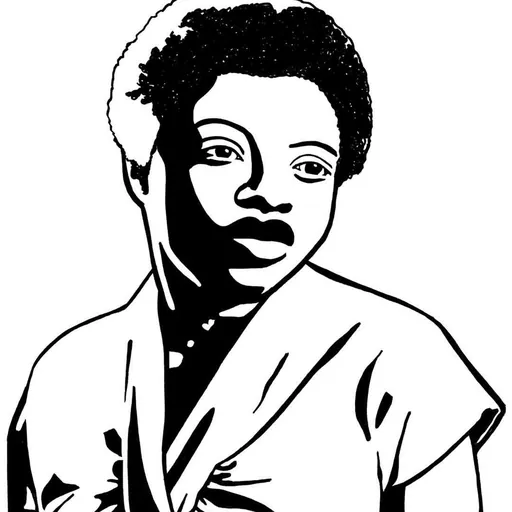
Joan Little
American acquitted of murder
About Joan Little
Born 1953.
Joan Little (pronounced "Jo Ann") (born May 8, 1954) is an African-American woman who was charged with the 1974 killing of Clarence Alligood, a white prison guard at Beaufort County Jail in Washington, North Carolina, who attempted to rape Little before she could escape. Her case became a cause célèbre of the civil rights, feminist, and anti-death penalty movements. Little was charged with murder in the death, but was later acquitted. She was the first woman in United States history to be acquitted of murder using the defense that she used deadly force to resist sexual assault. Her case also has become classic in legal circles as a pioneering instance of the application of scientific jury selection.
Early life Little was born and raised until age 15 in Washington, a town of under 10,000 in North Carolina's rural Atlantic coastal region. Her mother, Jessie Williams, was a "religious fanatic" who frequently consulted "root workers," or hoodoo folk healers. Her father was a security guard in Brooklyn, New York. The eldest of six blood siblings, she was forced to care for them and her four half-siblings as well. She took to running away and hiding and soon fell in with an older crowd who supported her rebellion. Her social worker, Jean Nelson, who once called her an "escape artist," also noted her intelligence, telling her "some day you could do a lot of good." As a teenager, she worked in the tobacco industry and as a waitress. In 1973, she went to work with a sheetrock finisher named Julius Rogers, whom she later accompanied to Greenville and subsequently to Chapel Hill, where she would become entangled with the law.
Criminality Little's problems with the law began in 1968, when her mother asked a judge to declare her a truant and to commit her to the Dobbs Farm Training School in Kinston, North Carolina. After a few weeks at Dobbs, Little fled, walking to a nearby service station, where she and a friend hitched a ride back to Washington. Her mother realized she had not been duly released and so sought to legitimize her daughter's situation by procuring an official release. She later sent Joan to live with relatives in Philadelphia. Three weeks after graduating from high school there, Joan developed a thyroid problem and returned to North Carolina for an operation. On January 3, 1974, she was arrested in Washington, North Carolina, for shoplifting. That charge, too, was dismissed. Six days later, she was again arrested for shoplifting, a charge for which she was given a six-month suspended sentence. Six days after her release, she was arrested yet again and charged with three separate counts of felony breaking and entering and larceny.
She returned to Washington in time for the trial, accompanied by Julius Rogers and two minors. The minors ended up in jail, where they were sexually harassed by a guard who offered them freedom if one would "give him some." Little was convicted on June 4, 1974, and asked to remain in the county jail rather than be transferred to the Correctional Facility for Women in Raleigh, as would have been customary. Serving her time in Washington, she said, would allow her to stay close to home, where she could work on raising her bond. She turned herself in to North Carolina authorities more than one week later, and said that she had killed Alligood while defending herself against sexual assault.
During the subsequent trial, the defense would present testimony from several former inmates who testified that Alligood had a history of using his authority to elicit sexual favors from female prisoners. Witnesses, including Phyllis Ann Moore and Ida Mae Roberson, testified that Alligood frequently provided inmates with small "gifts," such as snacks, cigarettes, and magazines, with the expectation of receiving sexual acts in return. Jerry Paul and Karen Bethea-Shields (Karen Galloway) were her attorneys. The question of whether or not Black people were treated equally by the criminal justice systems in the American South drew the attention of the national media.
When the autopsy came back, it was concluded that Little's explanation of the incident was true. The autopsy concluded that the eleven stab wounds given to Alligood were in self-defense. Only one stab had been a fatal one, while the other ten were clear signs of self-defense against an attacker. Among them were Jennie Lancaster, Pecola Jones, and 26-year-old jury spokesperson Mark Neilsen. Little broke down in sobs upon hearing the verdict.
Jerry Paul had Joan Little walk around in front of the media with the book To Kill a Mockingbird in order to encourage comparisons between her and Tom Robinson, the imprisoned Black man of the novel.
The Free Joan campaigns were successful enough that Joan's counsel were able to get the first degree murder charge reduced to second degree murder. Judge Hamilton H. Hobgood noted that the prosecution did not have liable evidence. Others who took part in Little's case included Maulana Karenga (Ron Karenga); Ralph Abernathy, who spoke during a protest outside Beaufort County courthouse; Bernice Johnson Reagon, who contributed to funding support for Ms. Little; and Dr. Larry Little, a Black Panther Party leader (Winston-Salem chapter), who stood by Little's side and was vocal in his concerns about the trial and about subjects that weren't well covered during the trial.
During the Little trial, other women came forward to testify about Alligood's history of sexual assault in prison, including African-American women Ida Mae Roberson and Phyllis Ann Moore. Their testimony encouraged Little's jury to lean toward her defense.
"Free Joan Little" was a slogan that activists used in order to raise awareness of her situation and try to get her released. It was said that without the funding and activists' support, Joan Little would possibly be serving a death sentence.
The trial became a globally known case, with observers split between those who believed her to be guilty and those who did not. Those standing behind her saw a woman who was a victim of racism and sexism, and was vulnerable because she was the only female prisoner at the Beaufort jail during that time. Those who thought of her as being guilty saw her as luring Alligood into her cell with ideas of sex and killing him in order to escape the prison.
Later life In 1981, Little was shot in New York, but later recovered from her injuries. A month before the shooting, she had found the message "Death to Joan" scrawled on a mirror in her Brooklyn apartment. After this incident, she moved to a different apartment.
In 1989, Little was arrested in New Jersey on charges including driving a stolen car. She telephoned William Kunstler, who had assisted her in the past, for help. She had returned to New York a free woman but at 34 years old, accompanied by a male, she was pulled over for driving a car with missing front license plate and stolen back license plate, as well as additional charges. She remained the night at the Hudson County jail.
Since the 1989 arrest, Little has disappeared from public view, though as of April 2026 she is still alive.
Don’t just read it —
keep it.
Full-length biographies made to live with: read them, listen on the way to work, watch them tonight.
- E-book
- Audio
- Video
Instant download · yours to keep · every purchase keeps this site free
Important facts
People in Joan Little's life
Named in this biography and alive at the same time






Contemporaries
People whose lives overlapped Joan Little's

Frequently asked questions
Who is Joan Little?
American acquitted of murder
When was Joan Little born?
Joan Little was born in 1953 in Washington.
Sources & further reading
Cite this page
APA: Biography.guide. (2026). Joan Little. https://biography.guide/joan-little/
MLA: "Joan Little." Biography.guide, https://biography.guide/joan-little/.
Chicago: "Joan Little." Biography.guide. https://biography.guide/joan-little/.
Data last updated: 2026-09-23 · Spot an error? Report a correction.
Portrait: Wikimedia Commons · author & licence
Page generated 2026-09-27 05:08 UTC