
About Joan Lamote de Grignon
Lived 1872 – 1949 (aged 76). Joan Lamote de Grignon was a Spanish conductor, composer and pianist.
Joan Lamote de Grignon i Bocquet (; 7 July 1872 – 11 March 1949) was a Catalan Spanish pianist, composer and orchestra director.
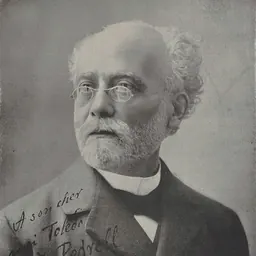
Life Joan Lamote de Grignon was born and died in Barcelona, the son of parents of French descent, Lluis Lamote de Grignon and Elena Bocquet. He studied with Felip Pedrell in Barcelona. In 1911 he founded the Barcelona Symphony Orchestra, of which he was also music director. He directed the Berlin Philharmonic Orchestra. He was the successor of Celestí Sadurní in directing the Municipal Band of Barcelona in 1914, from where he promoted young performers and provided the Band with an acknowledged repertoire. Three years later he was appointed director of the Conservatory of the Gran Teatre del Liceu of Barcelona. In 1943 he founded the Valencia Municipal Orchestra, which he directed until 1949.
His compositions, including transcriptions and arrangements, comprise some 150 songs, the oratorio La nit de Nadal(1906), the lyric drama Hespèria(1907), a symphonic trilogy, a symphony, a Missa eucarística for two voices and organ, motets and spiritual songs, and El parc d'atraccions for piano. He also wrote various sardanes for cobla and helped to found the band Cobla Barcelona.
His son Ricard Lamote de Grignon followed in his father's footsteps as a composer and orchestra director. Ricard worked alongside him as assistant director of the newly created València Municipal Orchestra.
The archive of the Lamote de Grignon family, with works by Joan and his son Ricard, is at the document repository of the Generalitat of Catalunya and may be studied in the Biblioteca de Catalunya.
He died 1949 and was buried in the Sant Gervasi Cemetery, Barcelona.
Music Lamote's compositions include about 150 songs, the oratorio La nit de Nadal (Christmas Night) (1906), the lyric drama Hespèria (1907), a symphonic trilogy, one symphony, a Mass for two voices and organ, motets and spiritual songs. There are also works for orchestra with voice, lieder and songs, scenic music, voice and piano, sardanes for cobla, and transcriptions for band.
Sardanes for cobla: Solidaritat de flors (1907), La Rosa del folló (1908) and El Testament de n'Amèlia (1909). His fourth and last sardana, Florida (1916), was for cobla and men's voices, written for a choir at the Orfeó Gracienc in Barcelona.
Recordings Songs of Joan and Ricard Lamote de Grignon
Don’t just read it —
keep it.
Full-length biographies made to live with: read them, listen on the way to work, watch them tonight.
- E-book
- Audio
- Video
Instant download · yours to keep · every purchase keeps this site free
Important facts
Family & relationships
People in Joan Lamote de Grignon's life
Named in this biography and alive at the same time
Related people
Same field, nearest in time



Contemporaries
People whose lives overlapped Joan Lamote de Grignon's


Frequently asked questions
Who was Joan Lamote de Grignon?
Catalan pianist, conductor and composer (1872-1949)
When was Joan Lamote de Grignon born?
Joan Lamote de Grignon was born on 7 July 1872 in Barcelona.
When did Joan Lamote de Grignon die?
Joan Lamote de Grignon died on 11 March 1949 in Barcelona.
What was Joan Lamote de Grignon's occupation?
Joan Lamote de Grignon was a conductor, composer and pianist.
What nationality was Joan Lamote de Grignon?
Joan Lamote de Grignon was Spanish.
Sources & further reading
· Wikipedia: Joan Lamote de Grignon
· DBpedia: Joan Lamote de Grignon
Cite this page
APA: Biography.guide. (2026). Joan Lamote de Grignon. https://biography.guide/joan-lamote-de-grignon/
MLA: "Joan Lamote de Grignon." Biography.guide, https://biography.guide/joan-lamote-de-grignon/.
Chicago: "Joan Lamote de Grignon." Biography.guide. https://biography.guide/joan-lamote-de-grignon/.
Data last updated: 2026-09-22 · Spot an error? Report a correction.
Page generated 2026-09-27 05:27 UTC