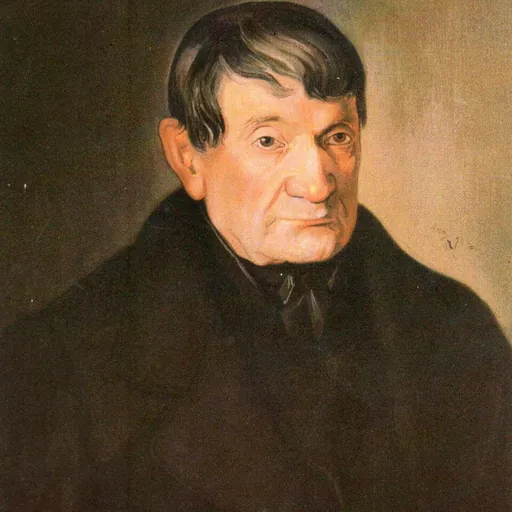
About Joakim Vujić
Lived 1772 – 1847 (aged 75). Joakim Vujić was a Serbian writer, playwright, actor, traveler and dramatist.
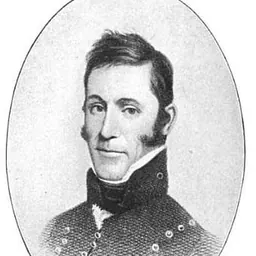
Joakim Vujić (; 1772–1847) was a Serb writer, dramatist (musical stage and theatre), actor and traveler. He was one of the most accomplished Serbian dramatists and writers at the end of the 18th- and beginning of the 19th century. He was the first director of the Princely Serbian Theatre in Kragujevac founded in 1835. He is known as the Father of Serbian Theatre.
Biography Vujić was born on 9 September 1772 in Baja (now in Hungary), at that time a small Serb-inhabited town in the Habsburg monarchy situated on the bank of the Danube, an area of the Pannonian Plain known as "Rascia". His family hailed from southern Serbia and had fled during wars with the Ottoman Empire. Vujić was educated in Baja, first in the Serbian school, and then Latin, German, and Hungarian schools. He was further educated in Novi Sad, Kalocsa, and the Evangelical Lyceum in Bratislava. He became a teacher, primarily of foreign languages. He was a supporter of the Enlightenment and was a follower of Dositej Obradović, whom he met personally in Trieste's Serb community before Dositej left for Revolutionary Serbia.
Vujić had a feud with archpriest Mihailo Pejić, that began in Zemun in 1809; Vujić was incarcerated for several months and he blamed Pejić who had allegedly accused him of being "a state enemy" of the Austrian monarchy. There were no proof that Pejić was the cause of his arrest.
His career as a dramatic author began with the exhibition of a drama in or about the year 1813 and continued for almost thirty years. Before 1813, he incurred the hostility of the Austrian authorities, especially, it is said, of the Habsburgs, by the attacks which he made upon them on the stage in Zemun, and at their instance, he was imprisoned for a while. After writing a play during his imprisonment, in which he is said to have recanted, he was freed. His many travels and literary accomplishments established his influence in the new Serbian capital—Kragujevac—once and for all and at the same time knitted him closely to Prince Miloš, who recognized in him a man after his own heart, and made him the knaževsko-srbskog teatra direktor, the director of the Royal Serbian Theatre.
He made several voyages to the Black Sea and different places in southern Russia before returning to Serbia in 1842, where he died on 8 November 1847.
Joakim Vujić was a polyglot and spoke Italian, German, French, English, Hungarian, as well as Greek and Latin. He also learned some Hebrew.
Work
He was one of the most productive Serbian writers of his time and left about fifty works, slightly more than half being published. At least one manuscript was destroyed during the World War II Bombing of Belgrade. He translated and adapted dramatic works (from German and Hungarian), wrote travel books, geographical textbooks, and translated novels. He compiled the first French grammar in the Serbian language (1805). He wrote in the so-called Slavo-Serbian language, a variant very close to the language of the people. Many Serbs subscribed to his publications, and he was, together with novelist Milovan Vidaković, one of the most widely read Serbian authors of his time. As such, he exercised a considerable influence on the broadening of the reading public among the Serbs. He seems to have also been among the first Serbian writers of travel books, for he began to write his first travel account as early as 1803 while touring Italy. His more important books of this kind are Travels in Serbia (1828) and Travels in Hungary, Wallachia, and Russia (1845). His famous autobiography – My Life—was also written in the form of a travel book.
Vujić lived and wrote in the time of the French Revolution (1789). He was a witness of the Napoleonic Wars, the Serbian Revolution, the actions of the Holy Alliance, and other great events in Europe in the period between the two revolutions (1789–1848): He wrote at the time of the national awakening in the Balkans. In his writings and theatrical work, he propagated progressive views, liberty, human rights, ethical ideas, and international cooperation. Although he was an Austrian subject, he was determined to serve Serbia as an intellectual and patriot.
Vujić is best known and most esteemed for his work in theatre. He organized stage performances in the Serb community of the Habsburg monarchy and in the Principality of Serbia. There were Serb theatrical companies at the time in Novi Sad, Pančevo, Kikinda, Sombor, and other places in Vojvodina. He was the first director of the Princely Serbian Theatre in Kragujevac founded in 1835. He is known as the Father of Serbian Theatre. Vujić was the organizer of the first theatrical performance in Serbian, which took place in the Hungarian theatre "Rondella" in Budapest on 24 August 1813. Španjoli u Peruviji ili Rolova smert, 1812 Nabrežnoje pravo, 1812 Žertva smerti, 1812 Sibinjska šuma, 1820 Negri ili Ljubov ko sočolovjekom svojim, 1821 Preduvjerenije sverhu sostojanija i roždenija, 1826 Dobrodeljni derviš ili Zveketuša kapa, 1826 Sestra iz Budima ili Šnajderski kalfa, 1826 Paunika Jagodinka, 1832 La Pejruz ili Velikodušije jedne divje, 1834 Ljubovna zavist črez jedne cipele, 1805 Stari vojak, 1816 Kartaš, 1821 Devojački lov 1826 Obručenije ili Djetska dolžnost sverhu ljubve, 1826 Svake dobre vešči jesu tri, 1826 Siroma stihotvorac, 1826 Seliko i Beriza ili LJubav izmeždu Negri, 1826 Siroma tamburdžija, 1826 Serbska princeza Anđelija, 1837 Djevica iz Marijenburga, 1826 Znajemi vampir, 1812
Legacy Soon after World War II and the formation of socialist Yugoslavia, the Yugoslav dramatic heritage was made an object of study in the newly established Academies for Theatre Arts in Belgrade, Zagreb, and Ljubljana. The events of 1948 contributed further to this search for cultural identity. The well-known production "The Theatre of Joakim Vujić", first shown in the vanguard theatre "Atelje 212" in Belgrade on 13 November 1958 (produced by Vladimir Petrić and directed by Josip Kulundžić, the founder of the Department of Dramaturgy in the Academy for Theatre Arts in Belgrade) marked not only the return of Vujić's works to the Serbian stage but also his artistic and personal rehabilitation.
Don’t just read it —
keep it.
Full-length biographies made to live with: read them, listen on the way to work, watch them tonight.
- E-book
- Audio
- Video
Instant download · yours to keep · every purchase keeps this site free
Important facts
People in Joakim Vujić's life
Named in this biography and alive at the same time
Related people
Same field, nearest in time




Contemporaries
People whose lives overlapped Joakim Vujić's




Frequently asked questions
Who was Joakim Vujić?
Serbian writer (1772-1847)
When was Joakim Vujić born?
Joakim Vujić was born on 20 September 1772 in Baja.
When did Joakim Vujić die?
Joakim Vujić died on 20 November 1847 in Belgrade.
What was Joakim Vujić's occupation?
Joakim Vujić was a writer, playwright, actor, traveler and dramatist.
What nationality was Joakim Vujić?
Joakim Vujić was Serbian.
Sources & further reading
Cite this page
APA: Biography.guide. (2026). Joakim Vujić. https://biography.guide/joakim-vujic/
MLA: "Joakim Vujić." Biography.guide, https://biography.guide/joakim-vujic/.
Chicago: "Joakim Vujić." Biography.guide. https://biography.guide/joakim-vujic/.
Data last updated: 2026-09-23 · Spot an error? Report a correction.
Portrait: Wikimedia Commons · author & licence
Page generated 2026-09-27 05:07 UTC