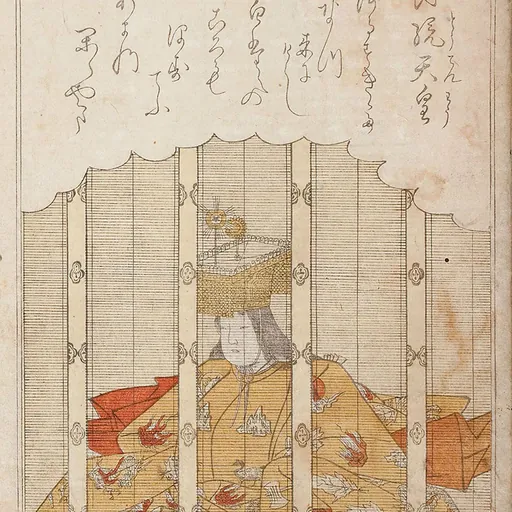
About Jitō
Lived 645 – 703 (aged 57–58). Jitō was a Japanese poet, writer, urban planner, waka poet and politician.
was the 41st monarch of Japan, according to the traditional order of succession.
Jitō's reign spanned the years from 686 through 697.
In the history of Japan, Jitō was the third of eight women to take on the role of empress regnant. The two female monarchs before Jitō were Suiko and Kōgyoku/Saimei. The five women sovereigns reigning after Jitō were Genmei, Genshō, Kōken/Shōtoku, Meishō, and Go-Sakuramachi.
Traditional narrative
Empress Jitō was the daughter of Emperor Tenji. Her mother was Ochi-no-Iratsume, the daughter of Minister Ō-omi Soga no Yamada-no Ishikawa Maro. She was the wife of Tenji's full brother Emperor Tenmu, whom she succeeded on the throne.
Empress Jitō's given name was , or alternatively Uno.
Events of Jitō's reign Jitō took responsibility for court administration after the death of her husband, Emperor Tenmu, who was also her uncle. She acceded to the throne in 687 in order to ensure the eventual succession of her son, Kusakabe-shinnō. Throughout this period, Empress Jitō ruled from the Fujiwara Palace in Yamato. in 690 at enthronement she performed special ritual then gave pardon and in 692 she travelled to Ise against the counsel of minister Miwa-no-Asono-Takechimaro.
Prince Kusakabe was named as crown prince to succeed Jitō, but he died at a young age. Kusakabe's son, Karu-no-o, was then named as Jitō's successor. He eventually would become known as Emperor Monmu. Empress Genmei, who was followed on the throne by her daughter, Empress Genshō, remains the sole exception to this conventional argument.
In 697, Jitō abdicated in Monmu's favor; and as a retired sovereign, she took the post-reign title daijō-tennō. After this, her imperial successors who retired took the same title after abdication.
Kugyō Kugyō (公卿) is a collective term for the very few most powerful men attached to the court of the Emperor of Japan in pre-Meiji eras.
In general, this elite group included only three to four men at a time. These were hereditary courtiers whose experience and background would have brought them to the pinnacle of a life's career. During Jitō's reign, this apex of the Daijō-kan included: Daijō-daijin, Takechi-shinnō (the 3rd son of Emperor Tenmu)
JapaneseRōmajiEnglishやすみしし 我が大君の 夕されば 見したまふらし 明け来れば 問ひたまふらし 神岳の 山の黄葉を 今日もかも 問ひたまはまし 明日もかも 見したまはまし その山を 振り放け見つつ 夕されば あやに悲しみ 明け来れば うらさび暮らし 荒栲の 衣の袖は 干る時もなしYasumishishi waga ōkimi no Yū sareba meshita furashi Akekureba toita furashi Kamuoka no yama no momichi to Kyō mo ka mo toita mawamashi Asu mo ka mo meshita mawamashi Sono yama o furisakemitsutsu Yū sareba aya ni kanashimi Akekureba Urasabikurashi Aratae no Koromo no sode wa Furu toki mo nashiOh, the autumn foliage Of the hill of Kamioka! My good Lord and Sovereign Would see it in the evening And ask of it in the morning. On that very hill from afar I gaze, wondering If he sees it to-day, Or asks of it to-morrow. Sadness I feel at eve, And heart-rending grief at morn— The sleeves of my coarse-cloth robe Are never for a moment dry.
One of the poems attributed to Empress Jitō was selected by Fujiwara no Teika for inclusion in the very popular anthology Hyakunin Isshu:
Japanese Rōmaji English 春過ぎて 夏来にけらし 白妙の 衣干すてふ 天の香具山Haru sugite Natsu kinikerashi Shirotae no Koromo hosu chō Ama no KaguyamaThe spring has passed And the summer come again For the silk-white robes So they say, are spread to dry On Mount Kaguyama
Don’t just read it —
keep it.
Full-length biographies made to live with: read them, listen on the way to work, watch them tonight.
- E-book
- Audio
- Video
Instant download · yours to keep · every purchase keeps this site free
Important facts
Family & relationships
People in Jitō's life
Named in this biography and alive at the same time
Related people
Same field, nearest in time

Contemporaries
People whose lives overlapped Jitō's


Frequently asked questions
Who was Jitō?
Empress of Japan (645-703)
When was Jitō born?
Jitō was born in 645.
When did Jitō die?
Jitō died on 13 January 703 in Fujiwara-kyō.
What was Jitō's occupation?
Jitō was a poet, writer, urban planner, waka poet and politician.
What nationality was Jitō?
Jitō was Japanese.
Sources & further reading
Cite this page
APA: Biography.guide. (2026). Jitō. https://biography.guide/jito-poet/
MLA: "Jitō." Biography.guide, https://biography.guide/jito-poet/.
Chicago: "Jitō." Biography.guide. https://biography.guide/jito-poet/.
Data last updated: 2026-09-23 · Spot an error? Report a correction.
Portrait: Wikimedia Commons · author & licence
Page generated 2026-09-27 05:07 UTC