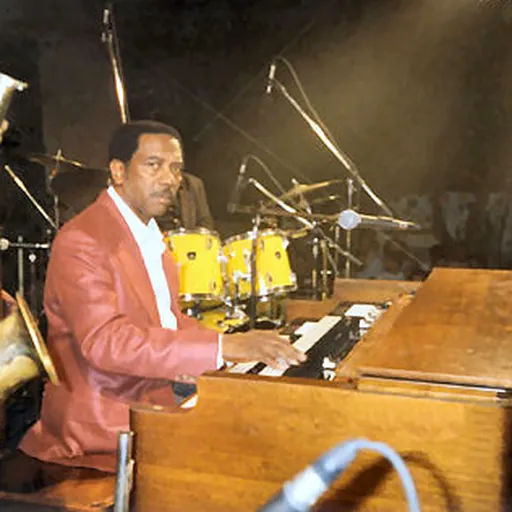
About Jimmy Smith
Lived 1925 – 2005 (aged 79). Jimmy Smith was an American organist, pianist, jazz musician, recording artist and composer.
James Oscar Smith (December 8, 1928 – February 8, 2005 ) was an American jazz musician who helped popularize the Hammond B-3 organ, creating a link between jazz and 1960s soul music.
In 2005, Smith was awarded the NEA Jazz Masters Award from the National Endowment for the Arts, the highest honor that America bestows upon jazz musicians.
Early years James Oscar Smith was born in Norristown, Pennsylvania, northwest of Philadelphia. He joined his father doing a song-and-dance routine in clubs at the age of six. He began teaching himself to play the piano. When he was nine, Smith won a Philadelphia radio talent contest as a boogie-woogie pianist. After a period in the U.S. Navy, he began furthering his musical education in 1948, with a year at Royal Hamilton College of Music, then the Leo Ornstein School of Music in Philadelphia in 1949. He began exploring the Hammond organ in 1951. From 1951 to 1954, he played piano, then organ in Philly R&B bands like Don Gardner and the Sonotones. He switched to organ permanently in 1954 after hearing Wild Bill Davis play.
Career Smith purchased his first Hammond organ, rented a warehouse to practice in, and emerged after little more than a year. Upon hearing him playing in a Philadelphia club, Blue Note's Alfred Lion immediately signed Smith to the label. His second album, The Champ, quickly established Smith as a new star on the jazz scene. He was a prolific recording artist and, as a leader, dubbed The Incredible Jimmy Smith, recorded around 40 sessions for Blue Note in just eight years beginning in 1956. Albums from this period include The Sermon!, House Party, Home Cooking', Midnight Special, Back at the Chicken Shack and Prayer Meetin'. The Jimmy Smith Trio performed "When Johnny Comes Marching Home" and "The Sermon" in the film Get Yourself a College Girl (1964).
In the 1970s, Smith opened his own supper club in the North Hollywood neighborhood of Los Angeles, California, at 12910 Victory Boulevard and played there regularly with Kenny Dixon on drums, Herman Riley and John F. Phillips on saxophone; also included in the band was harmonica/flute player Stanley Behrens. The 1972 album Root Down, considered a seminal influence on later generations of funk and hip-hop musicians, was recorded live at the club, albeit with a different group of backing musicians.
Later career Holle Thee Maxwell, then known as Holly Maxwell, was Smith's vocalist for two years in the late 1970s. During a South African tour, they recorded the album Jimmy Smith Plays for the People in 1978.
Smith had a career revival in the 1980s and 1990s, again recording for Blue Note and Verve, and for Elektra and Milestone. However, before the tour began, Smith died on February 8, 2005, at his Scottsdale home, where he was found by his manager, Robert Clayton. He died in his sleep of natural causes.
Musical style
While the electric organ had been used in jazz by Fats Waller, Count Basie, Wild Bill Davis and others, Smith's virtuoso improvisation technique on the Hammond helped to popularize the electric organ as a jazz and blues instrument. Later, Smith influenced bands such as Medeski, Martin & Wood and the Beastie Boys, who sampled the bassline from "Root Down (and Get It)" from Root Down—and saluted Smith in the lyrics—for their own hit "Root Down". Often called the father of acid jazz, Smith lived to see that movement come to reflect his organ style. In the 1990s, Smith went to Nashville, taking a break from his ongoing gigs at his Sacramento restaurant, which he owned, and in Music City, Nashville, with the help of a webmaster he produced Dot Com Blues, his last Verve album. In 1999, Smith guested on two tracks of a live album, Incredible! (Smith's nickname during the 1960s) with his protégé, Joey DeFrancesco, a then 28-year-old organist. Smith and DeFrancesco's collaborative album Legacy was released in 2005 shortly after Smith's death.
Discography
Don’t just read it —
keep it.
Full-length biographies made to live with: read them, listen on the way to work, watch them tonight.
- E-book
- Audio
- Video
Instant download · yours to keep · every purchase keeps this site free
Important facts
People in Jimmy Smith's life
Named in this biography and alive at the same time







Related people
Same field, nearest in time


Contemporaries
People whose lives overlapped Jimmy Smith's

Frequently asked questions
Who was Jimmy Smith?
American jazz organist
When was Jimmy Smith born?
Jimmy Smith was born on 8 December 1925 in Norristown.
When did Jimmy Smith die?
Jimmy Smith died on 8 February 2005 in Phoenix, Scottsdale.
What was Jimmy Smith's occupation?
Jimmy Smith was an organist, pianist, jazz musician, recording artist and composer.
What nationality was Jimmy Smith?
Jimmy Smith was American.
Sources & further reading
· DBpedia: Jimmy Smith (musician)
Cite this page
APA: Biography.guide. (2026). Jimmy Smith. https://biography.guide/jimmy-smith/
MLA: "Jimmy Smith." Biography.guide, https://biography.guide/jimmy-smith/.
Chicago: "Jimmy Smith." Biography.guide. https://biography.guide/jimmy-smith/.
Data last updated: 2026-09-23 · Spot an error? Report a correction.
Portrait: Wikimedia Commons · author & licence
Page generated 2026-09-27 05:06 UTC