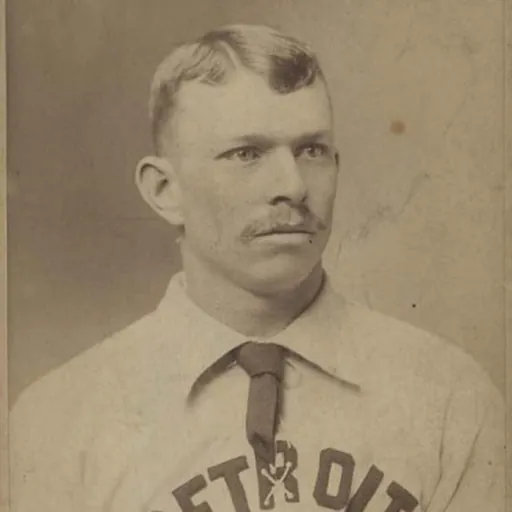
About Jim Manning
Lived 1862 – 1929 (aged 67). Jim Manning was an American baseball player.
James Henry Manning (January 31, 1862 – October 22, 1929) was an American professional baseball player, manager, executive and team owner. He played five seasons in Major League Baseball, primarily as an outfielder (261 games), but also as a second baseman (72 games), shortstop (35 games), and third baseman (four games). He played four years in the National League with the Boston Beaneaters (1884–85) and the Detroit Wolverines (1885–87). He also played professional baseball in Kansas City, Missouri, primarily as a second baseman, from 1887 to 1892 and 1894 to 1897, including one year in the American Association with the Kansas City Cowboys.
Manning was one of the three principal organizers of the Western League in 1893 and was the owner and manager of the Kansas City Cowboys/Blues from 1894 to 1900. He was also one of the principal organizers of the American League and the first owner and manager of the Washington Senators when his Kansas City club moved to Washington, D.C. in 1901. He was also the player-manager of the Birmingham Grays in 1892, the owner, manager and second baseman of the Savannah, Georgia baseball club in 1893, and the owner and president of the Kansas City Blue Stockings club in the Western League from 1902 to 1903.
Early years Manning was born in Fall River, Massachusetts, in 1862. His parents, Thomas and Catherine Manning, were immigrants from Ireland. His father worked as a common laborer. Manning had three younger sisters, Julia, Elizabeth and Mary. In May 1887, the Wolverines sent their "extra men" (Manning and Knowlton) to the Kansas City Cowboys in order to relieve the club of salary obligations for players it did not need. Manning played in Kansas City for the next two months of the 1887 season, but Detroit reclaimed Manning in July, after an injury to second baseman Fred Dunlap. Manning appeared in only 13 games for the 1887 Wolverines, 10 in the outfield and three at shortstop, compiling a .192 batting average.
Kansas City, Part I
Manning spent all or parts of six seasons with the Kansas City Cowboys from 1887 to 1892. He was acquired from Detroit in the middle of May 1887, and by the middle of July, Manning was referred to in The Sporting Life as "the best and most popular player that ever wore a Kansas City uniform." Manning compiled a career high .433 batting average in 381 at bats for the 1887 Cowboys.
In 1888, Kansas City had two rival baseball teams, both called the Cowboys, with one playing in the American Association, and the other playing in the Western Association. Manning was player-manager of the Cowboys in the Western Association during the 1888 season. He hit .289 and stole 101 bases in 116 games.
During the 1889 season, Manning joined the Cowboys of the American Association, considered a major league. Manning appeared in 132 games, 69 in the outfield and 63 at second base, and compiled a .204 batting average in 506 at bats. In fact, Manning was not the offensive liability that his batting average might suggest; he drew 54 bases on balls and was hit by pitch 13 times to boost his on-base percentage to .297, and he also stole 58 bases during the 1889 season. Manning had the best base-stealing record in organized baseball during the 1890 season, stealing 96 bases in only 111 games.
In 1891, Manning managed the club, played second base, and hit .299 with 10 triples and 58 stolen bases in 116 games. During the first half of the 1892 season, Manning hit .303 with 30 stolen bases in 62 games. He compiled a .268 batting average in 38 games for Birmingham,
Savannah In 1893, Manning was a player-manager and owner of the Savannah, Georgia club in the 12-team Southern Base Ball League. He played second base for the team and compiled a .290 batting average in 89 games. Despite the league's failure, the Savannah club made money and paid its bills on time, and Manning left in late August with a profit estimated at $4,000.
Kansas City, Part II In the fall of 1893, Manning was one of the three principal organizers, along with Charlie Cushman and John S. Barnes, of the new Western League (a league that was later renamed the American League in 1900). In September 1893, he visited Kansas City to lay the groundwork for establishing a new baseball club there, including securing an option for the Exposition baseball grounds. The Kansas City Journal at the time called Manning "the most popular ball player who ever wore a Kansas City uniform." Manning told the press in Kansas City, "I spent six years here. Kansas City is like home to me ... If I put a new team here next year, as I hope to, it will be a winner, for that is what this town wants and what it demands." Manning also stated that he would staff the new Kansas City Cowboys teams largely with the players who he had managed in Savannah in 1892. as Manning continued as owner and manager of the Kansas City Cowboys. He also appeared in 121 games as the team's second baseman and compiled a .359 batting average with 44 extra base hits and 39 stolen bases in 1895.
In December 1895, Manning and Frank Selee organized a tour of baseball players to Australia for the winter of 1896–1897.
Manning continued to serve as team owner, manager and second baseman in 1896. Although he did not continue as a player after the 1897 season, he continued as the owner and manager of the Kansas City club through the 1900 season.
During Manning's seven years as manager and owner of the Kansas City Blues, the team's record was as follows:
YearRecordFinish 1894 68-59 3rd 1895 73-52 3rd 1896 69-66 5th 1897 40-99 7th 1898 88-51 1st 1899 53-70 7th (t) 1900 69-70 5th
Washington Manning was also one of the organizers of the American League as a competing major league. The organizational meeting was held at Chicago in late November 1900, with Manning attending as the representative of the proposed club in Washington, D.C., along with Charles Comiskey of Chicago, John McGraw of Baltimore, James D. Burns of Detroit and Henry Killilea of Milwaukee.
In late 1900, Manning became president of the new American League club proposed for Washington, D.C. In December 1900, he secured a 10-year option on two ballparks in Washington and planned his move from Kansas City to Washington. In March 1901, the new team, named the Washington Senators, was incorporated by Manning, Fred Postal, Bob Needham, John J. Hogan and William F. Hart.
In 1901, Manning served as the first manager of the Senators, leading team to a 61–73 record. In November 1901, Manning sold his interest in the Senators to Fred Postal and also resigned as the team's manager. Later reports attributed Manning's departure to differences with co-owner Postal, who was not satisfied with Manning's business management, though Manning's defenders noted that Manning had "never posed as an expert book keeper, and was not originally engaged for business roles, and that point would have no bearing upon his re-engagement as team manager."
Kansas City, Part III In January 1902, after selling his interest in the Senators, Manning and Kid Nichols became partners and co-owners in the new Kansas City Blue Stockings baseball club in the Western League. Through the 1902 and 1903 seasons, Manning served as the club's president and Nichols the manager. Manning's club faced stiff competition from the Kansas City Blues baseball club in the American Association during the 1902 and 1903 season and folded after the 1903 season due to territorial rights.
Family and later years Through his baseball career, Manning had returned home to Fall River, Massachusetts, where he worked as a druggist in a store operated by Will Smith. Smith died suddenly in September 1894, and The Sporting News wrote at the time: "For years Manager Manning has had that blessing that comes to so few -- a true friend. This friend, Mr. Will Smith, of Fall River, Mass., has been the sharer of all his hopes, his joy and his reverses. It was with him Manning made his first start in life, and every fall since he has been a devotee of the diamond he has returned home to again take up his work with Mr. Smith."
After retiring from baseball, Manning was employed in the powder business in 1906. The following year, he was reported to be "prospering in business in Kansas City."
In 1929, Manning died at age 67 in either Mercedes, Texas, or Edinburg, Texas. He was buried at the North Burial Ground in Fall River, Massachusetts.
Don’t just read it —
keep it.
Full-length biographies made to live with: read them, listen on the way to work, watch them tonight.
- E-book
- Audio
- Video
Instant download · yours to keep · every purchase keeps this site free
Important facts
People in Jim Manning's life
Named in this biography and alive at the same time





Related people
Same field, nearest in time
Contemporaries
People whose lives overlapped Jim Manning's




Frequently asked questions
Who was Jim Manning?
American baseball player and manager (1862-1929)
When was Jim Manning born?
Jim Manning was born on 31 January 1862 in Fall River.
When did Jim Manning die?
Jim Manning died on 22 October 1929 in Edinburg.
What was Jim Manning's occupation?
Jim Manning was a baseball player.
What nationality was Jim Manning?
Jim Manning was American.
Sources & further reading
· DBpedia: Jim Manning (baseball, born 1862)
Cite this page
APA: Biography.guide. (2026). Jim Manning. https://biography.guide/jim-manning-baseball-player/
MLA: "Jim Manning." Biography.guide, https://biography.guide/jim-manning-baseball-player/.
Chicago: "Jim Manning." Biography.guide. https://biography.guide/jim-manning-baseball-player/.
Data last updated: 2026-09-21 · Spot an error? Report a correction.
Portrait: Wikimedia Commons · author & licence
Page generated 2026-09-27 04:59 UTC