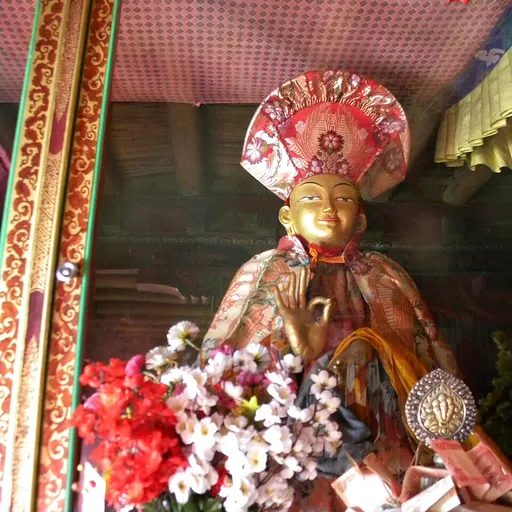
About Jikten Gonpo Rinchen Pel
Lived 1143 – 1217 (aged 73–74). Jikten Gonpo Rinchen Pel was a monk, writer and scholar.
Jigten Sumgön or Jigten Gönpo འཇིག་རྟེན་གསུམ་མགོན ("Lord of the Three Worlds", Skt: Trailokyanāthaḥ ) (1143–1217) was the founder of the Drikung Kagyu lineage and main disciple of Phagmo Drupa. He founded Drikung Thil Monastery in 1179.
Jigten Sumgön and the Drikung lineage are best known for the set of teachings known as The Five Profound Paths of Mahāmudrā (phyag chen lnga ldan). Some of Jigten Sumgön's sayings were collected by Sherab Jungne into what is known as the Gongchig (Wylie transliteration: dgongs gcig, "the single intention"), a profound philosophical compendium that further developed in commentarial works written in following generations. Some of Jigten Sumgön's teachings were collected by another disciple into what is known as The Heart of the Great Vehicle's Teachings (theg chen bstan pa'i snying po).
Life The meaning of Jigten Sumgön ( 'jig rten gsum mgon) is "The Lord of the Triple World". Jigten Sumgön is known under various names: Drikung Kyobpa Jigten Gönpo Rinpoche, Drikung Kyobpa Jikten Gönpo Rinchen Päl, Lord Jigten Sumgön, Kyobpa Rinpoche, and many others.
Because his mother had a connection with the Bön tradition, upon his birth Jigten Sumgön was initially given a Bön name, Welbar Tar (dbal 'bar thar).
Jigten Gönpo's great-grandmother was Achi Chökyi Drölma, who prophesied his birth and vowed to protect his lineage. Jigten Sumgön was born in 1143 into a famous clan called the Kyura (skyu ra) in the Kham (khams) region of Tibet by the name of Tsungu (tsu ngu); his mother was Rakyisa Tsunma, and his father, Naljorpa Dorje, was a devout Vajrayāna practitioner (of Yamāntaka) who died when Jigten Sumgön was still a boy—at that time, Jigten Sumgön started to support his family by reciting scriptures. It is said that when he was only eight years old, he understood that all phenomena are like a reflection in a mirror.
Due to his fame, many great masters came to study and practice in Drikung Thil for many centuries after Lord Jigten Sumgön's passing into parinirvāṇa. Perhaps the most famous of these was Lama Tsongkhapa, the founder of the Gelug school of Tibetan Buddhism. While staying near Drikung Thil, Tsongkhapa received the Drikung teachings on the Six Yogas of Naropa, as well as all of the outer and inner texts by Jigten Sumgön. Many Gelugpas, including the fourteenth Dalai Lama, uphold Tsongkhapa's lineage of Naropa's yogas until today.
Teaching Lord Jigten Sumgön was one of the most notable masters of Tibetan Buddhism, and his teachings had wide-reaching influence for centuries to come; up to 130,000 monks and practitioners came to his teaching at one time.
The Single Intent The most important idea associated with Jigten Sumgon is the "Single Intention", which is based on the idea that all of the Buddha's teachings have a single essence, a single meaning and a single intent. This single intent is generally identified with "nonarising" or "birthlessness" (skye ba med pa) in the context of sutra and "mahamudra" in the tantric context. This single intent is also identified with terms such as tathata and dharmata.
This is the central topic of a collection of 150 vajra statements which were collected into the influential text known by the name Single Intention (Gongchig, Wyl. Dgongs gcig). The first vajra statement encapsulates the main idea of the text: "All the teachings of the Buddha are the revelation of the original state of the fundamental nature (gshis babs)." suggesting he considered it to be the definitive text outlining the philosophical tenets of all Kagyu schools. Seven centuries later, Dudjom Rinpoche quotes Jigten Sumgön on something else he emphasized, the significance of the preliminary practices (ngöndro): "Other teachings consider the main practice profound, but here it is the preliminary practices that we consider profound."
The usefulness of philosophy Regarding Buddhist philosophical tenets, Jigten Sumgön and his followers generally held a dismissive attitude towards their usefulness. Jigten Sumgön states in Gongchig (4.13): "The truth is veiled by all [philosophical] tenets whatsoever." He also wrote:
May those who mistake the system of tenets, which is a knot of the mind, as the Buddha’s intention, realize true reality and may their mindfulness be purified in itself.
Moreover, echoing the mahāsiddha Saraha, he says:
All the views starting from the Non-Buddhists’ view of permanence and nihilism and up to the Madhyamikas’ [view] are something that is a mind-made duality. Since I have not studied these views of the various tenets, I do not know them.
Instead of establishing a specific philosophical view as unrefutable or attempting to conceptually express the truth intellectually, Jigten Sumgön held we should strive to attain direct realization of the nature of the mind.
Don’t just read it —
keep it.
Full-length biographies made to live with: read them, listen on the way to work, watch them tonight.
- E-book
- Audio
- Video
Instant download · yours to keep · every purchase keeps this site free
Important facts
Related people
Same field, nearest in time





Contemporaries
People whose lives overlapped Jikten Gonpo Rinchen Pel's





Frequently asked questions
Who was Jikten Gonpo Rinchen Pel?
founder of the Drikung Kagyu lineage
When was Jikten Gonpo Rinchen Pel born?
Jikten Gonpo Rinchen Pel was born in 1143 in Kham.
When did Jikten Gonpo Rinchen Pel die?
Jikten Gonpo Rinchen Pel died in 1217.
What was Jikten Gonpo Rinchen Pel's occupation?
Jikten Gonpo Rinchen Pel was a monk, writer and scholar.
Sources & further reading
· Wikipedia: Jikten Gonpo Rinchen Pel
Cite this page
APA: Biography.guide. (2026). Jikten Gonpo Rinchen Pel. https://biography.guide/jikten-gonpo-rinchen-pel/
MLA: "Jikten Gonpo Rinchen Pel." Biography.guide, https://biography.guide/jikten-gonpo-rinchen-pel/.
Chicago: "Jikten Gonpo Rinchen Pel." Biography.guide. https://biography.guide/jikten-gonpo-rinchen-pel/.
Data last updated: 2026-09-20 · Spot an error? Report a correction.
Portrait: Wikimedia Commons · author & licence
Page generated 2026-09-27 04:57 UTC