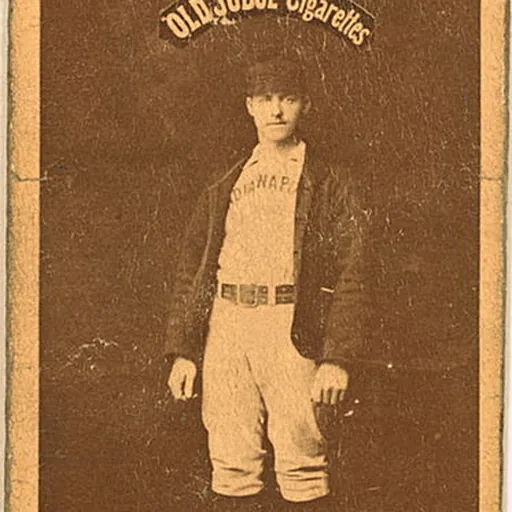
About Jerry Denny
Lived 1859 – 1927 (aged 68). Jerry Denny was an American baseball player.
Jeremiah Dennis Denny (born Jeremiah Dennis Eldridge; March 16, 1859 – August 16, 1927) was an American third baseman in Major League Baseball. He played for the Providence Grays (1881–1885), St. Louis Maroons, Indianapolis Hoosiers (1888–1889), New York Giants (1890–1891), Cleveland Spiders (1891), Philadelphia Phillies (1891), and Louisville Colonels (1893–1894). He also played 86 games at shortstop in six seasons.
After leaving the major leagues, Denny continued playing minor league baseball until 1902. He was the last major league position player (non-pitcher) to play his entire career on the diamond without wearing a fielding glove.
Name Eldridge attended St. Mary's College, Phoenix, Arizona, in the late 1870s, and wanted to play semi-professional baseball during the summer months, when he wasn't playing for the college as an amateur. He used the pseudonym "Jerry Denny" to hide his professional play from the college.
In 1884, Denny helped the National League champion Grays defeat the New York Metropolitans of the American Association in the major leagues' first post-season championship match-up, hitting the first postseason home run ever in game 2. That season, he was the Grays' leader in home runs (six, and one in the championship series) and runs batted in (59), and second in extra-base hits (37).
Denny's career totals are 1,237 games, 4,946 at bats, 714 runs, 1,286 hits, 238 doubles, 76 triples, 74 home runs, 667 RBI, 130 stolen bases, 173 walks, and a batting average of .260.
"Denny was a rarity among power-hitters in that he drew very few walks, a factor that led to his offensive value being overrated throughout his career," wrote baseball historian Craig Wright, who explained: "[Denny's] batting averages were very normal for a position player of his era, but he walked so little that when he retired he had the second worst on-base percentage (.287) among major leaguers with 5000 plate appearances."
Unconventional fielding technique At the time Denny began his professional career, fielding gloves had not yet become standard equipment, other than padded mitts for catchers and first basemen. Fielding gloves gradually gained acceptance between 1885 and the mid-1890s, but Denny refused to adapt. He was one of the few ambidextrous major league players; although he threw primarily with his right arm, he could also toss with his left. This gave him a defensive advantage at his customary field position—in ranging to his left on a ground ball, if he saw a play at second base, instead of having to transfer the ball to his right hand while pivoting and repositioning his body (as third basemen would customarily do), Denny could dispatch the ball to second with his left hand. This skill contributed to his refusal to wear a glove in the field, long after most players considered gloves essential.
Don’t just read it —
keep it.
Full-length biographies made to live with: read them, listen on the way to work, watch them tonight.
- E-book
- Audio
- Video
Instant download · yours to keep · every purchase keeps this site free
Important facts
Related people
Same field, nearest in time



Contemporaries
People whose lives overlapped Jerry Denny's


Frequently asked questions
Who was Jerry Denny?
Major League Baseball player (1859-1927)
When was Jerry Denny born?
Jerry Denny was born on 16 March 1859 in New York City.
When did Jerry Denny die?
Jerry Denny died on 16 August 1927 in Houston.
What was Jerry Denny's occupation?
Jerry Denny was a baseball player.
What nationality was Jerry Denny?
Jerry Denny was American.
Sources & further reading
Cite this page
APA: Biography.guide. (2026). Jerry Denny. https://biography.guide/jerry-denny/
MLA: "Jerry Denny." Biography.guide, https://biography.guide/jerry-denny/.
Chicago: "Jerry Denny." Biography.guide. https://biography.guide/jerry-denny/.
Data last updated: 2026-09-21 · Spot an error? Report a correction.
Portrait: Wikimedia Commons · author & licence
Page generated 2026-09-27 04:58 UTC