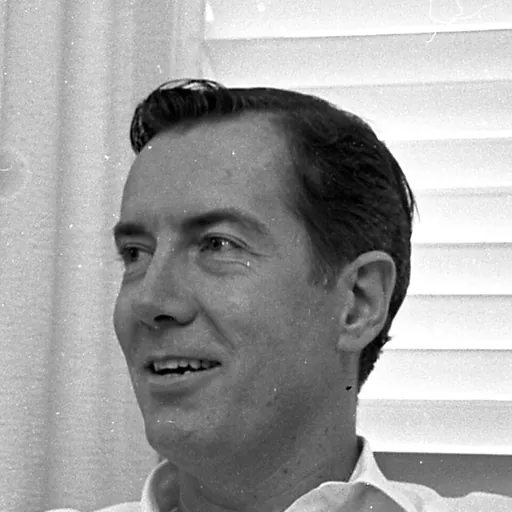
About Jerome Hines
Lived 1921 – 2003 (aged 81). Jerome Hines was an American opera singer, composer, music educator, singer and musician.
Jerome A. Hines (November 8, 1921 – February 4, 2003) was an American operatic bass who performed at the Metropolitan Opera from 1946 to 1987. Standing 6'6½", his stage presence and stentorian voice made him ideal for such roles as Sarastro in The Magic Flute, Mephistopheles in Faust, Ramfis in Aida, the Grand Inquisitor in Don Carlos, the title role of Boris Godunov and King Mark in Tristan und Isolde.
Early life and education Hines was born Jerome Albert Link Heinz in Hollywood. He studied mathematics and chemistry at the University of California, Los Angeles, and took private voice lessons.
In 1946, Hines made his debut at the Metropolitan Opera as the Sergeant in Boris Godunov. He went on to sing for a record 41 seasons there, including becoming the first US-born singer to tackle the title role of Boris Godunov in 1954. In 1953, he made his European debut with Glyndebourne Festival as Nick Shadow at the Edinburgh Festival in the first British performances of Stravinsky's The Rake's Progress. In 1958, he made his debut at La Scala in the title role of George Frideric Handel's Hercules. From 1958 to 1963, he sang at Bayreuth in the roles of Gurnemanz, King Mark and Wotan.
Hines composed an opera on the life of Jesus, I Am the Way. He sang the role of Jesus at the Met in 1968 (though not in a staged production of his opera) and performed the work many times around the world.
Hines wrote a memoir, This is My Story, This is My Song (1969) , and two books on singing, The Four Voices of Man (1997) and Great Singers on Great Singing (1982) .
Mathematics In the 1950s, Hines contributed the following scholarly articles to Mathematics Magazine: 1951: "On approximating the roots of an equation by iteration", Mathematics Magazine 24(3):123–7 1952: "Foundations of Operator Theory", Mathematics Magazine 25:251–61 1955: "Operator Theory II", Mathematics Magazine 28(4):199–207 1955: "Operator Theory III", Mathematics Magazine 29(2):69–76 1956: "A Generalization of the S-Stirling numbers", Mathematics Magazine 29:200–3 Hines did not accept the theory of transfinite numbers that had been put forward by Georg Cantor. As Opera News reported in 1991, he was collaborating with Henry Pollack, formerly of Bell Labs, on "a new look at the philosophy of mathematics".
Personal life Hines was married to the soprano Lucia Evangelista from 1952 until her death from amyotrophic lateral sclerosis in 2000. They had four children.
Death A resident of Scotch Plains, New Jersey, Hines died of undisclosed causes in 2003 at age 81 at Mount Sinai Hospital in Manhattan.
Don’t just read it —
keep it.
Full-length biographies made to live with: read them, listen on the way to work, watch them tonight.
- E-book
- Audio
- Video
Instant download · yours to keep · every purchase keeps this site free
Important facts
People in Jerome Hines's life
Named in this biography and alive at the same time



Related people
Same field, nearest in time




Contemporaries
People whose lives overlapped Jerome Hines's




Frequently asked questions
Who was Jerome Hines?
opera singer (1921-2003)
When was Jerome Hines born?
Jerome Hines was born on 8 November 1921 in Hollywood.
When did Jerome Hines die?
Jerome Hines died on 4 February 2003 in New York City.
What was Jerome Hines's occupation?
Jerome Hines was an opera singer, composer, music educator, singer and musician.
What nationality was Jerome Hines?
Jerome Hines was American.
Sources & further reading
Cite this page
APA: Biography.guide. (2026). Jerome Hines. https://biography.guide/jerome-hines/
MLA: "Jerome Hines." Biography.guide, https://biography.guide/jerome-hines/.
Chicago: "Jerome Hines." Biography.guide. https://biography.guide/jerome-hines/.
Data last updated: 2026-09-22 · Spot an error? Report a correction.
Portrait: Wikimedia Commons · author & licence
Page generated 2026-09-27 05:03 UTC