
About Jerome Frank
Lived 1889 – 1957 (aged 67). Jerome Frank was an American judge, lawyer, philosopher and jurist.
Jerome New Frank (September 10, 1889 – January 13, 1957) was an American legal philosopher and author who played a leading role in the legal realism movement. He was chairman of the U.S. Securities and Exchange Commission, and a United States circuit judge of the United States Court of Appeals for the Second Circuit.
Early life, education, and career
Born in New York City, New York, Frank's parents were Herman Frank and Clara New Frank, descendants of mid-19th-century German Jewish immigrants. Frank's father, also an attorney, relocated the family to Chicago, Illinois, in 1896, where Frank would attend Hyde Park High School, where he had the highest grades in the school's history, despite leaving the program for a year to work as secretary to reformist Chicago alderman Charles Edward Merriam. Frank distinguished two classes of American legal realists: rule skeptics and fact skeptics. Rule skeptics—who Frank dismissively referred to as "magic addicts"—were skeptical that the legal rules articulated in decisions could adequately explain case outcomes, While he, too, traced uncertainty in the law to indeterminate legal rules, he believed that legal uncertainty was inevitable given the impossibility of predicting judicial fact finding or fully comprehending the myriad psychological influences on a judge that might affect a decision. Like his judicial hero, Justice Oliver Wendell Holmes Jr., Frank urged judges and legal scholars to acknowledge openly the gaps and uncertainties in the law, and to think of law pragmatically as a tool for human betterment.
The book "dropped like a bombshell on the legal and academic world", quickly becoming "a jurisprudential bestseller" which "was widely noticed as well as criticized". In 1930, Frank moved to New York City, where he practiced until 1933, also working as a research associate at Yale Law School in 1932, where he collaborated with Karl Llewellyn of Columbia Law School, and feuded with legal idealist Roscoe Pound, dean of the Harvard Law School. In 1933, Frank published a landmark article proposing hands-on ("clinical"), not just book-based, education for law students.
In addition to the philosophical disagreements arising from Frank's realism and Pound's idealism, Pound accused Frank of misattributing quotes to him in Law and the Modern Mind, writing to Llewellyn:
Llewellyn defended Frank, but Pound would not relent. This led Frank to produce a lengthy memorandum showing where each quote attributed to Pound by Frank could be found in Pound's writing, and offering to pay Pound to hire someone to verify the citations. Pound would continue to attack Frank's legal philosophy throughout his life, although Frank later moderated his views on legal realism.
Later scholarly writing
Frank's judicial service (1941–1957) did not stem his scholarly output. In 1942, he published If Men Were Angels, a defense of the ambitious New Deal programs, and governmental regulation in general, expressing views that he developed while serving in the SEC. In 1951 he moved from New York City to New Haven, Connecticut, preferring to live closer to Yale. The book concerned specific cases of people who had been wrongfully convicted of crimes. but made Frank a special counsel to the Reconstruction Finance Association in 1935. He was confirmed by the United States Senate on March 20, 1941, and received his commission on March 27, 1941. His service terminated on January 13, 1957, due to his death.
Judicial philosophy
Frank was considered a highly competent judge, often taking what was perceived as the more liberal position on civil liberties issues.
Frank's scholarly tendency bled over into his judicial opinions, some of which were notoriously lengthy. One anecdote relayed about this aspect of Frank's work tells of a law clerk who had objected to the length of one of Frank's opinions. According to the story:
Julius and Ethel Rosenberg
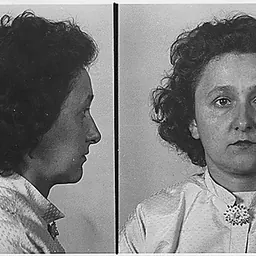
As a judge, Frank wrote the opinion in February 1952 affirming the convictions of Julius and Ethel Rosenberg, who had been convicted of conspiracy to commit espionage. Frank wrote a concurring opinion to the decision, which affirmed the obscenity conviction of a criminal defendant. In a lengthy appendix to his concurring opinion, Frank "drew on a host of historical, literary, and social science studies to point to the dangers and contradiction of all forms of government censorship of ideas and images". which noted Frank's approach. The concurrence has been asserted to be one of Frank's most important opinions, and one which set the stage for the direction the Supreme Court would take on such issues beginning in the 1960s. said of her husband: "Being married to Jerome is like being hitched to the tail of a comet".
Legacy
Frank's extensive personal and judicial papers are archived at Yale University and are mostly open to researchers. Yale Law School's clinical programs are housed in the Jerome N. Frank Legal Services Organization, named in recognition of Frank's early championing of adding a clinical component to legal education.
Works
Frank had published many influential books, including Law and the Modern Mind (1930), which argues for ‘legal realism’ and emphasizes the psychological forces at work in legal matters. In 1965, his daughter Barbara Frank Kristein published A Man's Reach: The Selected Writings of Judge Jerome Frank, with a foreword by William O. Douglas and an introduction by Edmond Cahn of New York University School of Law. At least one legal commentator has written that "ew jurisprudential writers have aroused such prolonged public controversy as Jerome Frank".
Law and the Modern Mind (Transaction Publishers, 1930),. Save America First (New York and London: Harper & Brothers Publishers, 1938) Fate and Freedom (New York: Simon & Schuster, 1945) Courts on Trial (Princeton, NJ: Princeton University Press, 1949), Not Guilty (Garden City, N. Y.: Doubleday & Company Inc., 1957)
Don’t just read it —
keep it.
Full-length biographies made to live with: read them, listen on the way to work, watch them tonight.
- E-book
- Audio
- Video
Instant download · yours to keep · every purchase keeps this site free
Important facts
People in Jerome Frank's life
Named in this biography and alive at the same time




Related people
Same field, nearest in time

Contemporaries
People whose lives overlapped Jerome Frank's



Frequently asked questions
Who was Jerome Frank?
American jurist (1889–1957)
When was Jerome Frank born?
Jerome Frank was born on 10 September 1889 in New York City.
When did Jerome Frank die?
Jerome Frank died on 13 January 1957 in New Haven.
What was Jerome Frank's occupation?
Jerome Frank was a judge, lawyer, philosopher and jurist.
What nationality was Jerome Frank?
Jerome Frank was American.
Sources & further reading
Cite this page
APA: Biography.guide. (2026). Jerome Frank. https://biography.guide/jerome-frank/
MLA: "Jerome Frank." Biography.guide, https://biography.guide/jerome-frank/.
Chicago: "Jerome Frank." Biography.guide. https://biography.guide/jerome-frank/.
Data last updated: 2026-09-20 · Spot an error? Report a correction.
Page generated 2026-09-27 05:21 UTC