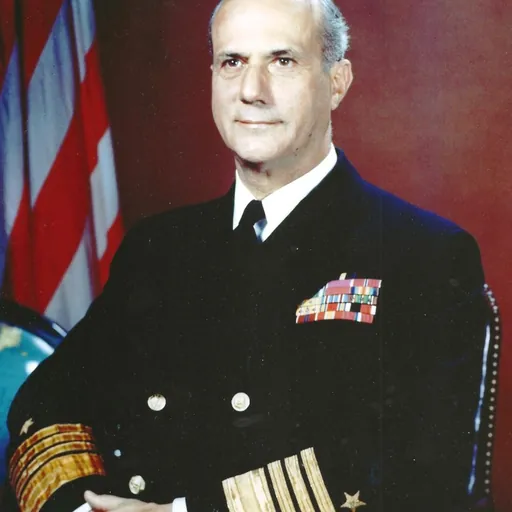
About Jerauld Wright
Lived 1898 – 1995 (aged 96). Jerauld Wright was an American military officer and diplomat.
Admiral Jerauld Wright (June 4, 1898 – April 27, 1995) was an officer in the United States Navy. He served as the Commander-in-Chief of the United States Atlantic Command (CINCLANT) and the Commander-in-Chief of the United States Atlantic Fleet (CINCLANTFLT), and became the second Supreme Allied Commander Atlantic (SACLANT) for the North Atlantic Treaty Organization (NATO), from April 1, 1954, to March 1, 1960, serving longer in these three positions than anyone else in history.
Following World War I, Wright served as a naval aide for Presidents Calvin Coolidge and Herbert Hoover. A recognized authority on naval gunnery, Wright served in the European and Pacific theaters during World War II, developing expertise in amphibious warfare and coalition warfare planning. After the war, Wright was involved in the evolution of the military structure of NATO as well as overseeing the modernization and readiness of the United States Atlantic Fleet during the Cold War.
Upon his retirement from the navy, Wright subsequently served on the Central Intelligence Agency's National Board of Estimates (NBE) and as the United States Ambassador to the Republic of China (Taiwan).
Early years
Jerauld Wright was born on June 4, 1898, in Amherst, Massachusetts, the second son of Major General William M. Wright (1863–1943), an officer in the United States Army, and the former Marjorie R. Jerauld (1867–1954), who also had another son, William Mason Wright, Jr. (1893–1977), and a daughter, Marjorie Wright (1900–1985).
Life for young Jerry Wright was a succession of United States Army posts, such as Fort Porter, Fort Omaha, the Presidio, and the Jefferson Barracks, as well as overseas tours of duty in Cuba and the Philippines. Keeping the family together while his father pursued an active military career was his mother, nicknamed "The Field Marshal" by her husband. Jerry remembered his mother fondly: "She was a tiger with her young."
Wright's father was a veteran of the Spanish–American War, the Boxer Rebellion, and World War I, during which he commanded the 89th Division in the St. Mihiel offensive and the Third Corps. He was a recipient of the Army Distinguished Service Medal. Following the war, General Wright commanded the Ninth Corps at the Presidio and the Department of the Philippines. While his father was assigned to the newly created United States Army General Staff before World War I, Wright met William Howard Taft. Later, Wright accompanied his father on inspection tours of U.S. military installations in the Philippines. During this tour, he was deeply impressed by the naval squadron visiting Manila. His growing interest in a naval career was further encouraged by his father, giving his son a very practical perspective:
Prior to going to the United States Naval Academy in Annapolis, Maryland, Wright attended the Franciscan Coligio de La Salle in Malate, California, and Shadman's School at Scott's Circle in Washington, DC.
United States Naval Academy Wright received an appointment to the United States Naval Academy from Congressman Edward W. Townsend of the Tenth Congressional District from the State of New Jersey. Wright entered the academy on July 31, 1914, the youngest midshipman to enter the academy since the American Civil War. Wright graduated on June 26, 1917, as part of the Class of 1918, ranked 92nd out of 193, the youngest member in his class.
Naval career World War I In July 1917, Lieutenant Wright joined the gunboat , which set sail for Gibraltar on August 5, 1917, for anti-submarine patrol and convoy duty, operating as a unit of the Patrol Force through December 21, 1918.
Inter-war service Sea duty
Wright served on , a , as a watch and division officer from December 1918 to July 1920. Dyer showed the flag in port visits to Gibraltar, La Spezia, Venice, Trieste, Spoleto, Corfu, and Constantinople during a nine-month cruise of the Mediterranean following the signing of the Armistice ending World War I. Following Dyer's return August 1919, Wright supervised her overhaul at the Brooklyn Navy Yard. Lt. Wright also briefly commanded the , a , which escorted the presidential yacht , with President Warren G. Harding on board, from Gardiner's Bay, New York, to the Capes. In October 1920, Lt. Wright took command of , anchored in reserve at Naval Station Newport, Rhode Island, for transfer to Charleston, South Carolina. Later, in February 1922, Lt. Wright joined , a slated for decommissioning at the Mare Island Navy Yard, serving as its executive officer.
In June 1922, Wright joined , a , as its executive officer, with additional duties as fire control officer and navigator. John D. Ford set sail from the Philadelphia Navy Yard with its sister ships of Squadron 15, Division 3, for the U.S. Asiatic Fleet. The John D. Ford operated throughout the Far East, including the South China Sea, the Sea of Japan, and the Philippines, showing the flag and training with other destroyers in the fleet. In July 1926, Lt. Wright joined the , a , as the principal assistant of the ship's Gunnery Division. In November 1928, the Maryland took President-elect Herbert Hoover on the outbound leg of his goodwill tour of Latin America. Wright also furthered his hands-on education of gunnery and ordnance while serving as an instructor at the Gunnery School on the battleship . Commander Wright joined , a attached to the Scouting Force, as its first lieutenant in August 1931 and later became the ship's gunnery officer from June 1932 to June 1934. The Salt Lake City participated in naval exercises in the Atlantic and Pacific, underwent a major overhaul and participated in the 1934 Naval Review.
Wright's first sea command was , a , with Wright serving as its first commanding officer from July 1937 to May 1939. The Blue completed its shakedown cruise, transited the Panama Canal, and joined the Destroyer Division 7 (DesRon 7) as its flagship, becoming a unit of the Battle Force based at the San Diego Naval Base, California. The Blue participated in Fleet Problem XX exercises staged in the Caribbean Sea.
Wright's final pre-war sea assignment was as the executive officer of , a , from March 1941 to May 1942. The Mississippi was based at the Pearl Harbor Naval Base in the Territory of Hawaii until May 1941 as part of Battleship Division 3 (BatDiv 3) with sister ships and . Following the Bismarck incident and the growing U-boat threat, Battleship Division 3 was secretly shifted to the newly reconstituted U.S. Atlantic Fleet, under the command of Admiral Ernest J. King, entering the Norfolk Naval Base in June 1941. Mississippi was present at the Atlantic Conference at Argentia, participated in the Neutrality Patrol, and joined the Idaho and the British battleship to form an Iceland-based fleet in being to deter the German battleship from deploying into the north Atlantic to threaten Allied convoys. After months of operations in the North Atlantic, Mississippi was en route to Norfolk for long overdue repairs two days after the Japanese attacked Pearl Harbor on December 7, 1941.
Shore duty
Wright served as a naval aide for two Presidents of the United States, including Calvin Coolidge from September 1924 to June 1926, with additional duties as a watch and division officer on board the presidential yacht , and Herbert Hoover during his pre-inaugural goodwill tour of Latin America in November 1928. Wright also served as aide to Assistant Secretary of the Navy Henry L. Roosevelt from June 1935 to March 1936. Wright subsequently served on board during its commissioning and fitting-out period.
Wright developed an interest in gunnery and ordnance after he was turned down for naval aviation because he had exophoria. His first tour of duty at the Bureau of Ordnance (BuOrd) was as a fire control section assistant, specializing in anti-aircraft equipment, from August 1929 to August 1931. Wright's second BuOrd assignment was with its supply and allowance division, involving ammunition distribution to the fleet, from June 1936 to July 1937. Bureau chief Rear Admiral Harold R. Stark rated Wright highly.
Commander Wright served two tours at the United States Naval Academy as the Battalion Commander for the First Battalion, from June 1934 to June 1935, and the Battalion Commander for the Second Battalion, from June 1939 to March 1941. Wright earned two nicknames at the Naval Academy. The first, Old Iron Heels because he wore steel wedges on his shoes to alert midshipmen of his approach. His second nickname, Old Stoneface originated because of his ability to elicit confessions from offending midshipmen regarding disciplinary infractions without uttering a word. Wright also served as the staff aide to the Commander Atlantic Squadron during the Midshipman's Practice Cruise in June–August 1940.
World War II Pearl Harbor aftermath, COMINCH, and London The USS Mississippi completed its overhaul in three weeks and transited the Panama Canal to re-join the U.S. Pacific Fleet, visiting San Francisco, California to re-assure its citizens in the aftermath of the attack on Pearl Harbor. In March 1942, Captain Jerauld Wright was detached from the Mississippi for temporary duty on the staff of Admiral Ernest J. King, the Commander-in-Chief of the U.S. Fleet (COMINCH), before being assigned to Admiral Harold R. Stark's staff in London, effective June 3, 1942.
One growing concern for Eisenhower and his planners was the likely reaction of local French political and military leaders toward an Allied invasion of North Africa. Strong French resistance could cause more casualties for the landing force. One issue coloring French attitudes was their deep-seated resentment toward the British for the Attack on Mers-el-Kébir in which the Royal Navy shelled the anchored French fleet in June 1940. Another issue was working with officials connected to the Vichy government which could cause serious political and security complications. Diplomat Robert D. Murphy, the U.S. consul general in Algiers, spearheaded efforts to gather pre-invasion intelligence and cultivate diplomatic contacts in French North Africa, and Wright would find himself intimately involved in his pre-invasion activities.
North Africa, Sicily, and Italy Operation Flagpole
On October 16, 1942, Captain Jerauld Wright was summoned to Operation Torch's staff headquarters at Norfolk House in London for an important meeting with General Eisenhower, alongside other senior officers. Eisenhower informed the group that the War Department had forwarded an urgent cable from U.S. diplomat Robert D. Murphy requesting the immediate dispatch of a top-secret high-level group to meet with Général Charles E. Mast, the military commander of Algiers and the leader of a group of pro-Allied officials in French North Africa.
The objective of this secret mission, code-named Operation Flagpole, was to reach an agreement through Mast and his colleagues to have Général Henri Giraud, a key pro-Allied French army officer, step forward, take command of French military forces in North Africa, and then arrange a ceasefire with the Allied invasion force. Other alternatives, like Jean Darlan and Charles de Gaulle, had been rejected by the British and American governments for a variety of political reasons. Clark would be Eisenhower's personal representative, with Lemnitzer as the top invasion planner, Hamblen as the invasion's logistics expert, and Holmes serving as translator. Wright would serve as the liaison with the French Navy, with the specific objective of convincing the French to have their fleet anchored in Toulon join the Allied cause.
The group flew in two Boeing B-17 Flying Fortress bombers to Gibraltar, and on October 19, they boarded the British submarine , Lieutenant Norman Limbury Auchinleck "Bill" Jewell, RN, commanding. Seraph then transported Clark's party to the small fishing village of Cherchell, located 82 mils (132 kilometers) west of Algiers. After midnight on the evening of October 21, the Seraph surfaced and set Clark's mission ashore, where they met with Mast and Murphy. Wright met with Capitaine de vaisseau Jean Barjot and learned that the French Navy was opposed to U.S. entry into North Africa, although the army and air force supported it.
On October 24, Clark's mission returned to the Seraph and later met a seaplane that flew them back to Gibraltar, arriving back in London on October 25 where Wright briefed Admiral Stark. Both Eisenhower and Clark recommended Jerauld Wright for a Distinguished Service Medal in recognition for his role in Operation Flagpole. Wright's DSM was personally pinned by Admiral Ernest J. King, the Chief of Naval Operations, during the Casablanca Conference.
Operation Kingpin With the preliminaries concluded during Operation Flagpole, the next task was to free Général Giraud (code-named Kingpin) whom the Vichy government had under house arrest for his anti-Nazi leanings at Toulon in southern France. On October 26, 1942, Captain Jerauld Wright was directed to take part in the mission to extract Giraud, code-named Operation Kingpin. Because of intense anti-British sentiment among French officers, the mission would present an American face. However, because there were no American submarines operating in the Mediterranean Sea, a novel solution was conceived with Wright taking command of the British submarine . As Captain G. B. H. Fawkes, RN, the commander of 8th Submarine Flotilla in the Mediterranean, noted:
The Seraph got underway on October 27 and arrived off Toulon on October 30. After several delays, Giraud and his party were brought on board, and a PBY Catalina flying boat subsequently flew Wright, Giraud, and the others back to Gibraltar, the new Operation Torch headquarters, to confer with generals Eisenhower and Clark. Captain Jerauld Wright was awarded his first Legion of Merit in recognition of his participation in Operation Kingpin.
Operation Torch
D-Day for Operation Torch, November 8, 1942, saw over 73,000 American and British troops landed at Casablanca, Oran, and Algiers. However, the most significant development was on the diplomatic and political front when U.S. consul general Robert D. Murphy alerted the Allied high command about the unexpected presence of Admiral de la flotte Jean Darlan, the head of the Vichy French military, who was visiting his ill son in Algiers. Darlan's presence complicated the pre-invasion arrangements with Général Henri Giraud. Darlan pointed out to Murphy that he outranked Giraud, whom Darlan maintained had little influence within the French military.
After a ceasefire was reached in Algiers, General Eisenhower sent a delegation to resolve the situation and broker a ceasefire with all French North African forces. Captain Jerauld Wright accompanied General Clark, who concluded that Darlan could, with certain conditions, deliver the general ceasefire and oversee the post-invasion occupation, and that Giraud lacked the political ability to accomplish these goals. Eisenhower endorsed Clark's recommendation, which caused a political firestorm within the Allied governments because of Darlan's connection to Vichy. About Giraud and Darlan, Wright observed:
Admiral Harold R. Stark noted in Wright's December 1942 fitness report that:
At the Casablanca Conference in January 1943, President Franklin D. Roosevelt, Prime Minister Winston Churchill, and the Combined Chiefs of Staff (CCS) made the decision to shelve plans for Operation Sledgehammer, and instead progress operations in Sicily (Operation Husky) and Italy (Operation Avalanche). Finally, Admiral Darlan was assassinated on December 24, 1942, and Charles de Gaulle would ultimately outmaneuver and marginalize Henri Giraud to become the sole leader of the Free French movement.
Operation Husky
Wright joined the staff of Vice Admiral H. Kent Hewitt, the Commander, U.S. Naval Forces, Northwest Africa Waters (COMNAVNAW), as its assistant chief of staff.
Hewitt would command the "Western Naval Task Force", which would land U.S. Seventh Army under Lieutenant General George S. Patton in the Gulf of Gela for Operation Husky, the Allied invasion of Sicily. Vice Admiral Sir Bertram Ramsay, RN, would command the Eastern Naval Task Force, which would land the British Eighth Army under General Sir Bernard Montgomery near Syracuse. Admiral Sir Andrew Cunningham, RN, would command all Allied naval forces for Operation Husky, and General Dwight D. Eisenhower, United States Army, would be in overall command of the Sicily invasion.
The Western Naval Task Force consisted of three subordinated forces, Task Force 80 (code name JOSS) under the command of Rear Admiral Richard L. Conolly was to land the 3rd Infantry Division, Major General Lucian Truscott commanding, on beaches near Licata. Task Force 82 (code name DIME) under Rear Admiral John L. Hall, Jr. was to land 1st Infantry Division, Major General Terry de la Mesa Allen commanding, on beaches near Gela. Task Force 85 (code name CENT) under the command of Rear Admiral Alan Kirk was to land the 45th Infantry Division, Major General Troy Middleton commanding, on beaches near Scoglitti.
Wright worked closely with his U.S. Army counterparts, and he considered Patton "a great fellow" who grew to appreciate the effectiveness of naval gun support for his landing force. However, Wright was critical of Lieutenant General Carl A. Spaatz, USAAF, and Air Vice-Marshal Sir Arthur Coningham, RAF, regarding the lack of cooperation on close air support from the Allied air forces. Wright did praise Air Vice-Marshal Sir Hugh Pughe Lloyd, RAF, for providing air support from Malta.
The loading of ships and landing craft of the Western Naval Task Force was completed on July 8, 1943, with Vice Admiral Hewitt and his staff embarking on the USS Monrovia, the invasion force's flagship. D-Day was July 10, and Patton's troops stormed ashore and began their history-making drive for Messina.
Operation Avalanche
Operation Avalanche was the Allied invasion of the Italian mainland with amphibious landings at Salerno, with additional landing at Calabria (Operation Baytown) and Taranto (Operation Slapstick).
For the Salerno landing, Wright faced two major challenges in his capacity as the assistant chief of staff for U.S. Naval Forces, Northwest Africa Waters (NAVNAW), namely the shortage of U.S. escort vessels and a shortage of landing craft. While Wright was able to secure additional British escorts, landing craft would remain a persistent problem given the competing demands from Operation Overlord and the Pacific Theater of Operations, with Wright noting: "LST's don't grow on trees." On the other hand, two developments were welcomed by Wright and his fellow invasion planners, including U.S. escort aircraft carriers (CVE) which would provide much needed off-shore close air support for the landing force, and the news that Major General E. J. House would oversee tactical air support for the ground forces using aircraft from the Northwest African Air Force. However, Wright felt that the Army's decision to forgo pre-invasion naval gun bombardment was ill-considered, even for the sake of maintaining the element of surprise.
The invasion force got underway, with Vice Admiral H. Kent Hewitt, Wright, and the NAVNAW staff embarked on the USS Ancon, Hewitt's flagship for Operation Avalanche. While en route, Wright heard the announcement about the Armistice with Italy by General Dwight D. Eisenhower, the supreme allied commander, on September 9. While this removed the Italian military from the battlefield, German Army forces in Italy under Generalfeldmarschall Albert Kesselring were not bound by this agreement. The immediate objective for Operation Avalanche was to secure the Gulf of Salerno and capture Naples. A powerful German counter-attack on September 13 threatened to drive a wedge into the Salerno bridgehead, but it was beaten back by a powerful Allied air-land-sea assault, forcing a German retreat. With the Fifth U.S. Army under Lieutenant General Mark Clark driving for Naples, Admiral Hewitt and Wright returned to Malta to give a full report on Operation Avalanche to General Eisenhower. Captain Jerauld Wright was awarded a second Legion of Merit for his contributions on Operation Husky and Operation Avalanche. During December 1943, Santa Fe underwent amphibious training off San Pedro, California.
On January 13, 1944, Santa Fe set sail from California for the Marshall Islands, as part of the invasion force for Operation Flintlock. Santa Fe served as an escort for the Northern Attack Force (Task Force 53), Rear Admiral Richard L. Conolly commanding, which was tasked to capture Roi-Namur and the northern half of the Kwajalein atoll. Santa Fe joined the bombardment force (Task Group 53.5), Rear Admiral Jesse B. Oldendorf commanding, that provided naval gunfire support for U.S. Marine landing forces at Kwajalein which was secured on February 4.
Following a lay-over at Majuro, Santa Fe participated in air raids against Truk and Saipan as part of Task Force 58 during February 1944. Wright received a Letter of Commendation for his actions as the commanding officer of the Santa Fe during this engagement. From March 15 through May 1, 1944, Santa Fe was part of Task Group 58.2, Rear Admiral Joseph J. Clark commanding, which provided air support for amphibious landings at Emirau Island and Hollandia while also participating in air raids against Japanese garrisons on Palau, Yap, Wakde, Woleai, Satawan, and Ponape, as well as major air strike against the Japanese naval base at Truk. Santa Fe also participated in the shore bombardment of Wakde Airfield and Sawar Airfield.
On June 15, 1944, Santa Fe participated in landings on Saipan, Guam, and Tinian (Operation Forager) as a part of the United States Fifth Fleet under the overall command of Vice Admiral Raymond A. Spruance. On June 19, Japanese carrier aircraft began attacking the Fifth Fleet which remained close to the beachhead on orders from Spruance. Wright concurred that this controversial decision was the correct one given the importance of protecting the landing force. During the ensuing Battle of the Philippine Sea, Santa Fe's anti-aircraft guns helped to protect the fleet during these enemy air attacks while American naval aviators counter-attacked the Japanese fleet. Later, on June 20, Santa Fe ignored possible Japanese submarine activity when she turned on her lights to help guide returning American aircraft back to their carriers during highly hazardous night landings. After air strikes on Pagan Island, Santa Fe returned to Eniwetok for reprovisioning.
In August, Santa Fe joined Task Group 38.3, Rear Admiral Frederick C. Sherman commanding, for the invasion of Peleliu and Angaur (Operation Stalemate II) as part of the United States Third Fleet under the overall command of Admiral William F. Halsey, and carrier air attacks to neutralize Japanese air bases on Babelthuap and Koro in preparation for the upcoming Philippines campaign led by General Douglas MacArthur. During air raids on Formosa in October, the heavy cruiser and light cruiser were seriously damaged by aerial torpedoes. Santa Fe was part of a covering force (Task Force 30.3), nicknamed "CripDiv 1," formed to protect the damaged cruisers as they were being towed back for Ulithi for repairs. The final engagements that Wright participated in as the commanding officer of USS Santa Fe were the invasion of Leyte and the Battle of Leyte Gulf. Captain Jerauld Wright received the Silver Star in recognition of his participation in the towing of the Canberra and Houston back to Uliti. Amphibious Group Five would transport the 2nd Marine Division, Major General Thomas E. Watson, USMC, commanding, with Wright flying his flag from .
For Operation Iceberg, Wright's force was designated Demonstration Group Charlie (Task Group 51.2), whose mission was to serve as a decoy force working in conjunction with the Southern Attack Force (Task Force 55) commanded by Rear Admiral John L. Hall while the Western Islands Group (Task Group 51.1) under Rear Admiral Ingolf N. Kiland and the 77th Infantry Division secured Kerama Retto and other offshore islands before landing at Ie Shima. Task Group 51.2 would subsequently serve as a floating reserve for the U.S. Tenth Army (Task Force 56), commanded by Lieutenant General Simon B. Buckner, USA, before returning to Saipan.
Wright was ordered to Pearl Harbor to begin planning the invasion of the Japanese home islands, which would begin with Operation Olympic, the invasion of the southern island of Kyūshū. Wright's Amphibious Group Five would be part of the 5th Amphibious Force, commanded by Vice Admiral Harry W. Hill, which would land the V Amphibious Corps (VAC) on the west coast in the Kaminokawa – Kushikino area. Amphibious Group Five would consist of four old battleships, ten cruisers, fourteen destroyers, and seventy-four support craft. However, Operation Olympic and the follow-up invasion of Honshū (Operation Coronet) were cancelled following the dropping of the atomic bombs on Hiroshima and Nagasaki. Rear Admiral Jerauld Wright was awarded a Bronze Star, with a combat "V" device, for his leadership as the commander of Task Group 51.2 during Operation Iceberg.
Cold War Operational Readiness Division In October 1945, Wright joined the Office of the Chief of Naval Operations (OPNAV) as the head of its Operational Readiness Division, helping to organize this newly created organization. Other OPNAV divisions created were Plans (OP-31), Combat Intelligence (OP-32), Operations (OP-33), and Anti-submarine Warfare (OP-35) within the Chief of Naval Operations. Wright organized OP-34 into four sections, and working with his sister divisions, Wright directed the development of a host of manuals on tactical doctrine based upon experience from World War II. Wright involved civilian think tanks, such as the Operation Evaluation Group (OEG), in projects undertaken by OP-34. CNO Fleet Admiral Chester W. Nimitz appointed Wright to chair the U.S. Navy's Air Defense Committee to help improve fleet air defenses. Wright also succeeded Rear Admiral Walter DeLaney as the chairman of the Joint Army-Navy Assessment Committee (JANAC), an inter-service agency set up in 1943 to analyze and assess Japanese naval and merchant marine shipping losses caused by U.S. and Allied forces during World War II.
Commander Amphibious Forces U.S. Atlantic Fleet
On November 24, 1948, Wright assumed command of Amphibious Forces U.S. Atlantic Fleet (COMPHIBLANT), a position that he held through November 1, 1950. Based at the Norfolk Naval Station, Wright would be responsible for three major subordinate commands, Amphibious Group Two, Amphibious Group Four and the Little Creek Naval Amphibious Base. COMPHIBLANT also included Amphibious Training, an Amphibious Air Control Group, a Naval Beach Group, a Detached Group, and a Mediterranean Group. Wright's flagship was , an Adirondack-class amphibious force command ship. The most significant accomplishment during Wright's tour of duty as COMPHIBLANT was PORTREX, a multi-service amphibious assault exercise held from February 25 to March 11, 1950. PORTREX was the largest peacetime amphibious exercise up to that time and it was staged to evaluate joint doctrine for combined operations, test new equipment under simulated combat conditions and provide training for the defense of the Caribbean.
Over 65,000 men and 160 ships were involved, and it was climaxed by a combined amphibious and airborne assault on Vieques Island, a first in military history. The success of PORTREX offered a prelude for future amphibious operations, including the landings at Incheon during the Korean War. Jerauld Wright received his third star, effective September 14, 1950, at the conclusion of his tour of duty as COMPHIBLANT. General of the Army Omar Bradley, United States Army, Marshal of the Royal Air Force Lord Tedder, Royal Air Force and Lieutenant General Paul Ely, French Army. The Standing Group was charged with providing policy guidance and military-related information to NATO's various regional planning groups, including General Dwight D. Eisenhower at SHAPE headquarters. The Standing Group undertook short-term (STDP), mid-term (MTDP), and long-range (LTDP) strategic military planning for the NATO alliance, as well as making recommendations regarding NATO's unified military command structure, which included the creation of a Supreme Allied Commander Atlantic (SACLANT) billet.
Commander-in-Chief, U.S. Naval Forces Eastern Atlantic and Mediterranean
Wright became the Commander-in-Chief, U.S. Naval Forces Eastern Atlantic and Mediterranean (CINCNELM), an important U.S. Navy fleet command, effective June 14, 1952. CINCELM's area of responsibility (AOR) stretched from the eastern Atlantic through the Indian Ocean to Singapore.
Wright's operational control over the Sixth Fleet proved to be a source of friction with Admiral Lord Louis Mountbatten, RN, NATO's Commander-in-Chief Allied Forces Mediterranean (CINCAFMED). Mountbatten felt that the Sixth Fleet should be assigned to his command while Wright wanted to maintain control of the fleet, particularly its nuclear-armed aircraft carriers, pursuant to both U.S. Navy policy and Federal law. The dispute tested the diplomatic skills of both men. CINCNELM forces participated in NATO Operation Mariner and Operation Weldfast exercises during 1953, and units of the Sixth Fleet did participate in NATO exercises while staying under U.S. control.
As CINCNELM, Wright maintained strong diplomatic ties with allies within his area of responsibility. He made a 14-day goodwill trip to the Middle East that culminated with a courtesy call with the newly crowned King Saud bin Abdul Aziz in Jidda, Saudi Arabia. Later, Wright attended the coronation ceremonies of King Hussein of Jordan in May 1953. In June 1953, Wright served as the senior U.S. Navy representative at the coronation pageant of Queen Elizabeth II, including flying his flag from the heavy cruiser during the Coronation Naval Review of Spithead on June 15. Admiral Wright also made the arrangements for United States Ambassador to the United Kingdom Winthrop Aldrich to present a bronze plaque of John Paul Jones from the Naval Historical Center to the British government, initiating his longtime association with the famous naval hero of the American Revolution.
During a high-level conference in Washington from October 20 to November 4, 1953, Wright was informed that CINCNELM was to become a subordinate command of the U.S. Atlantic Fleet reporting directly to Admiral Lynde D. McCormick, the Commander-in-Chief U.S. Atlantic Fleet (CINCLANTFLT). Also, Wright would become the head of NATO's Eastern Atlantic Area, reporting to Admiral McCormick, the first Supreme Allied Commander Atlantic (SACLANT). Jeruald Wright was promoted to the rank of Admiral effective April 1, 1954.
Wright assumed command of the U.S. Atlantic Fleet, the U.S. Atlantic Command, and Allied Command Atlantic on April 12, 1954, relieving Admiral Lynde D. McCormick who had been the first Supreme Allied Commander Atlantic.
Command structure and responsibilities Wright's command responsibilities included acting as Commander-in-Chief U.S. Atlantic Fleet (CINCLANTFLT), one of the two major fleet commands within the U.S. Navy with responsibility for all naval operations throughout the Atlantic Ocean; Commander-in-Chief U.S. Atlantic Command (CINCLANT), a unified command responsible for U.S. military operation throughout the Atlantic Ocean geographical region;
Other Atlantic Fleet exercises included Operation Springboard, the annual winter naval maneuvers in the Caribbean Sea. Units of the U.S. Atlantic Fleet and the Royal Canadian Navy participated in Operation Sweep Clear III, a bilateral mine warfare exercise, between July and August 1958. Also, in 1960, the U.S. Atlantic Fleet initiated UNITAS, an annual multilateral series of exercises between the South Atlantic Force (SOLANTFOR) and Latin American navies. As SACLANT, Wright coordinated such NATO naval exercises as Operation Sea Watch, a convoy escort exercise. However, the most significant naval exercise during Admiral Wright's tour of duty was Operation Strikeback, a ten-day exercise involving over 250,000 men, 300 ships, and 1,500 aircraft during September 1957, which was the largest naval exercise staged by NATO up to that time. Under Admiral Wright, the U.S. Atlantic Fleet also took the lead on the field of operational testing and evaluation (OT&E) of systems and tactics, particularly regarding anti-submarine warfare for the United States Navy, with the Operational Development Force (OPDEVFOR), under the command of Rear Admiral William D. Irvin, serving as the lead agency for this effort.
Finally, in February 1959, when several transatlantic cables off Newfoundland were cut and the Soviet fishing trawler MV Novorossisk was operating in the vicinity at the time of the break, the radar-picket ASW destroyer was dispatched to enforce the 1884 Convention for the Protection of Submarine Cables. On the August 26, the Hale sent a boarding party to the Novorossisk to investigate and determined that there were no indications of intentions "other than fishing." A diplomatic protest was lodged, but there were no more breaks.
Anti-submarine warfare
Wright stated in a Time magazine article from 1958 that: "The primary mission of every combat ship in the Atlantic Fleet is antisubmarine. Everything else is secondary." Given his previous exposure to anti-submarine warfare (ASW) doctrine at OP-34, Wright was a natural fit for overseeing the anti-submarine renaissance during his tour of duty as CINCLANTFLT. One significant innovation was the Sound Surveillance System (SOSUS), a network of underwater hydrophones and listening posts designed to track the movement of submarines. The first operational test of SOSUS was done during the ASDevEx 1–54 exercise from April 6 to June 7, 1954.
However, 1958 news accounts about the growing threat of the Soviet snorkel-equipped diesel-electric submarine force began to gain the attention of the American public. Central Intelligence Agency Director Allen Dulles was reported to have said that ten missile-carrying Soviet submarines could destroy 1600 square miles (4144 km2) of the industrial-rich eastern seaboard in a sneak attack. Also, an Associated Press dispatch, dated April 14, 1958, quoted U.S. Congressman Carl Durham D-North Carolina, who said that 184 Soviet submarines had been sighted off the U.S. Atlantic coast during 1957.
Chief of Naval Operations (CNO) Arleigh A. Burke had responded on April 1 by creating Task Force Alfa, a hunter-killer (HUK) flotilla under the command of Rear Admiral John S. Thach, which would develop new ASW tactics to counter this growing Soviet submarine threat.
Wright's personal contribution provided the first look at a missile-armed Soviet submarine, a Project AV611/Zulu-V variant armed with two R-11FM ("SS-1b Scud-A") ballistic missiles. Wright also spearheaded the establishment of the SACLANT ASW Research Centre, created on May 2, 1959, in La Spezia, Italy, to serve as a clearinghouse for NATO's anti-submarine efforts. The efforts of the Atlantic Fleet to develop and implement new ASW tactics during Admiral Wright's tour of duty laid the groundwork for the success that the U.S. Navy had in locating and tracking Soviet submarines during the Cuban Missile Crisis.
Showing the flag
One example of soft power regarding sea power is showing the flag. In his capacity as CINCLANT/CINCLANTFLT/SACLANT, Admiral Wright and his staff participated in 18 formal presentations and 62 NATO and joint military planning meetings during his six-year tour of duty in these positions.
Final change of command and retirement The White House announced on December 31, 1959, that Admiral Jerauld Wright was stepping down as CINCLANTFLT/CINCLANT/SACLANT, with President Dwight D. Eisenhower reflecting wider sentiment when he noted:
On February 29, 1960, Wright stepped down as CINCLANTFLT/CINCLANT/SACLANT, retiring after 46 years of service in the United States Navy effective March 1, 1960. Admiral Wright received a second Distinguished Service Medal in recognition of his six-year as CINCLANTFLT/CINCLANT/SACLANT from Secretary of the Navy William B. Franke in a special ceremony held on board the supercarrier .
Dates of rank
Don’t just read it —
keep it.
Full-length biographies made to live with: read them, listen on the way to work, watch them tonight.
- E-book
- Audio
- Video
Instant download · yours to keep · every purchase keeps this site free
Important facts
People in Jerauld Wright's life
Named in this biography and alive at the same time



Related people
Same field, nearest in time


Contemporaries
People whose lives overlapped Jerauld Wright's



Frequently asked questions
Who was Jerauld Wright?
United States Navy admiral (1898–1995)
When was Jerauld Wright born?
Jerauld Wright was born on 4 June 1898 in Amherst.
When did Jerauld Wright die?
Jerauld Wright died on 27 April 1995 in Washington, D.C..
What was Jerauld Wright's occupation?
Jerauld Wright was a military officer and diplomat.
What nationality was Jerauld Wright?
Jerauld Wright was American.
Sources & further reading
Cite this page
APA: Biography.guide. (2026). Jerauld Wright. https://biography.guide/jerauld-wright/
MLA: "Jerauld Wright." Biography.guide, https://biography.guide/jerauld-wright/.
Chicago: "Jerauld Wright." Biography.guide. https://biography.guide/jerauld-wright/.
Data last updated: 2026-09-23 · Spot an error? Report a correction.
Portrait: Wikimedia Commons · author & licence
Page generated 2026-09-27 05:06 UTC