
About Jefferson Monroe Levy
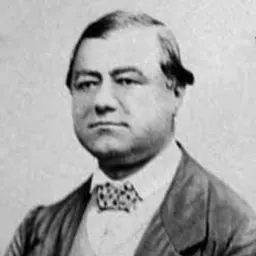
Lived 1852 – 1924 (aged 71). Jefferson Monroe Levy was an American politician and lawyer.
Jefferson Monroe Levy (April 16, 1852 – March 6, 1924) was a three-term U.S. congressman from New York, a leader of the New York Democratic Party, and a renowned real estate and stock speculator.
In 1879 at the age of 27, he took control of Monticello, Thomas Jefferson's home. Levy spent a considerable part of his fortune having Monticello and its grounds restored and preserved.
Early life and education Born in New York City to Jonas Levy and Frances (Phillips) Levy, an American Jewish couple, Jefferson was one of five children. His father was a merchant and sea captain, and his mother was a descendant of Jonas Phillips and his wife Rebecca Machado. Levy and his siblings attended public and private schools. His mother's parents had immigrated from Germany and London in the mid-18th century, respectively, and his father's Sephardic Jewish ancestors, also from London, were among the first settlers of Savannah, Georgia, in 1733.
Levy graduated from the New York University School of Law in 1873. He was admitted to the bar and practiced in New York City, making money in real estate investment and finance.
Monticello Jefferson Levy's uncle Uriah P. Levy, the first Jewish commodore (highest rank at the time) of the U.S. Navy, had bought Monticello and some related property in 1834. He had spent much money to restore and preserve the house and grounds, which he used as a summer retreat. During the American Civil War, the Confederacy took control of the property. After the war, the lawyers of Levy's estate regained it for his heirs. In 1879, after buying out the other heirs of his uncle Uriah P. Levy for $10,050 (~$ in ), Jefferson Levy took control of Monticello (formerly the plantation of Thomas Jefferson).
When Jefferson Levy took over, the grounds had been reduced to 218 acres. During his tenure, he bought 500 acres to add to the complex.
In 1915, after Woodrow Wilson was elected to the presidency, the likelihood of Congressional approval seemed high, but authorization was not achieved. In the Post–World War I recession, Levy's fortune declined. In 1923 he agreed to a down payment and mortgage for Monticello's sale to the newly organized Thomas Jefferson Foundation, which raised funds for the purchase and operated it as a house museum. Levy died in New York City in 1924. He was interred in Beth Olam Cemetery in Brooklyn, which associated with Shearith Israel Congregation, the Spanish and Portuguese Synagogue in Manhattan, near his uncle Uriah Levy.
Political career Levy was elected as a Democrat to the Fifty-sixth Congress, serving from March 4, 1899, to March 3, 1901. He was not a candidate for renomination in 1900. After this, he resumed law practice in New York City and attended to his real estate and stock investments.
He was later elected to the Sixty-second and Sixty-third Congresses, serving from March 4, 1911, to March 3, 1915. He was not a candidate for renomination in 1914. He resumed the practice of law in New York City.
Other activities Levy was involved with the American Boy Scouts. He resigned from the board along with William Randolph Hearst over poor fundraising actions in 1910.
In 1894 Levy became a member of the New York State Society of the Sons of the American Revolution. He was assigned national membership number 4539 and state-society number 439.
Legacy and honors A portrait of Levy was painted by George Burroughs Torrey.
After 1985, when Daniel P. Jordan became president of the Thomas Jefferson Foundation, he arranged to honor the Levy family - uncle and nephew- at Monticello for their roles in preserving the mansion. Jordan had Rachel Levy's gravesite restored, and the Foundation commissioned a monograph that recognized the contributions of the family and was published in 2001.
In 2001, the Thomas Jefferson Foundation published The Levy Family and Monticello, 1834-1923: Saving Thomas Jefferson's House, a history of Jefferson and Uriah Levy's contributions. That same year, Free Press/Simon & Schuster published Marc Leepson's Saving Monticello: The Levy Family's Epic Quest to Rescue the House that Jefferson Built.
Don’t just read it —
keep it.
Full-length biographies made to live with: read them, listen on the way to work, watch them tonight.
- E-book
- Audio
- Video
Instant download · yours to keep · every purchase keeps this site free
Important facts
People in Jefferson Monroe Levy's life
Named in this biography and alive at the same time

Related people
Same field, nearest in time



Contemporaries
People whose lives overlapped Jefferson Monroe Levy's


Frequently asked questions
Who was Jefferson Monroe Levy?
U.S. Congressman from New York
When was Jefferson Monroe Levy born?
Jefferson Monroe Levy was born on 16 April 1852 in New York City.
When did Jefferson Monroe Levy die?
Jefferson Monroe Levy died on 6 March 1924 in New York City.
What was Jefferson Monroe Levy's occupation?
Jefferson Monroe Levy was a politician and lawyer.
What nationality was Jefferson Monroe Levy?
Jefferson Monroe Levy was American.
Sources & further reading
· Wikipedia: Jefferson Monroe Levy
· DBpedia: Jefferson Monroe Levy
Cite this page
APA: Biography.guide. (2026). Jefferson Monroe Levy. https://biography.guide/jefferson-monroe-levy/
MLA: "Jefferson Monroe Levy." Biography.guide, https://biography.guide/jefferson-monroe-levy/.
Chicago: "Jefferson Monroe Levy." Biography.guide. https://biography.guide/jefferson-monroe-levy/.
Data last updated: 2026-09-26 · Spot an error? Report a correction.
Page generated 2026-09-27 05:15 UTC