
Jean-Victor Poncelet
French engineer and mathematician
About Jean-Victor Poncelet
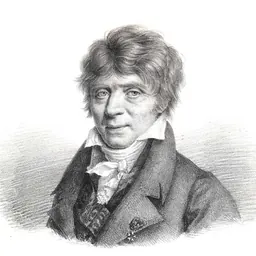
Lived 1788 – 1867 (aged 79). Jean-Victor Poncelet was a French mathematician, politician, physicist, professor, engineer and military engineer.
Jean-Victor Poncelet (; 1 July 1788 – 22 December 1867) was a French engineer and mathematician who served most notably as the Commanding General of the . He is considered a reviver of projective geometry, and his work Traité des propriétés projectives des figures is considered the first definitive text on the subject since Gérard Desargues' work on it in the 17th century. He later wrote an introduction to it: Applications d'analyse et de géométrie.
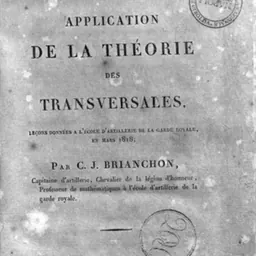
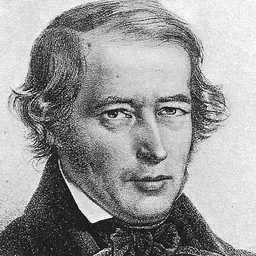
As a mathematician, his most notable work was in projective geometry , although an early collaboration with Charles Julien Brianchon provided a significant contribution to Feuerbach's theorem. He also made discoveries about projective harmonic conjugates; relating these to the poles and polar lines associated with conic sections. He developed the concept of parallel lines meeting at a point at infinity and defined the circular points at infinity that are on every circle of the plane. These discoveries led to the principle of duality, and the principle of continuity and also aided in the development of complex numbers. In 1837, a tenured 'Chaire de mécanique physique et expérimentale' was specially created for him at the Sorbonne (the University of Paris). In 1848, he became the commanding general of his alma mater, the . son of Claude Poncelet, a lawyer of the Parliament of Metz and wealthy landowner. His mother, Anne-Marie Perrein, had a more modest background. At a young age, he was sent to live with the Olier family at Saint-Avold. He returned to Metz for his secondary education, at Lycée Fabert.
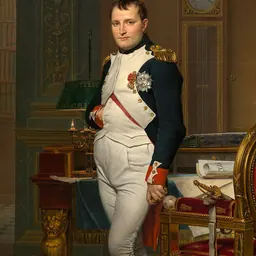
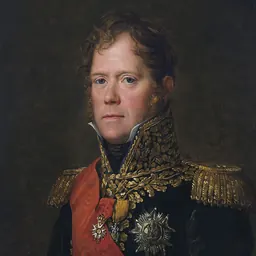
Poncelet took part in Napoleon's invasion of Russia in 1812. His biographer Didion writes that he was part of the group which was cut from Marshal Michel Ney's army at the Battle of Krasnoi and was forced to capitulate to the Russians, though other sources say that he was left for dead. The Russians held him as a prisoner of war and confined him at Saratov. Although the turbine of his design was not constructed until 1838, he envisioned such a design twelve years previous to that.
Commanding General at École Polytechnique (1848–1867) In 1848, Poncelet became the Commanding General of his alma mater, the École Polytechnique. He held the position until 1850, when he retired.
During this time, he wrote Applications d'analyse et de géométrie, which served as an introduction to his earlier work Traité des propriétés projectives des figures. It was published in two volumes in 1862 and 1864. He was elected a Foreign Honorary Member of the American Academy of Arts and Sciences in 1865.
Contributions
Poncelet–Steiner theorem
Poncelet discovered the following theorem in 1822: Euclidean compass and straightedge constructions can be carried out using only a straightedge if a single circle and its center is given. Swiss mathematician Jakob Steiner proved this theorem in 1833, leading to the name of the theorem. The constructions that this theorem states are possible are known as Steiner constructions.
Poncelet's porism
In geometry, Poncelet's porism (sometimes referred to as Poncelet's closure theorem) states that whenever a polygon is inscribed in one conic section and circumscribes another one, the polygon must be part of an infinite family of polygons that are all inscribed in and circumscribe the same two conics.
List of selected works
(1822) Traité des propriétés projectives des figures (1826) Cours de mécanique appliqué aux machines
(1829) Introduction à la mécanique industrielle
(1862/64) Applications d'analyse et de géométrie
Don’t just read it —
keep it.
Full-length biographies made to live with: read them, listen on the way to work, watch them tonight.
- E-book
- Audio
- Video
Instant download · yours to keep · every purchase keeps this site free
Important facts
People in Jean-Victor Poncelet's life
Named in this biography and alive at the same time
Related people
Same field, nearest in time





Contemporaries
People whose lives overlapped Jean-Victor Poncelet's


Frequently asked questions
Who was Jean-Victor Poncelet?
French engineer and mathematician (1788-1867)
When was Jean-Victor Poncelet born?
Jean-Victor Poncelet was born on 1 July 1788 in Metz.
When did Jean-Victor Poncelet die?
Jean-Victor Poncelet died on 22 December 1867 in Paris.
What was Jean-Victor Poncelet's occupation?
Jean-Victor Poncelet was a mathematician, politician, physicist, professor, engineer and military engineer.
What nationality was Jean-Victor Poncelet?
Jean-Victor Poncelet was French.
Sources & further reading
· Wikipedia: Jean-Victor Poncelet
· DBpedia: Jean-Victor Poncelet
Cite this page
APA: Biography.guide. (2026). Jean-Victor Poncelet. https://biography.guide/jean-victor-poncelet/
MLA: "Jean-Victor Poncelet." Biography.guide, https://biography.guide/jean-victor-poncelet/.
Chicago: "Jean-Victor Poncelet." Biography.guide. https://biography.guide/jean-victor-poncelet/.
Data last updated: 2026-09-20 · Spot an error? Report a correction.
Page generated 2026-09-27 05:24 UTC