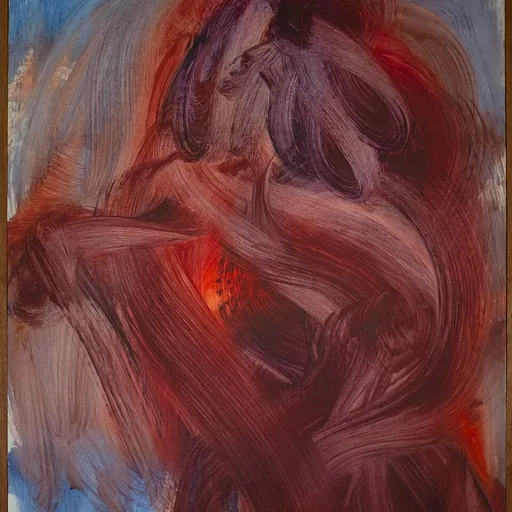
About Jean Messagier
Lived 1920 – 1999 (aged 79). Jean Messagier was a French sculptor, painter, graphic artist and poet.
Jean Messagier (13 July 1920 – 10 September 1999) was a French painter, sculptor, printmaker and poet. Jean Messagier had his first solo exhibition in Paris at Galerie Arc-en-Ciel in 1947. From 1945 to 1949 the artist worked under the influence of Pablo Picasso, André Masson, Paul Klee and , his professor at École nationale supérieure des arts décoratifs in Paris. Messagier again was revealed to the public at an exhibition organized by Charles Estienne at the Galerie de Babylone in 1952, entitled "La Nouvelle École de Paris" (The New School of Paris). The following year, Messagier deliberately broke away from his expressionistic form of Post-Cubism; his inspirations now focused on Jean Fautrier and Pierre Tal-Coat to develop a personal vision in which he renders "light...approached abstractly."
Life and career Jean Messagier spent his childhood during the 1920s and 1930s between Paris and Franche-Comté, where he realized his first representational watercolors and drawings (1940); portraits and landscapes. He first exhibited his works in a group show at the Salon des Moins de Trente Ans in Paris (1941), before participating regularly in Parisian salons: Salon des Moins de Trente Ans, Paris, 1941–51; Salon d'Automne, 1947–52; Salon de Mai, 1948–53; Jeune Gravure Contemporaine, 1950; Young Painters of the Ecole de Paris, Royal Scottish Academy, Edinburgh, 1952; Mostra dell'Incisione Francese Contemporanea, Milan, 1953; Galerie L'Étoile scellée and Galerie Craven, Paris, 1953. Messagier would soon be represented at group exhibitions in Germany, Zurich, Florence, Brussels, London and the Solomon R. Guggenheim Museum in New York. He would also participate in the Salon des Réalités Nouvelles, Salon Comparaisons, Peinture informelle (alongside Jean Fautrier, Hans Hartung, Jean-Paul Riopelle, Mark Tobey, Wols) and the Salon d’Octobre of which he was one of the founding members.
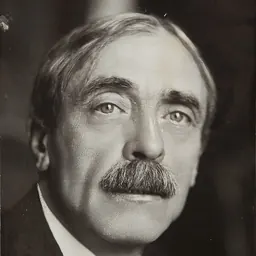
Following his schooling at Large-Chênois in Montbeliard, Messagier moved to Paris. At l'Ecole Nationale des Arts Décoratifs in Paris, his professors included Roland Oudot, Maurice Brianchon, Raymond Legueult and François Desnoyer. In parallel he studied with the poet Paul Valéry at the Collège de France. Messagier then showed at the Galerie de Babylone in 1952 entitled "La Nouvelle École de Paris" (The New School of Paris), organized by Charles Etienne,
Messagier co-founded the Salon d'Octobre in Paris and exhibited there in 1952 and 1953. In 1954 Marcelle gave birth to their second son, Thomas (who would become a taxidermist). At this time the family resided in the heart of Paris, 8 Rue Pierre et Marie Curie. In 1958 their third son, Simon, was born. By this time a new vocabulary had appeared in the press that described the new form of painting: art autre, art lyrique, tachiste, paysage abstrait, nouveau primitivisme, l'informel were the terms used. The gesture of painting itself became the creative act. Painting was no longer an activity oriented towards an aesthetic production. L'informel became the dominant expression of the times, not solely amongst the critics, poets and artists, but also among scientists and philosophers, such as Merleau-Ponty and Bachelard, and psychiatrists oriented toward phenomenology who used post-Freudian theory to speak of "paysage intérieur", the internal landscape of the personality. Painting (and drawing) for Messagier became the medium through which the universe spoke. Natural forms were observed and replaced by paintings within which the forces of nature could be experienced. One year later, in the 8th São Paulo Art Biennial, Messagier represented France along with four other artists. The following year Messagier created an annual shooting competition, and became a full member of the Comité National de la Gravure Française. In 1967 he participated again in the international exhibition in Pittsburgh.
and the release of a series of artistic postal stamps and co-created a fresco for the Salon de Mai in Paris. He was awarded Chevalier de l'Ordre des Arts et Lettres and in 1978 exhibited in the 7th Alexandria Biennale for Mediterranean Countries. Titles, often inscribed directly into the painted surface, are a fundamental aspect of Messagier's paintings. The title becomes part of the work, opening the viewers imagination to the pleasure the artist wishes to share.
The term paysagisme abstrait (literally, abstract landscapism) could be reserved for a process where the artist senses and tries to capture the 'rhythms' of a landscape. This concept of rhythm is explicitly mentioned by a number of painters in addition to Messagier; Jean René Bazaine, Raoul Ubac and Zao Wou Ki. The rhythm of the landscape is experienced by the artist and expressed by the gesture; something the viewer in turn would experience as sensation. The landscape in this case is a direct source of inspiration. It must be felt.
During the winter of 1969 Messagier elaborated a technique he called "le Gel" in an effort to perfect a certain number of compositions whereby nature itself (e.g., temperature, hydrometry, condensation, and decomposition) would intervene in the creative process. These paintings were realized outside of his studio at the Moulin de Lougres between two streams, where the calm of the land was superimposed with the turbulent current of the water and air. For Messagier the process was equivalent to sculpting air, and the works became replicas of air itself influenced by liquid. Both solid and liquid would intermingle, one born from the other. His goal had been the reconciliation between art and life, between man and nature. Both abstraction and figuration could play a role. This was not the pitting of human nature against nature itself, but the fusion of the two. From the early 1950s Messagier had put into question the utility of debating the concepts of abstraction and figuration. Now both had been surpassed.
From the 1970s onwards, Messagier simultaneously evoked images from popular culture such as Goldorak, Marsupilami, Betty Boop, or famous figures like Lady Diana or Greta Garbo, and shamelessly shook up his masters by quoting Delacroix, Matisse, Picasso. These years 1970-80, where he painted the beautiful triviality of fried eggs, radishes, giant mille-feuilles and the poetry of poppies, daisies, frost, monotypes with direct impressions of leaves or lace on the other. In 1982, he painted the cover of a Jimi Hendrix album. After the experiments of the 1970s-80s, he would the turn in the 1988-90 to a new gesture, where broad brushstrokes and the fresh colors including glitters condense all the artist's energy.
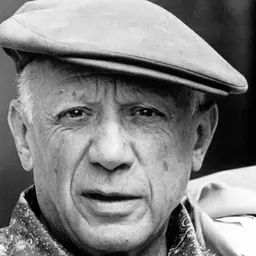
Legacy Messagier, beyond abstraction and beyond figuration, had immersed himself in the world of life and nature. His gesture is life, his colors impressions and sensations of nature. His work was described by the critic Jean-Luc Daval as "the true nouvelle figuration." In response to Picasso's phrase "I do not search, I find", Messagier would scribbled a few years before the end of his life, "I do not find, I search." In this phrase, writes Alexandre Rolla, "Jean Messagier gives some clues as to the nature of the gesture", the stance he defended throughout his life, and observed throughout his oeuvre, "a winding path that should be explored today, to consider, finally, the importance of this work in the history of art." Plaine battante (1956), Grenoble, Musée de Grenoble Novembre cerné (1959), Vitry-sur-Seine, Musée d'art contemporain du Val-de-Marne Antichambre pour une plage (1960), Dijon, Musée des beaux-arts Mai à palier (1962), Vitry-sur-Seine, Musée d'art contemporain du Val-de-Marne Clef de mars (1963), private collection Sous les statues d'Italie (1963), Dijon, Musée des beaux-arts Théâtre des marionnettes (1963), Dijon, Musée des beaux-arts Paul Valéry (1965), Dijon, Musée des beaux-arts Louis XIV l'apres midi (1966), private collection Louis XIV (1966), Dijon, Musée des beaux-arts Aube à bijoux (1967), Dijon, Musée des beaux-arts Printemps du monde (1967), Dijon, Musée des beaux-arts Monstres d'été (1967), private collection Mesdemoiselles Printemps (1968), Marseille, Musée Cantini Le Sexe des vallées (1970), Dijon, Musée des beaux-arts Portrait de Kathleen et Pierre Granville (1973), Dijon, Musée des beaux-arts Projet pour onze penalties de gala (1975), Marseille, Musée Cantini Picasso aurait dû pêcher à Antibes avec les Marsupilamis et Betty Boop (1982), Antibes, Musée Picasso Waterloo à Java (1983), private collection Le grand équipage du Val-de-Marne (1986), Vitry-sur-Seine, Musée d'art contemporain du Val-de-Marne Les grands grillons (1990), private collection Enchevêtrements dirigés (1993), Musée d'art contemporain du Val-de-Marne
Selected literature Jean Messagier: 31 juillet-8 août, 1943, Musée du Château de Montbéliard, 1943 Solomon R. Guggenheim Museum, New York, Younger European painters: a selection, exhibition catalogue, 2 December 1953 - 21 February 1954 Jean Messagier: 23 avril au 13 mai, 1954, Palais des beaux-arts (Brussels, Belgium), 1954 Frank Elgar, Cercle Volney, Jean Messagier, Paris, 1955 Charles Estienne, Catalogue de l'Exposition Jean Messagier, Peintures et aquarelles à la Galerie André Schoeller Jr., Paris, 1960 Charles Estienne, Jean Messagier: Quinze années de peinture, oeuvres de 1947 a 1962, 8 au 30 novembre 1963, Galerie André Schoeller Jr., Galerie Bernheim-Jeune, Paris, 1963 Jean Messagier, monotypes: 12 mars-11 avril 1964, Galerie Edwin Engelberts, Éditeur La Galerie, 1964 Annette Michelson, Jean Messagier, Choix d'Estampes 1945-1966, Engèlberts, 1966 Œuvres récentes de Jean Messagier: Galerie André Schoeller, Paris, novembre/décembre, Paris, 1967 Jean Messagier: sculptures, 1948 - 1969, 23 avril - 17 mai 1969, Galerie Knoedler, Paris, 1969 Pierre Cabanne, Jean Messagier, Éditions du Temps, 1969 Danièle Giraudy, Cantini 69 [i.e. soixante-neuf]: naissance d'une collection, Numéro 2, Musée Cantini, 1969 Jean Messagier: exposition, mai-juin 1973, Galerie Ariel, Paris 8e, Galerie Beno d'Incelli, Paris 8e, Editions Galerie Ariel, 1973 Entretien de Jean Messagier avec Daniel Meiller et Patrick Le Nouene—Biographie, expositions, bibliographie. Messagier, Putman, Alpers, Nouene, Messagier, les estampes et les sculptures: 1945-1974, Arts et métiers graphiques, Y. Rivière, 1975 Les dévelofixers: exposition, Jean Messagier, Fondation Claude-Nicolas Ledoux, 1976 Jean Messagier: parcours d'un peintre de 1949 à 1979, Musée Granet (Aix-en-Provence, Bouches-du-Rhône), 25 juillet-30 septembre 1980, Maison de la culture d'Amiens, Centre national de recherche, d'animation et de création pour les arts plastiques (Le Creusot, Saône-et-Loire), 1979 Jean Messagier, Roger Meier, Anne Cuneo, André Ramseyer, Editions de la Prévôté, 1979 Galeries nationales du Grand Palais, Jean Messagier: Galeries Nationales du Grand Palais, Paris, 13 novembre 1981 - 11 janvier 1982 Jean Messagier: Musée Despiau-Wlérick et Dubalen (Mont-de-Marsan), exposition, juin-août 1983 École du Louvre, Image et signification, Documentation française, 1983, pp. 275–280 Jean Messagier, Feuilles de mille-feuilles, Fata Morgana, 1984 Jean Messagier à St-Ursanne, 16 juin au 18 août 1984, diffusion Société jurassienne d'émulation, 1984 Ante Glibota, Jean Messagier: bourgeons de papier, croquis 1940-1985, Editions galerie d'art international, 1985 Jean Messagier: oeuvres choisies entre 1945-1985, Exposition, Musée d'Art Contemporain, Dunkerque, 1985 Jean Messagier au Musée de Brou: Bourg en Bresse, 5 octobre-17 novembre 1985 Traces de visites, C. Tchirakadzé, Evelyne Salmon, Jean Messagier, Musée du Château de Montbeliard, 1986 Le grand cortège de Jean Messagier: installations thermoformées et lieux créés par Jean Messagier, Ministère de la Culture, Direction des Musée de France, Association générale des conservateurs des collections publiques de France, Association des Conservateurs de Franche-Comté Paris Art Center, 1987 Jean de Bengy, Jean-Michel Alberola, François Mitterrand, Comme un coursier indompté, Jean-Michel Alberola, Pierre Alechinsky, Gilles Aillaud, Avigdor Arikha, Jean-Charles Blais, Pierre Buraglio, Jean Messagier, Rouan, Dominique Bozo, Jean-Michel Foray, Centre national des arts plastiques, 1989 Jean Messagier, Le Grand défroissement, Fata Morgana, 1989 Jean Messagier: 1947-1990, du 16 Juin au 16 Septembre 1990, Musée Toulouse-Lautrec, 1990, , 9782901284208 Messagier à la Galerie Katia Granoff, Édition Katia Granoff (Paris), 1990 Jean Messagier, Météores quotidiens, Fata Morgana, 1992 Cimaise, Volume 41, Numéros 228 à 233, 1994 Jean Messagier, Edition Arts et dialogues européens, 1995 Jean Messagier, Le gel, 1995 Jean Messagier: magicien d'imaginaires, expositions, Saline Royale d'Arc-et-Senans, 15 mai-3 août 1997, Musée Gustave Courbet, Ornans, 7 juin-31 octobre 1997, Jean-Jacques Fernier, Musée Gustave Courbet Ornans, Doubs, Fondation Claude-Nicolas Ledoux, 1997 Messagier, Estampes: Exposition Au Musee de Gravelines, 30 Novembre 1997 au 1er Fevrier 1998, Musée de Gravelines, 1997 Jean Messagier, Tous les pollens du monde, Volume 38 de L'Art en écrit, Éditeur Jannink, 1998, , 9782902462513 Matthieu Messagier, Jean Messagier, oeuvres graphiques: (1943 - 1998); Musée Baron Martin de Gray, du 16 juin au 11 septembre 2000 Jean Messagier, 1920-1999: portes pour une joie, Musée Paul Valéry (Sète, Hérault), 2004 Jean Messagier: la nature au creux de la main, Montbéliard (Doubs), Musée du Château (Montbéliard), Musée d'art et d'histoire (Belfort), ADAGP, 2006 Francette Messagier, Jean Messagier: traces, Néo éditions, 2006, , 9782914741323 Nouvelles de l'Estampe, Numéros 203 à 208, Comité national de la gravure française, Bibliothèque nationale (France). Cabinet des estampes, 2006, pp. 61–64 Richard Leydier, Alain Jouffroy, Jean Messagier, Le Cercle d'art contemporain, Cercle d'Art, 2007, , 9782702208052
Don’t just read it —
keep it.
Full-length biographies made to live with: read them, listen on the way to work, watch them tonight.
- E-book
- Audio
- Video
Instant download · yours to keep · every purchase keeps this site free
Important facts
People in Jean Messagier's life
Named in this biography and alive at the same time




Related people
Same field, nearest in time


Contemporaries
People whose lives overlapped Jean Messagier's





Frequently asked questions
Who was Jean Messagier?
French artist (1920–1999)
When was Jean Messagier born?
Jean Messagier was born on 13 July 1920 in 17th arrondissement of Paris.
When did Jean Messagier die?
Jean Messagier died on 10 September 1999 in Montbéliard.
What was Jean Messagier's occupation?
Jean Messagier was a sculptor, painter, graphic artist and poet.
What nationality was Jean Messagier?
Jean Messagier was French.
Sources & further reading
Cite this page
APA: Biography.guide. (2026). Jean Messagier. https://biography.guide/jean-messagier/
MLA: "Jean Messagier." Biography.guide, https://biography.guide/jean-messagier/.
Chicago: "Jean Messagier." Biography.guide. https://biography.guide/jean-messagier/.
Data last updated: 2026-09-22 · Spot an error? Report a correction.
Portrait: Wikimedia Commons · author & licence
Page generated 2026-09-27 05:04 UTC