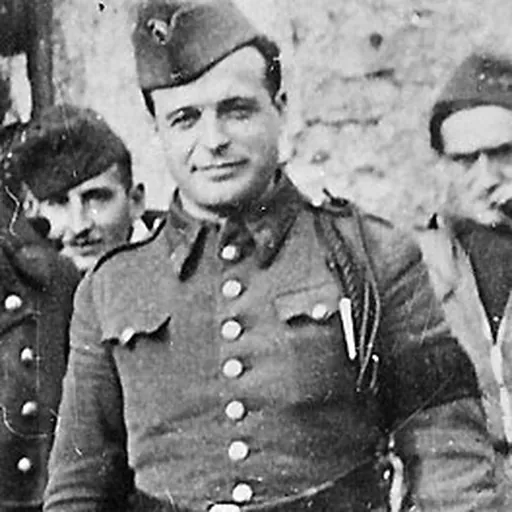
Jean Cavaillès
French philosopher and mathematician
About Jean Cavaillès
Lived 1903 – 1944 (aged 40). Jean Cavaillès was a French philosopher, university teacher, mathematician and resistance fighter.
World War II After the outbreak of World War II, he was mobilized in 1939 as an infantry lieutenant with the 43rd Regiment and was later attached to the Staff of the 4th Colonial Division. He was honoured for bravery twice and was captured on 11 June 1940. At the end of July 1940 he escaped from Belgium and fled to Clermont-Ferrand, where the university of Strasbourg was re-organized.
At the end of December 1940, he met Emmanuel d'Astier de la Vigerie with whom he created a small group of resistance fighters, known as "the Last Column". To reach a broader audience, they created a newspaper which was to become Libération. It served as the mouthpiece of both Libération-Sud and Libération-Nord. Cavaillès took an active part in editing the paper. The first edition appeared in July 1941.
In 1941, he was appointed professor at the Sorbonne and left Clermont-Ferrand for Paris, where he helped form the Libération-Nord resistance group, becoming part of its management committee.
In April 1942, at the instigation of Christian Pineau, the central Office of Information and Action (BCRA) of London charged him with the task of forming an intelligence network in the Northern Zone, known as "Cohors". He was ordered by Christian Pineau to pass into the Southern Zone, and Cavaillès headed the network and formed similar groups in Belgium and the north of France.
In September 1942 he was arrested with Pineau in Narbonne by the French police. After a failed escape attempt to London, he was interned in Montpellier at the Saint-Paul d' Eyjeaux prison camp from where he escaped at the end of December 1942. The book Cavaillès wrote in prison in Montpellier in 1942 was published posthumously in 1946, edited by the epistemologist Georges Canguilhem and the mathematician Charles Ehresmann under the title Sur la logique et la theorie de la science.
Denounced as a public enemy by the Vichy regime and sought by the police, he fled clandestinely to London in February 1943. There he met General Charles de Gaulle on several occasions.
Back in France on 15 April he resigned from the management Committee of the Libération movement in order to dedicate himself entirely to direct action. He was in charge of the sabotage of the stores of the Kriegsmarine in Brittany and German radio installations on the coast.
Betrayed by one of his liaison officers, he was arrested on 28 August 1943 in Paris with his sister
Buried at first in Arras under a wooden cross marked "unknown n°5", his body was exhumed in 1946 to be buried in the Crypt at the Sorbonne in Paris.
Legacy The Centre Cavaillès de l'École Normale Supérieure was established in Paris in 1969, at 29 rue d'Ulm, as Centre for the Study of the History and Philosophy of Science. At the formal opening, philosopher Georges Canguilhem said, "A philosopher-mathematician loaded with explosives, lucid and reckless, resolute without optimism. If that's not a hero, what is a hero?" (Translated from the original French language: "Un philosophe mathématicien bourré d'explosifs, un lucide téméraire, un résolu sans optimisme. Si ce n'est pas un héros, qu'est-ce qu'un héros ?")
Cavaillès is honored in the Heroes of the Resistance postage stamp set.
In L'Armée des ombres, a 1969 film directed by Jean-Pierre Melville, the character of Luc Jardie (the Chief) was in part inspired by Cavaillès. Jardie's chief operative, recuperating from injuries in a hideaway, has only five books; the title of each is a publication of Cavaillès, though the author is shown as "Luc Jardie."
Military honours Chevalier de la Légion d'honneur Compagnon de la Libération – decree of 20 November 1944 Croix de Guerre 39/45 Médaille de la Résistance Officier de l'Ordre de la Couronne de Belgique (avec palme) Médaille de la Résistance (Belgique)
Works Sur la deuxième définition des ensemble finis donnée par Dedekind [On the second definition of finite sets given by Dedekind], Fundamenta Mathematicae, XIX, 1932, pp. 143–148. L'école de Vienne au Congrès de Prague, Revue de métaphysique et de morale, XLII, 1935, pp. 137–149. Briefwechsel Cantor-Dedekind, ed. by E. Noether and J. Cavaillès, Actualités scientifiques et industrielles, 518, Paris, Hermann, 1937. French translation by Charles Ehresmann in Cavaillès, Philosophie mathématique, Paris, Hermann, 1962, pp. 177–252. Remarques sur la formation de la théorie abstraite des ensembles [Remarks on the formation of abstract set theory], Actualités scientifiques et industrielles, 606 & 607, Paris, Hermann, 1938. Reprinted in Cavaillès, Philosophie mathématique, Paris, Hermann, 1962, pp. 23–176. Méthode axiomatique et formalisme [Axiomatic method and formalism], Actualités scientifiques et industrielles, 608, 609 & 610, Paris, Hermann, 1938. Du collectif au pari [From the collective to the bet], Revue de métaphysique et de morale, XLVII, 1940, pp. 139–163. La pensée mathématique [Mathematical thought], discussion with Albert Lautman (February 4, 1939), Bulletin de la Société française de philosophie, XL, 1946. Transfini et continu [Transfinite and continuum], Actualités scientifiques et industrielles, 1020, Paris, Hermann, 1947. Reprinted in Cavaillès, Philosophie mathématique, Paris, Hermann, 1962, pp. 253–274. Sur la logique et la théorie de la science [On logic and the theory of science], Paris, Presses universitaires de France, 1947. English translation by T. S. Kisiel in J. Kockelmans and T. Kisiel (eds), Phenomenology and the Natural Sciences, Evanston, Northwestern University Press, 1970. Philosophie mathématique [Mathematical philosophy], Paris, Hermann, 1962. Œuvres complètes de philosophie des sciences [Complete works in philosophy of the sciences], Paris, Hermann, 1994.
English translations’ A Cavailles and Canguilhem reader: an introduction to the French philosophy and history of science, trans. Camille Akmut. 76 pages.
Don’t just read it —
keep it.
Full-length biographies made to live with: read them, listen on the way to work, watch them tonight.
- E-book
- Audio
- Video
Instant download · yours to keep · every purchase keeps this site free
Important facts
People in Jean Cavaillès's life
Named in this biography and alive at the same time


Related people
Same field, nearest in time


Contemporaries
People whose lives overlapped Jean Cavaillès's
Frequently asked questions
Who was Jean Cavaillès?
French philosopher and mathematician (1903–1944)
When was Jean Cavaillès born?
Jean Cavaillès was born on 15 May 1903 in Saint-Maixent-l'École.
When did Jean Cavaillès die?
Jean Cavaillès died on 4 April 1944 in Arras.
What was Jean Cavaillès's occupation?
Jean Cavaillès was a philosopher, university teacher, mathematician and resistance fighter.
What nationality was Jean Cavaillès?
Jean Cavaillès was French.
Sources & further reading
Cite this page
APA: Biography.guide. (2026). Jean Cavaillès. https://biography.guide/jean-cavailles/
MLA: "Jean Cavaillès." Biography.guide, https://biography.guide/jean-cavailles/.
Chicago: "Jean Cavaillès." Biography.guide. https://biography.guide/jean-cavailles/.
Data last updated: 2026-09-23 · Spot an error? Report a correction.
Portrait: Wikimedia Commons · author & licence
Page generated 2026-09-27 05:05 UTC