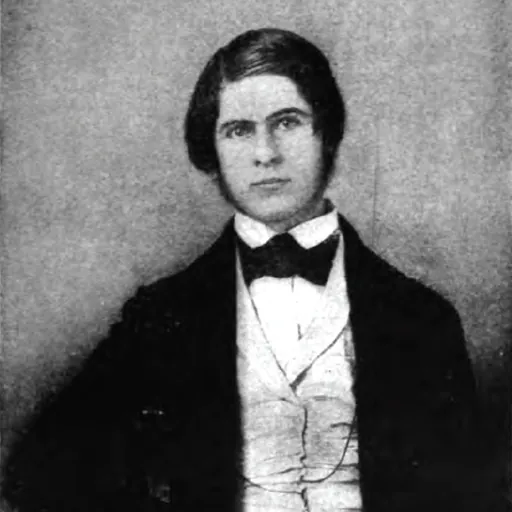
About Jay Cooke
Lived 1821 – 1905 (aged 83). Jay Cooke was an American explorer and businessperson.
Jay Cooke (August 10, 1821 – February 16, 1905) was an American financier who helped finance the Union war effort during the American Civil War and the postwar development of railroads in the northwestern United States. He is generally acknowledged as the first major investment banker in the United States and creator of the first wire house firm.
Early life
Cooke was born at Sandusky, Ohio, the son of Eleutheros Cooke and Martha Carswell Cooke. Eleutheros Cooke was a pioneer Ohio lawyer and Whig, a member of the Ohio General Assembly, and a member of Congress from Ohio from 1831 to 1833.
Financier of the Civil War
In 1838, Cooke went to Philadelphia, where he entered the banking house of E. W. Clark & Co. as a clerk, and became a partner in 1842. He left this firm in 1858. On January 1, 1861, just months before the start of the American Civil War, Cooke opened the private banking house of Jay Cooke & Company in Philadelphia. Soon after the war began, the state of Pennsylvania borrowed $3 million ($ today) to fund its war efforts. Cooke quickly sold the $500 million in bonds, and $11 million more. Congress immediately sanctioned the excess.
Cooke influenced the establishment of national banks, and organized a national bank at Washington and another at Philadelphia almost as quickly as Congress could authorize the institutions.
Although Cooke's bond campaigns were widely praised as a patriotic contribution to the Union cause, his huge personal financial gains did not go unnoticed. Notorious for stalling the deposit of bond proceeds into federal coffers, he was accused of corruption, and on December 22, 1862, Representative Charles R. Train proposed a Congressional investigation of the Treasury – though the investigation was never realized. However, in advancing the money for the work (especially on the railway), the firm overestimated its capital, and at the approach of the Panic of 1873 it was forced to suspend operations. Jay Cooke, Jr. – Cooke's son and Barney's brother-in-law – joined the new firm as a minority partner.
By 1880, Cooke had met all his financial obligations, and through an investment in the Horn Silver Mine in Utah, had again become wealthy. He died in the Ogontz (now Elkins Park) section of Cheltenham Township, Pennsylvania, on February 16, 1905. and St. Paul's Episcopal Church on South Bass Island, across the bay from his summer home on Gibraltar. After he had been forced to give up his Ogontz estate in bankruptcy, he later repurchased it and converted it into a school for girls. A statue of Jay Cooke by Henry Shrady is located in Jay Cooke Plaza near the intersection of 9th Avenue East and Superior Street in Duluth.
Don’t just read it —
keep it.
Full-length biographies made to live with: read them, listen on the way to work, watch them tonight.
- E-book
- Audio
- Video
Instant download · yours to keep · every purchase keeps this site free
Important facts
People in Jay Cooke's life
Named in this biography and alive at the same time


Related people
Same field, nearest in time

Contemporaries
People whose lives overlapped Jay Cooke's




Frequently asked questions
Who was Jay Cooke?
American lawyer, businessman and politician (1821–1905)
When was Jay Cooke born?
Jay Cooke was born on 10 August 1821 in Sandusky.
When did Jay Cooke die?
Jay Cooke died on 16 February 1905 in Ogontz.
What was Jay Cooke's occupation?
Jay Cooke was an explorer and businessperson.
What nationality was Jay Cooke?
Jay Cooke was American.
Sources & further reading
Cite this page
APA: Biography.guide. (2026). Jay Cooke. https://biography.guide/jay-cooke/
MLA: "Jay Cooke." Biography.guide, https://biography.guide/jay-cooke/.
Chicago: "Jay Cooke." Biography.guide. https://biography.guide/jay-cooke/.
Data last updated: 2026-09-23 · Spot an error? Report a correction.
Portrait: Wikimedia Commons · author & licence
Page generated 2026-09-27 05:05 UTC