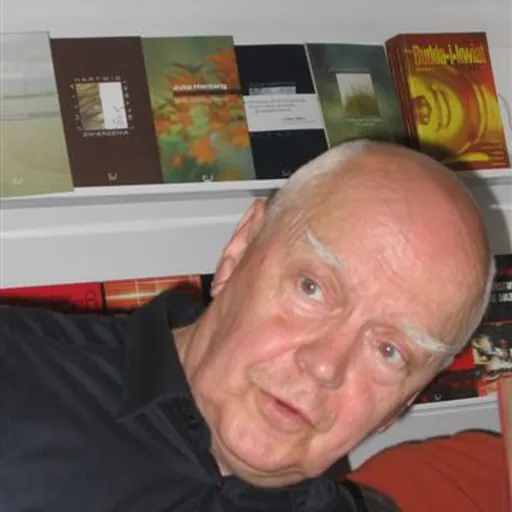
Jarosław Rymkiewicz
Polish writer, poet and literary critic
About Jarosław Rymkiewicz
Lived 1935 – 2022 (aged 86). Jarosław Rymkiewicz was a Polish poet, essayist, literary critic, playwright, university teacher and literary historian.
Jarosław Marek Rymkiewicz (Jarosław Marek Szulc; 13 July 1935 – 3 February 2022) was a Polish poet, essayist, dramatist, translator and literary critic. He was the recipient of the 2003 Nike Award, Poland's most important literary prize.
Life and work Rymkiewicz was the son of Władysław Szulc, of German and Polish origin, who changed his last name to Rymkiewicz (a writer) and wife Hanna Baranowska, of German and Tatar origin (a physician).
He studied Polish philology at the University of Łódź and worked at the Literary Research Institute of Polish Academy of Sciences and Letters. As a poet, he was influenced by the traditions of classicism and the baroque. He has received multiple prizes for his novels, essays, and translations, including the Kościelski Prize (1967), S. Vincenz Prize (1985), and Polish PEN Club Prize. His volume of poetry Zachód słońca w Milanówku won the prestigious Nike Award in 2003.
Although Rymkiewicz was primarily a poet, he is better known as the author of two influential novels that contributed to the two most important debates of the 1980s: that involving the 1981 martial law and Polish-Jewish relations. His novel Rozmowy polskie latem, 1983 (Polish Conversations in Summer 1983) discusses the meaning of being Polish and the preoccupation with achieving independence. Rymkiewicz’s second novel, entitled Umschlagplatz (1988), had a greater impact. Instytut Literacki, the largest Polish émigré publishing house, originally published the novel in Paris in 1988 as it could not appear in communist Poland. It was reprinted a few times by underground publishing houses in Poland but officially appeared only in 1992 after the communists lost power in 1989. It was translated into French (1989), German (1993), and English (1994).
The novel focuses on the symbolic meaning of Umschlagplatz, which denotes a small square in German-occupied Warsaw (1939–1945) from which the Germans sent more than 300,000 Jews to their deaths, and thus a place which "may well be the only place of its kind" in the world. (p. 7, Umschlagplatz). He attempts to understand the implication of the existence of such a place for the contemporary Warsaw and the contemporary Poles. It took Rymkiewicz two years of study and research to create a detailed plan of the square. He concluded that Germans introduced the name Umschlagplatz sometime before July 1942; in pre-war Poland the place was called Transfer Square and was the centre for the Jewish wholesale trade.
He is also known as a translator, particularly of American poetry (T. S. Eliot and Wallace Stevens) and of Spanish poetry (Federico García Lorca and Pedro Calderón de la Barca).
Publications Poetry Each year links to its corresponding "[year] in poetry" article: 1957: Konwencje ("Conventions") 1983: Ulica Mandelsztama ("Mandelstam Street") 1984: Mogila Ordona ("Ordon's Grave") 1993: Moje dzielo posmiertne ("My Posthumous Works") Krakow: Znak 1999: Znak niejasny, baśń półżywa ("The Unclear sign, a Half-living Legend"), Warsaw: Państwowy Instytut Wydawniczy 2002: Zachód słońca w Milanówku ("Sunset in Milanówek"), Warsaw: Sic! 2006: Do widzenia gawrony ("Good-bye, Rooks"), Warsaw: Sic!
Prose Each year links to its corresponding "[year] in literature" article:
Books of Essays 1967: Czym jest klasycyzm ("What is Classicism?") 1968: Mysli rozne o ogrodach ("Various Thoughts about Gardens") 1977: Aleksander Fredro jest w zlym humorze ("Aleksander Fredro is in a Bad Mood") 1982: Juliusz Slowacki pyta o gozine ("Juliusz Slowacki Inquires about the Time"). Warsaw: Czytelnik 1983: Wielki Ksiaze ("Archduke"). Warsaw: PIW 1987: Zmut Warsaw: Niezalezna Oficyna Wydawnicza 1989: Baket 1994: Kilka szczegolow ("A Few Particulars"). Cracow: Arcana 1996: Do Snowia i dalej ("To Snow and Beyond"). Cracow: Arcana 2001: Lesmian. Encyklopedia ("Lesmian. Encyclopedia"). Warsaw: Sic! 2004: Słowacki. Encyklopedia ("Słowacki: The Encyclopaedia"), Warsaw: Sic! 2007: Wieszanie ("Hanging"), Warszawa: Sic! 2008: Kinderszenen, Warszawa: Sic!
Novels 1983: Rozmowy polskie latem roku 1983 ("Polish Conversations during 1983 Summer") 1988: Umschlagplatz
Comedies 1970: Krol Miesopust ("The King of Meat") 1971: Porwanie Europy ("The Abduction of Europe") 1972: Kochankowie pieklo ("The Lovers of Hell") 1973: Niebianskie bliznieta ("The Heavenly Twins") 1979: Dwor nad Narwia ("Country House on the Narwa")
Don’t just read it —
keep it.
Full-length biographies made to live with: read them, listen on the way to work, watch them tonight.
- E-book
- Audio
- Video
Instant download · yours to keep · every purchase keeps this site free
Important facts
People in Jarosław Rymkiewicz's life
Named in this biography and alive at the same time


Related people
Same field, nearest in time


Contemporaries
People whose lives overlapped Jarosław Rymkiewicz's



Frequently asked questions
Who was Jarosław Rymkiewicz?
Polish writer, poet and literary critic (1935–2022)
When was Jarosław Rymkiewicz born?
Jarosław Rymkiewicz was born on 13 July 1935 in Warsaw.
When did Jarosław Rymkiewicz die?
Jarosław Rymkiewicz died on 3 February 2022 in Warsaw.
What was Jarosław Rymkiewicz's occupation?
Jarosław Rymkiewicz was a poet, essayist, literary critic, playwright, university teacher and literary historian.
What nationality was Jarosław Rymkiewicz?
Jarosław Rymkiewicz was Polish.
Sources & further reading
· Wikipedia: Jarosław Rymkiewicz
· DBpedia: Jarosław Marek Rymkiewicz
Cite this page
APA: Biography.guide. (2026). Jarosław Rymkiewicz. https://biography.guide/jaroslaw-rymkiewicz/
MLA: "Jarosław Rymkiewicz." Biography.guide, https://biography.guide/jaroslaw-rymkiewicz/.
Chicago: "Jarosław Rymkiewicz." Biography.guide. https://biography.guide/jaroslaw-rymkiewicz/.
Data last updated: 2026-09-20 · Spot an error? Report a correction.
Portrait: Wikimedia Commons · author & licence
Page generated 2026-09-27 04:57 UTC