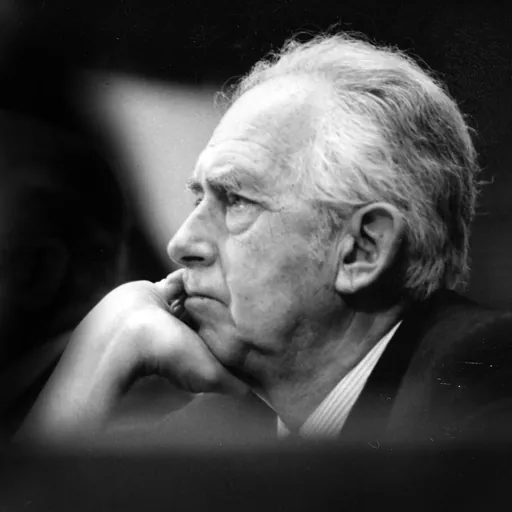
János Szentágothai
Hungarian anatomist, university professor, MP, President of the Hungarian Academy of Sciences
About János Szentágothai
Lived 1912 – 1994 (aged 81). János Szentágothai was a Hungarian anatomist, neuroscientist, university teacher, politician and physician.
Biography He was born as János Schimert, in Budapest in 1912, to Dr Gustav Schimert and Margit Antal, in a family of doctors. He was descended from Transylvanian Saxons on his father's side and Székely on his mother's side. He was admitted to the German grammar school in Budapest in 1930, and was admitted to the Peter Pázmány University Medical School. Four brothers also studied in the same place. Doctors was inaugurated in 1936.
Family On 7 June 1938 he married Alice Biberauer, who he met in the Pro Christo Student Association. They had three daughters, Catherine (1939), Clare (1941) and Maria Christina (1951), all three of whom entered the medical field. John Szentágothai four doctor's brother lived in the United States and Germany. In his free time with pleasure fumbling with in Révfülöp weekend on the same property with plants.
Academic career Schimert started his medical studies at the Budapest University Medical School in 1930, and was accepted in the first year by Professor Mihály Lenhossék as a research student in the Department of Anatomy. He received his MD in 1936 and continued to teach at Budapest, becoming Associate Professor in 1942. During the Second World War (karpaszományos) he was a physician, airman, and a prisoner of war. He returned in 1946. He then attended Pécs University Medical School, where he was later Head of the Anatomy Department. After the war, he resumed study of the vestibular system and dealt with the topic of neuroendocrinology. During his study at Pécs, he pursued innovative work in the field of neuroanatomy. In 1948 he was elected a corresponding member of the Hungarian Academy of Sciences. In 1961, he started the department of electron microscopy in brain research in Hungary.
In 1963, he returned to Budapest to lead the Semmelweis University School of Medicine Department of Anatomy. There he mainly addressed the cerebellum and functioning of the cerebral cortex. In addition, he performed experimental research on the spinal cord and brainstem reflex mechanisms. In 1967 he was elected a full member of the Hungarian Academy of Sciences. He headed the department until 1977, and in 1986 officially retired from teaching. Ferenc Kiss, famous for his work produced for the human anatomy atlas, drew his textbook, which was translated into thirteen languages and more than a hundred editions. He proclaimed that half the age of most of the people speaking the development of one and a half years of age, and it will need to communicate is the most important factor.
Public career In 1956 at Pécs, he was chairman of the Revolutionary Committee of Intellectuals. He did not return to public life until 1973, when he was elected vice-president of the Hungarian Academy of Sciences. Four years later he became its president and therefore left the position of University department head. In 1985, he entered parliament as a member of the Presidential Council of the Hungarian People's Republic. He was (later a member of its abolition), involved in the work of the Hungarian Democratic Forum during the transition. She was a member of the Foreign Affairs Committee. Szentágothai and his wife are buried in Budapest.
Main works Eccles, John Carew, Masao Ito, and János Szentágothai. The cerebellum as a neuronal machine. New York: Springer-Verlag, 1967. Szentágothai, János. "The modular architectonic principle of neural centers." Reviews of Physiology, Biochemistry and Pharmacology, Volume 98. Springer Berlin Heidelberg, 1983. 11–61. Szentágothai, János. Hypothalamic control of the anterior pituitary: an experimental-morphological study. Akadémiai Kiadó, 1968. Arbib, Michael Anthony, Péter Érdi, and János Szentágothai. Neural organization: Structure, function, and dynamics. The MIT Press, 1998. Szentágothai, János. "Synaptology of the visual cortex." Visual Centers in the Brain. Springer Berlin Heidelberg, 1973. 269–324.
Awards and recognition Kossuth Prize (1950) I state fee degree (1970) – achievements in the functional structure of the nervous system research. Honorary member of the American Association for Anatomy (1975) Karl Spencer Lashley Award (1973) Academic Gold Medal (1985) The Hungarian Order of Merit Cross with the Star (1992) Fellow of the Royal Society
Don’t just read it —
keep it.
Full-length biographies made to live with: read them, listen on the way to work, watch them tonight.
- E-book
- Audio
- Video
Instant download · yours to keep · every purchase keeps this site free
Important facts
People in János Szentágothai's life
Named in this biography and alive at the same time





Related people
Same field, nearest in time


Contemporaries
People whose lives overlapped János Szentágothai's






Frequently asked questions
Who was János Szentágothai?
Hungarian anatomist, university professor, MP, President of the Hungarian Academy of Sciences (1912–1994)
When was János Szentágothai born?
János Szentágothai was born on 31 October 1912 in Pestújhely.
When did János Szentágothai die?
János Szentágothai died on 8 September 1994 in Budapest.
What was János Szentágothai's occupation?
János Szentágothai was an anatomist, neuroscientist, university teacher, politician and physician.
What nationality was János Szentágothai?
János Szentágothai was Hungarian.
Sources & further reading
· Wikipedia: János Szentágothai
Cite this page
APA: Biography.guide. (2026). János Szentágothai. https://biography.guide/janos-szentagothai/
MLA: "János Szentágothai." Biography.guide, https://biography.guide/janos-szentagothai/.
Chicago: "János Szentágothai." Biography.guide. https://biography.guide/janos-szentagothai/.
Data last updated: 2026-09-20 · Spot an error? Report a correction.
Portrait: Wikimedia Commons · author & licence
Page generated 2026-09-27 04:58 UTC