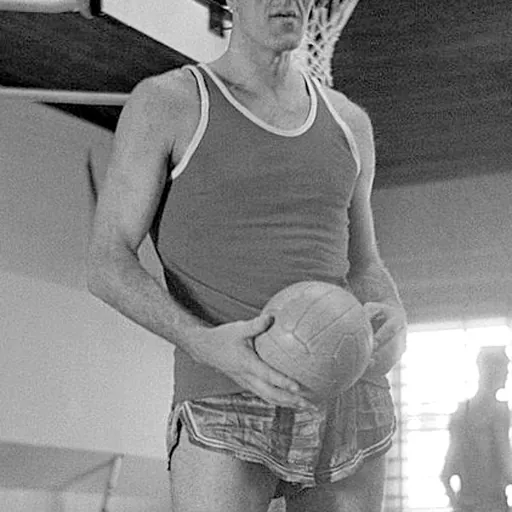
About Jānis Krūmiņš
Lived 1930 – 1994 (aged 64). Jānis Krūmiņš was a Russian and Latvian basketball player.
Jānis Krūmiņš (30 January 1930 – 20 November 1994) was a Soviet-Latvian professional basketball player. Helped by his height (about 220 cm, or 7'3"), he was the first giant center that dominated under European baskets, for years. As a player of the senior Soviet Union national basketball team, Krūmiņš won 3 gold medals at the 1959, 1961, and 1963 EuroBaskets, as well as 3 silver medals at the 1956, 1960, and 1964 Summer Olympic Games.
A Russian poll that was conducted in 2006, named Krūmiņš as the 3rd most popular Soviet men's basketball player of all time, after Arvydas Sabonis and Vladimir Tkachenko.
Early life and career Jānis Krūmiņš was born on 30 January 1930, in Raiskums Parish, Cēsis district, Latvia. His father was a big strong man, who died when Jānis was still a boy. At the age of 13, Krūmiņš had to start working, as a collector of tree resin. Very soon, he became an efficient worker, partly because his height (he was tall by the age 14) allowed him to reach where others failed. He liked his work, and later was hesitant to turn into a professional basketball player, saying that he could always get injured and lose his job as a basketball player, but not as a resin collector. As a well-built giant, Krūmiņš attracted the attention of many sports coaches, who tried to get him into wrestling, boxing, and athletics. Famous Soviet athletics coach Viktor Alexeyev even brought him in for a month to an athletics training camp. All of those attempts failed, because of a lack of interest from Krūmiņš.
In 1953, Krūmiņš was discovered by head basketball coach Alexander Gomelsky, and he was brought to the basketball club Rīgas ASK. The variation was mostly due to his body's natural contraction during the day, and over the length of his playing career.
In the following two seasons, ASK led by Krūmiņš, repeated their success, winning the EuroLeague in 1959 and 1960 seasons, completing a three-peat. The Latvian center was the Finals Top Scorer in both instances, averaging 28.0 points per game in 1959 and 21.5 points per game in 1960.
ASK reached the EuroLeague Finals for the fourth consecutive time in 1961. This time, it was a duel of two Soviet teams. ASK could not defend their title, losing to CSKA Moscow. Krūmiņš averaged 10.0 points per game in the finals and 14.7 points per game throughout the season. It was his last appearance in the EuroLeague and after first four seasons, Krūmiņš was the all-time leading scorer of this competition with 440 points.
In 1964, Krūmiņš was asked to join the recently-founded VEF Rīga team. Being in the twilight of his career, Krūmiņš still remained valuable player and in he helped VEF to win the bronze medals of the Soviet League in 1966. Krūmiņš played for the factory team till 1969 and finished his club career with VEF at the age of 39.
Krūmiņš remained a laid back player over all of those years, as he continued to spare smaller and weaker opponents from his best. However, he was quite emotional and active in the key games that his teams played, and he played with full effort against players that were similar to him in size. Krūmiņš had a rare free throw shooting style — as he shot free throws underhanded, rather than the usual overhanded free throw technique. However, he was still able to make 90% of his free throw attempts on average. and Summer Olympic Games silver medals in 1956, 1960, and 1964. He also played at the 1959 FIBA World Championship.
Personal life Krūmiņš was shy around people, including women. He met his wife, Inessa, by chance. In 1960, while she was working as a sculptor, she was ordered to make a bust of Krūmiņš, on the occasion of the 20th anniversary of the Latvian Soviet Socialist Republic. The couple had two sons, and a daughter. After retiring from playing basketball, Krūmiņš worked within his family business, and became a renowned metalworker, molding metal art from sketches done by his wife. Krūmiņš died on 20 November 1994, at the age of 64.
Awards and honors EuroLeague 3× EuroLeague champion (1958, 1959, 1960) 3× EuroLeague Finals Top Scorer (1958, 1959, 1960) 3× Top 10 in EuroLeague scoring - 4th (1959), 2nd (1960), 8th (1961) Only player in EuroLeague history to win three consecutive EuroLeague titles and Finals MVP awards combined EuroLeague all-time best scorer after 1961 season (440 points)
Don’t just read it —
keep it.
Full-length biographies made to live with: read them, listen on the way to work, watch them tonight.
- E-book
- Audio
- Video
Instant download · yours to keep · every purchase keeps this site free
Important facts
People in Jānis Krūmiņš's life
Named in this biography and alive at the same time


Related people
Same field, nearest in time


Contemporaries
People whose lives overlapped Jānis Krūmiņš's
Frequently asked questions
Who was Jānis Krūmiņš?
Soviet basketball player (1930-1994)
When was Jānis Krūmiņš born?
Jānis Krūmiņš was born on 30 January 1930 in Raiskums.
When did Jānis Krūmiņš die?
Jānis Krūmiņš died on 20 November 1994 in Riga.
What was Jānis Krūmiņš's occupation?
Jānis Krūmiņš was a basketball player.
What nationality was Jānis Krūmiņš?
Jānis Krūmiņš was Russian and Latvian.
Sources & further reading
Cite this page
APA: Biography.guide. (2026). Jānis Krūmiņš. https://biography.guide/janis-krumins-basketball-player/
MLA: "Jānis Krūmiņš." Biography.guide, https://biography.guide/janis-krumins-basketball-player/.
Chicago: "Jānis Krūmiņš." Biography.guide. https://biography.guide/janis-krumins-basketball-player/.
Data last updated: 2026-09-23 · Spot an error? Report a correction.
Portrait: Wikimedia Commons · author & licence
Page generated 2026-09-27 05:06 UTC