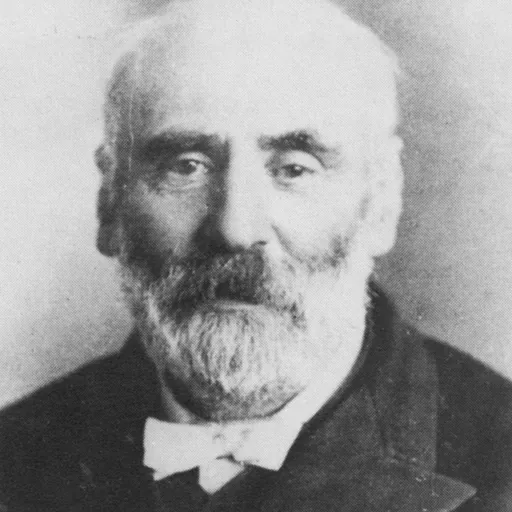
About Jan Lion Cachet
Lived 1838 – 1912 (aged 73). Jan Lion Cachet was a South African writer, pedagogue and preacher.
Jan Lion Cachet (29 November 1838 – 21 September 1912) was a minister and professor in the Reformed Church and an early Afrikaans writer and poet. Cachet was born to Jewish-Portuguese parents as the younger brother of Frans Lion Cachet. In 1849 the family converted to Christianity. In 1861 Cachet emigrated to South Africa as a teacher. He qualified as a minister and later became a professor at the Theological School in Burgersdorp, of which Prof. Dirk Postma was the rector. In 1905 he moved with the theological school to Potchefstroom and a few years later he died.
Dr. B. Spoelstra describes Cachet in the South African Biographical Dictionary as a preacher of the gospel; he was called by the State President Paul Kruger, also a member of the Reformed Church, to lead a prayer meeting in Pretoria on 27 August 1899 with a view to the impending war. As a professor, he helped train ministers for service to church and people, instead of theologians. Spoelstra also described him as identifying as Jewish, Dutch, and Afrikaner, and as active in church, political, educational, and cultural fields.
In February 1909, he received the Officer's Cross of the Order of Orange-Nassau from Queen Wilhelmina of the Netherlands. He is particularly remembered for his poem, "Di Afrikaans Taal", which appeared in Ons Klyntji in 1896, and later in his prose work Sewe duiwels en wad hulle dogen het.
Early life
Jan Lion Cachet was born on 29 November 1838 at Krom Boomssloot 3, Amsterdam, one of five children and the third son. In 1849, the entire family, like the Dutch poet Isaac da Costa, converted to Christianity under the influence of the Dutch Réveil movement and were baptized on 30 September 1849 in the Noorderkerk in Amsterdam. Jan attended Isaac da Costa's school and then received missionary training at the seminary of the Free Scottish Church in Amsterdam. He qualified as a religious teacher in 1857 and taught in the Havenlooze school in Amsterdam until 1860.
To South Africa Cachet came to South Africa in January 1861 in response to a call by Dr. William Robertson for teachers and catechists from Europe for the Dutch Reformed Church. His eldest brother and study partner, Frans Lion Cachet, was already working in South Africa at that time. He taught for about two months in the Cape at the school Tot Nut van het Algemeen and then until March 1862 at a small church school (the Dutch Reformed Seminary) in Breëstraat. However, the Cape was at this time largely under the influence of the liberal movement in the church, where he felt at home. So in April 1862 he went to Ladysmith in Natal and taught at a farm school here and then private teaching in the district. On his own he studied various languages and thus became fluent in French, German and English. In Ladysmith he transferred from the Dutch Reformed Church to the Reformed Church and decided in 1865 to qualify as a minister. After private study under the Rev. Dirk Postma (then still minister of Rustenburg) was allowed to be confirmed as minister of the Reformed Church in Rustenburg on 27 July 1868.
After the death of Postma in 1890, he returned to Burgersdorp as acting professor of Theology until he received his permanent appointment as professor of the Reformed Synod of Reddersburg in 1894. At the Theological School, Totius was one of his students. As the only professor, it was his task to cover the entire field of theology and to teach in all subjects. During this time, he also edited the newspaper De Stem op die dorp. At the first Afrikaans Language Congress held in Paarl on 15 and 16 January 1896, he delivered a lecture on the nature of Afrikaans. Here he also provided valuable input on the translation of the Bible, the establishment of his own magazine (Ons Klyntji) and his own dictionary. According to the first edition of Ons Klyntji in March 1896, the name of this magazine was suggested by him. mainly through Totius's efforts, and he and his family then moved to this town, where he was succeeded as professor by Totius in May 1911.
Poetry and writing Under the pseudonym “Neef Jan wat versies maak” he wrote a number of (especially Dacostian-religious) poems in Dutch and Afrikaans and he was one of the first contributors to Di Patriot. His most important poem is probably the allegorical “Di Afrikaanse taal”, which was first published in Ons Klyntji in 1896 and was subsequently regularly included in anthologies. In this, the relationship between Afrikaans, Dutch and English is allegorically indicated by the Boerenooi, her Dutch sister and English niece.
Other well-known poems are Op, op met die Vierkleur (which was later set to music by Professor J. de Villiers and became known and popular as a flag song after the First War of Independence), Die Vierkleur in gevaar! (written when it was clear that the Anglo-Boer War was threatening to break out), Jesus’ Hemelvaart and Jesus is umhool gevaar.
He also wrote poems in English, including the long, moralizing poem Vita Christi about the life of Christ.
As can be deduced from the titles, the main themes of his poems are nationality, language and religion. Apart from Di Afrikaans taal (which is included in various anthologies, including Groot verseboek, Die Afrikaans poësie in ’n kuisied en enkele gedigte, Afrikaans letterkunde, Eerste stemme, Digters en digkuns, Uit ons letterkunde, Patriot-digters and Die junior digbundel), his poetry, however, fell into oblivion quite quickly. Die Afrikaans liettegessinger first appeared in Ons Klyntji of June 1896 and was later included in Die junior digbundel.
In 1913 members and honorary members of the Reformed Student Corps Veritas Vincet decided to collect money for a fund, the interest from which would be used to buy books for the library. The front of each book will be marked "Cachet Library".
Don’t just read it —
keep it.
Full-length biographies made to live with: read them, listen on the way to work, watch them tonight.
- E-book
- Audio
- Video
Instant download · yours to keep · every purchase keeps this site free
Important facts
People in Jan Lion Cachet's life
Named in this biography and alive at the same time



Related people
Same field, nearest in time

Contemporaries
People whose lives overlapped Jan Lion Cachet's


Frequently asked questions
Who was Jan Lion Cachet?
South African writer (1838-1912)
When was Jan Lion Cachet born?
Jan Lion Cachet was born on 29 November 1838 in Amsterdam.
When did Jan Lion Cachet die?
Jan Lion Cachet died on 21 September 1912 in Potchefstroom.
What was Jan Lion Cachet's occupation?
Jan Lion Cachet was a writer, pedagogue and preacher.
What nationality was Jan Lion Cachet?
Jan Lion Cachet was South African.
Sources & further reading
Cite this page
APA: Biography.guide. (2026). Jan Lion Cachet. https://biography.guide/jan-lion-cachet/
MLA: "Jan Lion Cachet." Biography.guide, https://biography.guide/jan-lion-cachet/.
Chicago: "Jan Lion Cachet." Biography.guide. https://biography.guide/jan-lion-cachet/.
Data last updated: 2026-09-20 · Spot an error? Report a correction.
Portrait: Wikimedia Commons · author & licence
Page generated 2026-09-27 04:57 UTC