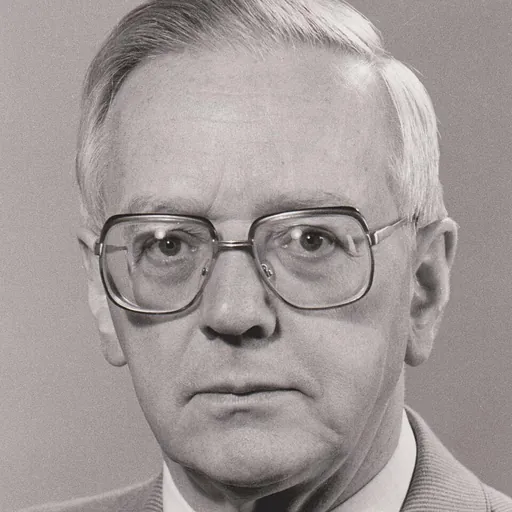
About Jan Agema
Lived 1919 – 2011 (aged 91). Jan Agema was a Dutch engineer, hydraulic engineer and university teacher.
Jan Fokke Agema (12 September 1919 – 23 April 2011) was a Dutch hydraulic engineer and professor at Delft University of Technology. He is notable for his design of the harbour entrance at Hoek van Holland and involvement in the construction of the Oosterscheldekering. The prof. dr.ir. J.F. Agemaprijs (English: the Professor ir. J.F. Agema Prize) is named for him, and has been awarded every five years since 2000.
Family, early life and education Agema was born in Opmeer in 1919, the eldest of three brothers in a working class family. His father, Sibbele Agema, was born in Wirdum, and met his mother, Johanna Catharina Agema (née van Dolder), when he was billeted in her family's farmhouse in Gouwsluis, near Alphen aan den Rijn whilst he was mobilised with the Royal Netherlands Army during World War I.
In 1938, Agema was transferred as an assistant draftsman to Johan van Veen at the Rijkswaterstaat Lower Rivers study service in The Hague, living in a boarding house in Scheveningen. He spent the money that remained after paying rent on evening class lessons in mathematics, hydraulic engineering, and other subjects in preparation for the Rijkswaterstaat (English: Technical Official) exams.
Activities during World War II In 1940, Agema was mobilised with the Netherlands Armed Forces and stationed in Schoonhoven with the (English: pontoon engineers). Following the German bombing of Rotterdam in May 1940, he moved to Grave, where his company were ambushed by German troops in the early morning of 10 May 1940.
In 1942, he was transferred back to Hoorn, but in April 1943, the Wehrmacht commander in the Netherlands announced that all members of the former Dutch army had to report to be taken back into captivity as prisoners of war. Agema was one of the thousands of ex-soldiers who ignored this order, going into hiding at a farm near his parents' house in Opmeer, where he was given shelter and food in exchange for doing odd jobs.
Works for Rijkswaterstaat, the Delta Works and continuing academic education
On 1 July 1957, Agema was transferred to the Rijkswaterstaat office in The Hague as a hydraulic engineering senior official. In 1959, he decided to enrol as a working student of hydraulic engineering at Delft University of Technology, being accepted on the course due to the fact that the Rijkswaterstaat Technical Officer diploma was equivalent to a (English: Higher Technical School) diploma.
Agema's combination of study whilst working full-time for Rijkswaterstaat meant that he did not graduate until 1970, when he was fifty years of age, and therefore older than his graduation professor, Eco Bijker. He was subsequently promoted to Chief Engineer at Rijkswaterstaat.
The Oosterscheldekering In 1973, Agema took on the role of Principal Engineer at the Rijkswaterstaat Delta Service, leading the hydrological department. Initially, his assignment was to work on the closure of the (English: Eastern Scheldt) with a dam. The dam, known as the (English: Eastern Scheldt storm surge barrier), had originally been designed as a fully closed structure.
Following public protests from environmental campaigners and fisheries groups, the Den Uyl cabinet decided in 1974 to make significant changes to the project and the requirements were changed to mandate a partially open dam. There was no precedent for such a structure anywhere in the world, and therefore no design codes to follow or construction experience from which to draw ideas.
By 1976, the requirements for the design and execution of the works were fully established, creating a formidable challenge for Agema's hydrological department, which included the development of mathematical models for water movement, among other tasks. The Oosterscheldekering was successfully completed in 1986.
Academic career at Delft University of Technology and later works From 1972, Agema served as a part-time lecturer at Delft University of Technology. In September 1979, he was appointed full professor of Hydraulic Engineering. He was a strong advocate of quality assurance, and was particularly concerned with improving civil engineering execution processes to ensure the completed work met design specifications, extending the scope of quality assurance into operational management and maintenance of constructed projects.
Agema also strongly promoted the use of probabilistic methods in design, and encouraged Professor Han Vrijling, Professor in Probabilistic Design and Hydraulic Structures at Delft, to develop this into a major part of the chair. His work with Vrijling in this period included the development of probabilistic methods for analysis of the failure risk of armour layers in breakwaters. He retired from the university in October 1985, and joined Ballast Nedam as a consultant until 1990, when he became an independent consultant. This award is made to the entire project team of client, designer and contractor. From the entries, five projects are nominated, from which a jury ultimately chooses the winner.
The following are the award winners since inception:
2000: The construction of the Bangabandhu Bridge (awarded in 2001) 2005: The inflatable dam at Ramspol, in Overijssel 2010: The Busan–Geoje Fixed Link 2015: Maasvlakte 2. The book "Building the Delta" provides an overview of all nominated projects from 2015. 2025: The Borselle Wind Energy Project. 2nd prize: Afsluitdijk Dike Reinforcement project.
International work Agema was involved in works in Bangladesh, including the closure of the Feni River in 1986, and served on the panel to assess a river crossing over the Jamuna River in 1985, as an adviser to the World Bank. He was then responsible for the implementation of the hydraulic engineering elements of the project, which accounted for approximately 50% of the total costs. In addition, he was involved in the design of the MOSE storm surge barrier in Venice, and the Cardiff Bay Barrage, where he served as the adviser to the design team for the closure and embankment works.
Personal life Agema married Lien Koot from Rotterdam in 1960. The couple moved to Hoek van Holland after their wedding and had three children. In 1977, he was appointed officer in the Order of the Dutch Lion, in recognition of his works as Chief Engineer for special services at Rijkswaterstaat. In 1979, Agema and his family moved to 's-Gravenzande before settling in Zeist in 2010, where Agema died in 2011, at the age of 91.
Don’t just read it —
keep it.
Full-length biographies made to live with: read them, listen on the way to work, watch them tonight.
- E-book
- Audio
- Video
Instant download · yours to keep · every purchase keeps this site free
Important facts
People in Jan Agema's life
Named in this biography and alive at the same time



Related people
Same field, nearest in time



Contemporaries
People whose lives overlapped Jan Agema's




Frequently asked questions
Who was Jan Agema?
Dutch Hydraulic engineer (1919-2011)
When was Jan Agema born?
Jan Agema was born on 12 September 1919 in Opmeer.
When did Jan Agema die?
Jan Agema died on 23 April 2011 in Zeist.
What was Jan Agema's occupation?
Jan Agema was an engineer, hydraulic engineer and university teacher.
What nationality was Jan Agema?
Jan Agema was Dutch.
Sources & further reading
Cite this page
APA: Biography.guide. (2026). Jan Agema. https://biography.guide/jan-agema/
MLA: "Jan Agema." Biography.guide, https://biography.guide/jan-agema/.
Chicago: "Jan Agema." Biography.guide. https://biography.guide/jan-agema/.
Data last updated: 2026-09-21 · Spot an error? Report a correction.
Portrait: Wikimedia Commons · author & licence
Page generated 2026-09-27 05:00 UTC