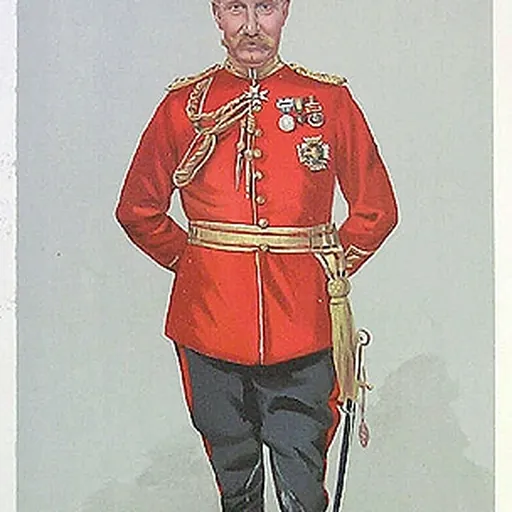
About James Wolfe-Murray
Lived 1853 – 1919 (aged 66). James Wolfe-Murray was a British military personnel.
Lieutenant-General Sir James Wolfe Murray (13 March 1853 – 17 October 1919) was a British Army officer who served in the Fourth Anglo-Ashanti War, Second Boer War and First World War. He became Chief of the Imperial General Staff three months after the start of the First World War, but was ineffectual and was replaced in September 1915 following the failure of the Dardanelles campaign.
Military career Murray was born the son of Brigadier General James Wolfe Murray (1814–1890) and Elizabeth Charlotte Murray (née Whyte-Melville).
He was educated at Trinity College, Glenalmond, Harrow School and the Royal Military Academy, Woolwich, He was promoted to captain on 1 November 1881. After attending Staff College, Camberley he became Deputy Assistant Adjutant and Quartermaster-General in Northern England January 1884. Deputy Assistant-Quartermaster General in the Intelligence Branch on 31 August 1884 and Deputy Assistant Adjutant-General (with responsibility for intelligence on Russia, Central and South Asia and the Far East) on 1 June 1887. Promoted to major in January 1889
He saw action in the Fourth Anglo-Ashanti War in West Africa between November 1895 and February 1896 and was then transferred to India where he became Assistant Adjutant-General on 25 January 1898, receiving promotion to lieutenant colonel on 31 March 1898. He was appointed Assistant Quartermaster General (in charge of intelligence) at Indian Headquarters on 25 March 1899.
He served in the Second Boer War on the staff of the Commander, Lines of Communication in Natal with the local rank of colonel from 21 September 1899, of brigadier general from 9 October 1899 and of major general on 1 May 1900. He was appointed Knight Commander of the Order of the Bath on 19 April 1901 in recognition of his services during the war.
In May 1901 he returned to India to command a brigade, and received the temporary rank of brigadier general whilst so employed. Promoted to the substantive rank of major-general on 1 January 1903, and Master-General of the Ordnance at Army Headquarters in London on 12 February 1904. At this time the Esher Committee chaired by Lord Esher was proposing far reaching changes to the structure of the British Army including the creation of a "blue ribbon" elite drawn strictly from the General Staff to the exclusion of Administrative Staff: Murray strongly opposed this aspect of the proposals. he became General Officer Commanding, 9th (Secunderabad) Division in India on 1 March 1907 and was promoted to lieutenant general on 1 April 1909.
After serving as an army representative on a British delegation to Russia set up by Parliament in 1912, he was appointed Commander-in-Chief at Scottish Command on 9 December 1913 and Commander-in-Chief in South Africa on 18 May 1914.
First World War Following the sudden death of General Sir Charles Douglas in October 1914, Murray was appointed his replacement as Chief of the Imperial General Staff (CIGS) on 30 October 1914. Following the failure of the Dardanelles campaign, Murray was replaced by General Sir Archibald Murray on 26 September 1915.
After undertaking a special mission to Russia in the spring of 1916, he was made General Officer Commanding (GOC) of Eastern Command on 5 May 1916 He was awarded the Russian Order of the White Eagle on 14 January 1918 and the Grand Cordon of the Japanese Order of the Sacred Treasure on 9 November 1918.
He was also colonel-commandant of the Royal Artillery from 9 April 1917
Don’t just read it —
keep it.
Full-length biographies made to live with: read them, listen on the way to work, watch them tonight.
- E-book
- Audio
- Video
Instant download · yours to keep · every purchase keeps this site free
Important facts
People in James Wolfe-Murray's life
Named in this biography and alive at the same time

Related people
Same field, nearest in time



Contemporaries
People whose lives overlapped James Wolfe-Murray's




Frequently asked questions
Who was James Wolfe-Murray?
British army officer, 1853-1919
When was James Wolfe-Murray born?
James Wolfe-Murray was born on 13 March 1853 in Ireland.
When did James Wolfe-Murray die?
James Wolfe-Murray died on 17 October 1919 in Cringletie.
What was James Wolfe-Murray's occupation?
James Wolfe-Murray was a military personnel.
What nationality was James Wolfe-Murray?
James Wolfe-Murray was British.
Sources & further reading
· Wikipedia: James Wolfe-Murray
Cite this page
APA: Biography.guide. (2026). James Wolfe-Murray. https://biography.guide/james-wolfe-murray/
MLA: "James Wolfe-Murray." Biography.guide, https://biography.guide/james-wolfe-murray/.
Chicago: "James Wolfe-Murray." Biography.guide. https://biography.guide/james-wolfe-murray/.
Data last updated: 2026-09-21 · Spot an error? Report a correction.
Portrait: Wikimedia Commons · author & licence
Page generated 2026-09-27 05:00 UTC