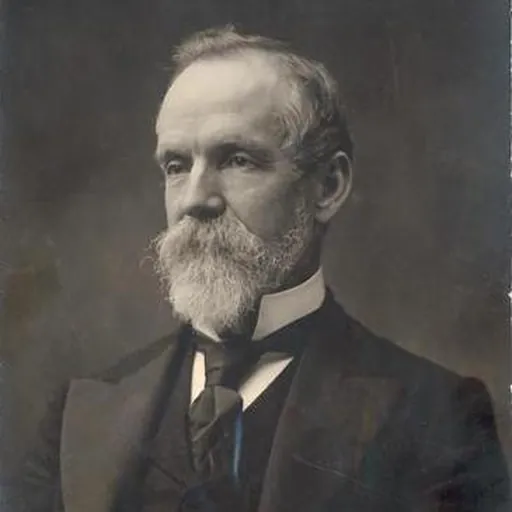
James Walker
Banker and politician in New South Wales, Australia
About James Walker
Lived 1841 – 1923 (aged 81). James Walker was an Australian politician, engineer and banker.
James Thomas Walker (20 March 1841 – 18 January 1923) was an Australian banker and politician. He served as a Senator for New South Wales from 1901 to 1913.
Walker was born in Edinburgh, Scotland. He spent his early childhood in New South Wales, before returning to Scotland with his family to study finance. Joining the Bank of New South Wales, he returned to Australia and held various financial positions in New South Wales and Queensland. Gaining a public reputation for financial expertise, he was active in the Federationist cause and was a delegate to the 1897 Constitutional Convention, where he was a significant figure in the development of Commonwealth finance schemes. After assisting the successful "Yes" campaign for the 1898 referendum, he was elected to the Senate in 1901 as a Free Trader.
As a senator, Walker continued to focus on finance, although his views on social policy sometimes saw him on the outside of his party. He supported the White Australia policy but disagreed with key elements, and was a leader in opposition to the dictation test, by which a potential immigrant was required to pass a test in any European language before their application was accepted. He also campaigned for a transcontinental railway and for a capital city to be located on federal territory. Attempts to guide financial reform through the parliament as a backbench senator led to frustration, and Walker retired due to ill health in 1913 with his legislation unpassed.
Early life and career Walker was born on Leith Walk in Edinburgh to grazier John William Walker and his wife Elizabeth, née Waterston. The family migrated to New South Wales in 1844 and settled on Castlereads Station near Boorowa. In 1849, John Walker sold the property to Hamilton Hume and returned to Scotland. James was educated at the Edinburgh Institution and King's College London before returning to Edinburgh in 1857.
Senate career
As a senator, Walker devoted his support to a variety of causes, including a transcontinental railway and equal pay for women. He opposed a federal old-age pension scheme on the grounds of lack of funds, and also opposed the Immigration Restriction Bill, although he supported the White Australia policy in principle. He opposed the proposed form of the dictation test and supported James Macfarlane's amendment requiring the test to be administered in a language known to the immigrant, moving his own amendment after Macfarlane's was defeated. He also expressed reservations about the deportation of Kanaka labourers, supporting the reduction in their use but advocating that those resident in Australia for at least five years be permitted to remain. He vigorously opposed compulsory arbitration, and voted against the Conciliation and Arbitration Bill.
Re-elected as an Anti-Socialist in 1906, Walker expressed the view that the three-party system of the Australian Parliament's first decade was dysfunctional, and implored electors to vote "for either socialism or anti-socialism, and so end this triangular government". He continued to support the transcontinental railway and lamented the slow progress of the decision on a site for the federal capital, and supported a higher rate of immigration and the watering down of the Immigration Restriction Act. In 1908, he introduced the Commonwealth Companies Reserve Liabilities Bill, which permitted special reserve funds for banks to assist shareholders during a financial crisis, and in 1910 followed with the similar Commonwealth Banking Companies Reserve Liabilities Bill. He complained of the difficulty of passing private senators' bills, and at the 1913 election he retired, suffering from ill health.
Later life Walker maintained an interest in politics after his retirement, and remained a director of the Bank of New South Wales until 1921. He had been president of the Australian Golf Club (1903–19), a director of the Royal Prince Alfred Hospital, and a member of the Presbyterian Church's finance committee. A fellow of the Institute of Bankers in London since 1886 and vice-president of the Australian Economic Association, he also continued as a director of the Australian Mutual Provident Society and a councillor of St Andrew's College at the University of Sydney. Walker died on 18 January 1923 at Woollahra in Sydney, and was survived by his wife and five of their seven children. Buried at South Head Cemetery, his estate at his death was worth £27,697.
Don’t just read it —
keep it.
Full-length biographies made to live with: read them, listen on the way to work, watch them tonight.
- E-book
- Audio
- Video
Instant download · yours to keep · every purchase keeps this site free
Important facts
People in James Walker's life
Named in this biography and alive at the same time



Related people
Same field, nearest in time




Contemporaries
People whose lives overlapped James Walker's


Frequently asked questions
Who was James Walker?
banker and politician in New South Wales, Australia (1841–1923)
When was James Walker born?
James Walker was born on 20 March 1841 in Edinburgh.
When did James Walker die?
James Walker died on 18 January 1923 in Woollahra.
What was James Walker's occupation?
James Walker was a politician, engineer and banker.
What nationality was James Walker?
James Walker was Australian.
Sources & further reading
· DBpedia: James Walker (Australian politician)
Cite this page
APA: Biography.guide. (2026). James Walker. https://biography.guide/james-walker-politician-1841/
MLA: "James Walker." Biography.guide, https://biography.guide/james-walker-politician-1841/.
Chicago: "James Walker." Biography.guide. https://biography.guide/james-walker-politician-1841/.
Data last updated: 2026-09-21 · Spot an error? Report a correction.
Portrait: Wikimedia Commons · author & licence
Page generated 2026-09-27 04:59 UTC