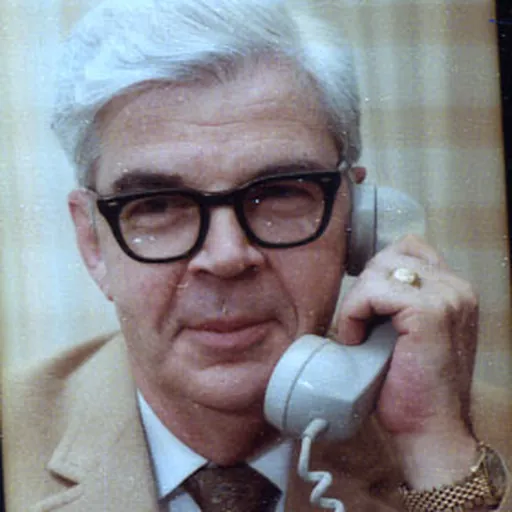
About James W. Nance
Lived 1921 – 1999 (aged 77). James W. Nance was a naval officer.
James Wilson "Bud" Nance (August 20, 1921 – May 11, 1999) was a United States Navy officer who was the 10th Deputy National Security Advisor from 1981 to 1982, also briefly the acting National Security Advisor. A childhood friend of Senator Jesse Helms, he later worked as a Congressional aide.
Early life and education James Wilson Nance was born in Monroe, North Carolina, on August 20, 1921. He grew up two blocks away from a young Jesse Helms, born two months after him. After high school, Nance attended North Carolina State University and the United States Naval Academy in Annapolis, Maryland, graduating in 1944. he saw service in World War II, serving on USS North Carolina, and tested jets for the Navy until the end of the 1950s, flying with John Glenn and Alan Shepard; he also served in the Korean War and in the Vietnam War. and from December 1968 to late 1969, the USS Forrestal. During his time as skipper, Forrestal suffered a minor fire at Norfolk Navy Yard that injured eight.
In 1970, he was attached to the National Military Command Center, as the deputy director,
At the time, the United States National Security Council under Richard V. Allen, the National Security Advisor, was split into four, with Major General Robert L. Schweitzer heading the military quarter, and Nance above him; Nance, considered well-connected, later took on Schweitzer's duties after the general's removal from the council for inopportune remarks. Allen also placed him in charge of a secret effort, Operation Golden Eagle, to resolve the Vietnam War POW/MIA issue by finding and releasing any men held: the first attempt failed, a second attempt was delayed, and further action was scrapped by the end of the year, by which point Allen was out of the White House.
On November 29, 1981, Nance was named acting National Security Advisor, after Allen took a leave of absence due to an investigation into the discovery of $1000 in his safe. He entered into his duties the next morning, sending President Reagan his daily brief.
Nance, though somewhat deferential, was considered better than Allen, especially in terms of administration—though he was not perceived as a candidate for the job permanently. Still, during his short tenure as acting National Security Advisor, Nance informed Vice President George H. W. Bush about the imposition of martial law in Poland, and helped the Reagan administration draft a response to it. He also hired Oliver North and John Poindexter, among others. despite the pleas of some within the White House, he was then removed as Deputy National Security Advisor on January 20, 1982, instead shifting to a lesser role as one assistant among many, though Larry Speakes claimed that he was put in charge of certain special projects.
In March 1982, he was moved out of national security entirely, and appointed the director of the Private Sector Survey on Cost Control, led by J. Peter Grace.
Congressional aide Nance soon returned to the private sector, working for the Boeing Military Airplane Company; even paying his filing fee in 1990.
In late 1991, the senator coaxed his friend out of retirement, With the Republican Revolution in 1994, Nance became the majority staff director for Helms, now the chairman of the committee. He also worked for minimum wage, after failing in an attempt to work for nothing; he called his 38-fold pay increase in 1995 "living high off the hog".
As his old friend and fellow conservative, Nance had the rare ability to persuade the obstinate and obstructionist Helms to support certain measures, such as the START II treaty. Still, the admiral came under fire: a North Carolina POW/MIA group began a national letter-writing campaign against him in 1995, claiming that, in firing Lucier and other aides, he had turned Helms away from the POW/MIA issue; and the next year, when Ruth Marcus of The Washington Post revealed that the Jesse Helms Center, of which Nance was a board member, received hundreds of thousands of dollars from the governments of Taiwan and Kuwait, as well as from R. J. Reynolds Tobacco Company, United States Tobacco Company and Milliken & Company.
Still, Nance endured; and though his health declined over timein 1997, he suffered serious injuries in a car accident Nance, seen as the more genial gentleman to Helms's more feisty populism, continued to work, often arriving at 7am. A few hours before his death, Senator Helms had tearfully requested prayers for Nance from his fellow senators; their tributes took up 13 whole pages of the Congressional Record. He was later replaced as staff director by Stephen Biegun.
He is buried at Arlington National Cemetery.
Nance was survived by his wife, Mary Lyda and his four children.
Don’t just read it —
keep it.
Full-length biographies made to live with: read them, listen on the way to work, watch them tonight.
- E-book
- Audio
- Video
Instant download · yours to keep · every purchase keeps this site free
Important facts
People in James W. Nance's life
Named in this biography and alive at the same time




Related people
Same field, nearest in time



Contemporaries
People whose lives overlapped James W. Nance's





Frequently asked questions
Who was James W. Nance?
U.S. Navy admiral
When was James W. Nance born?
James W. Nance was born on 20 August 1921 in Monroe.
When did James W. Nance die?
James W. Nance died on 11 May 1999 in Bethesda, Maryland.
What was James W. Nance's occupation?
James W. Nance was a naval officer.
Sources & further reading
Cite this page
APA: Biography.guide. (2026). James W. Nance. https://biography.guide/james-w-nance/
MLA: "James W. Nance." Biography.guide, https://biography.guide/james-w-nance/.
Chicago: "James W. Nance." Biography.guide. https://biography.guide/james-w-nance/.
Data last updated: 2026-09-22 · Spot an error? Report a correction.
Portrait: Wikimedia Commons · author & licence
Page generated 2026-09-27 05:03 UTC