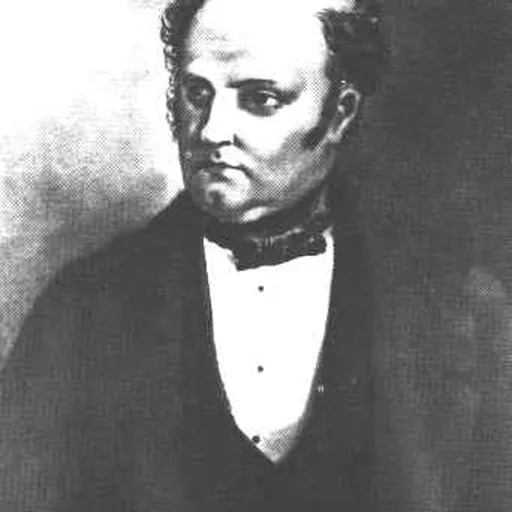
About James Smart
Lived 1804 – 1870 (aged 66). James Smart was a British police officer and merchant.
James Smart (22 March 1804 – 27 May 1870) was a British police officer who served as head of the City of Glasgow Police from 1848 until his death in 1870, first as chief superintendent before being designated as Glasgow's first chief constable in 1862.
Smart served as superintendent of the Burgh of Calton from 1835 until its amalgamation into Glasgow in 1846 and as assistant superintendent of Glasgow's Eastern Division Glasgow from 1846 to 1848 in which he was praised for his handling of the Glasgow bread riots of 1848.
Early life and career Smart was born on 22 March 1804 (The Glasgow Police Museum states that Smart was born on 22 March 1805 but in The First Chief Constable (1993) by Alistair L.) Goldsmith his birth year is given as 1804.
On 6 March 1848, bread riots occurred in Glasgow leading to warehouse windows being smashed and firearms and other weapons being stolen from gun-smiths. The Glasgow Herald described the city as being in a "state of utmost apparent security" and the following day Smart, escorted by a group of pensioners armed with firearms approached the mob. The mob reportedly began to "hoot and groan" and throw stones at Smart and the pensioners. The pensioners were then ordered by Smart to charge at the mob to disperse them but they possibly misunderstood the orders and fired at the crowd instead. The riot led to three people receiving fatal wounds and four people being injured. The Glasgow Herald reported that it was soon acknowledged that Smart's "firmness had prevented the riot attaining even more formidable proportions" with Sheriff Sir Archibald Alison stating that "his conduct was not only unexceptionable but highly meritorious in the trying circumstances".
City of Glasgow Police The bread riots led to the resignation of Glasgow's Chief Superintendent William Pearce who had received complaints over the way in which he dealt with the crowds. He was succeeded by Assistant Superintendent Cameron for an interim period of 14 days before he was succeeded by Henry Miller. Miller who had previously served as Glasgow's Chief Superintendent between 1836 and 1844, took nine weeks' sick-leave after his health deteriorated before he resigned on 4 December 1848. Smart was appointed to the vacant position on 18 December 1848.
In 1849, Queen Victoria, Prince Albert and the Prince of Wales visited Glasgow on route to Balmoral Castle. It was the city's first royal visit since James VI and I visited the city in 1617 with an estimated 400,000 people cheering along the route which was well marshalled by the city's police force.
On 28 August 1850, Smart discontinued the practice of night constables calling the hours and half hours with the exception of five and half past five. On 26 May 1856, he ordered that superior officers in the force no longer arrange excise commissions so that they could focus their attentions on the prevention of illicit distillation. Smart requested that the Scottish Office produce criminal statistics from 1857 which he used to make "repeated representations to his Police Board bemoaning the carelessness of the public affecting his crime figures". The Glasgow Police Act 1862 (25 & 26 Vict. c. cciv) designated Smart as Glasgow's first Chief Constable; previously only county police officers could use the title. His protégé McCall was the favoured candidate to succeed him described in the same report as Smart's funeral as being an intelligent and polite young man with "plenty of vigour and resources as has more than once been shown by the way he has handled notorious criminal cases". The police authority concurred with this view and appointed McCall as Glasgow's Chief Constable with him serving in the position until his own death on 29 March 1888.
On 28 June 1972, the inaugural was given by Lord Fraser at the University of Glasgow under the chairmanship of Alick Buchanan-Smith. The 2003 lecture about global terrorism was given by the Director-General of MI5 Eliza Manningham-Buller. At the 2009 lecture, Director of Public Prosecutions Keir Starmer described Smart as "one of the founding fathers of the Scottish Police". The 44th lecture was given by Cabinet Secretary for Justice Michael Matheson at the 2016 Scottish International Policing Conference. The 50th anniversary lecture was given by former Chief Constable of Lancashire Constabulary Andy Rhodes on 3 August 2022.
Don’t just read it —
keep it.
Full-length biographies made to live with: read them, listen on the way to work, watch them tonight.
- E-book
- Audio
- Video
Instant download · yours to keep · every purchase keeps this site free
Important facts
People in James Smart's life
Named in this biography and alive at the same time




Related people
Same field, nearest in time


Contemporaries
People whose lives overlapped James Smart's





Frequently asked questions
Who was James Smart?
British police officer
When was James Smart born?
James Smart was born on 22 March 1804 in Cathcart.
When did James Smart die?
James Smart died on 27 May 1870 in Glasgow.
What was James Smart's occupation?
James Smart was a police officer and merchant.
What nationality was James Smart?
James Smart was British.
Sources & further reading
· DBpedia: James Smart (police officer)
Cite this page
APA: Biography.guide. (2026). James Smart. https://biography.guide/james-smart-police-officer/
MLA: "James Smart." Biography.guide, https://biography.guide/james-smart-police-officer/.
Chicago: "James Smart." Biography.guide. https://biography.guide/james-smart-police-officer/.
Data last updated: 2026-09-20 · Spot an error? Report a correction.
Page generated 2026-09-27 05:09 UTC