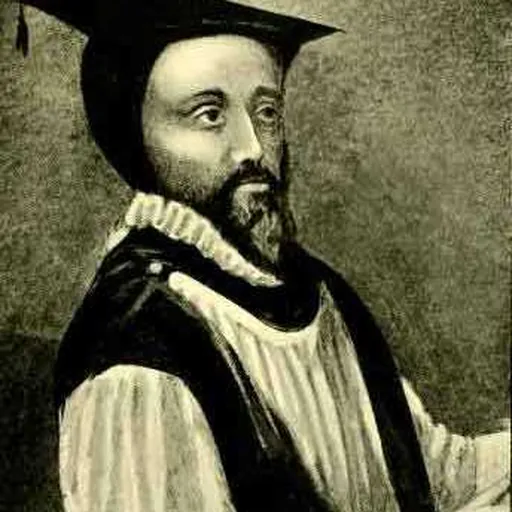
James Pilkington
The first Protestant Bishop of Durham from 1561 until his death in 1576
About James Pilkington
Lived 1520 – 1576 (aged 55–56). James Pilkington was an English prelate, religious leader, anglican priest, bishop and bishop of Durham.
James Pilkington (1520–1576), was the first Protestant Bishop of Durham from 1561 until his death in 1576. He founded Rivington Grammar School and was an Elizabethan author and orator.
Early life
James was the second son of Richard Pilkington of Rivington Hall, in the parish of Bolton le Moors and Alice Asshaw of Hall oth' Hill, near Heath Charnock in the parish of Chorley in Lancashire. His paternal ancestry is a junior line of the Pilkington family who owned land at Rivington from 1212 where they were Lords of the manor.
James Pilkington's early education is speculated to have been at Manchester Grammar School. He entered Pembroke College, Cambridge in 1536, and moved to St John's College, Cambridge, from where he graduated B.A. in 1539, and M.A. in 1542. James Pilkington was appointed Vicar of Kendal in 1545. He resigned this position to return to Cambridge. From 1547 he was granted right to preach under the ecclesiastical seal. In 1550 he became president of the college and graduated Bachelor of Theology in 1551.
Marriage and children
In or before 1564 They had two sons and two daughters:
His sons Joshua and Isaac, died in infancy. His daughter Deborah (born 1564 – died unknown) married twice, first to Walter Dunch (circa 1552 – 4 June 1594), of Avebury Manor in Wiltshire, M.P. for Dunwich, then she married Sir James Mervyn, of Fonthill Gifford also in Wiltshire, M.P. for that county. His younger daughter Ruth (died 1627) became the second wife of Sir Henry Harrington of Bagshaw and Baltinglass in 1587, they had a son, Henry. Henry's only daughter to survive into adulthood, Morag Harrington (Died 1669), married James Pilkington's own great nephew, Charles Tynewood Pilkington (died 1689).
Exile On the death of Edward VI in 1553 the line of succession fell to Queen Mary I, a Roman Catholic, intent on restoring England to the Church of Rome. During her reign, Pilkington escaped the Marian persecutions in England by fleeing to the continent, ensuring his survival. Whilst he was there many Protestants were persecuted and executed in England. James Pilkington went to Zürich, Geneva, Basel, and Frankfurt
Oratory On his return he became prominent through preaching at St Paul's Cross and in Spital pulpit. On 20 July 1559, he was appointed Master of St John's, and also Regius Professor of Divinity at Cambridge. He was an active preacher in Cambridge and London; on 20 July 1560 he preached at the memorial service for Martin Bucer and Paul Fagius at Cambridge.
In June 1560 he preached before Elizabeth I at the Royal Court, impressing the Queen who wrote to the chancellors of the universities recommending the study of divinity and making an offer of office or preferment to the best of those who preached divinity. In 1560 he wrote, "Aggeus (Haggai) the Prophete, declared by a Large Commentary".
Bishop After turning down the bishopric of Winchester over a dispute about crown alienation of church land, he was nominated Bishop of Durham on 26 December 1560, consecrated on 2 March 1561, and enthroned on 10 April. He resigned the mastership of St John's in October of that year, where he was succeeded by his brother, Leonard. He obtained the restitution of the lands belonging to the see, but had to pay over £1,000 a year to the Crown as compensation.
As bishop, Pilkington sought to bring order to his diocese, dealing with recusancy and conflicts of power with the Earls of Westmorland and Northumberland, in which he was helped by the new dean, William Whittingham, appointed in 1563. Pilkington and Whittingham worked to ensure the appointment of committed reformers in what had been an area of strong recusant Roman Catholic feeling. In the 1560s and 1570s Pilkington exercised his patronage of cathedral prebends and invariably nominated zealous Protestants, many of them his relatives and friends.
The east window of Rivington and Blackrod High School Chapel contains a stained glass window installed in 1912 commemorating the bishop and other donors to the chapel. The side lights illustrate events in the career of the bishop, his mastership of St John's College, Cambridge, the bishop fleeing to Europe, teaching children in Zürich, and revising the Book of Common Prayer with Matthew Parker, the Archbishop of Canterbury.
Rising of the North The bishop and his family had fled to London dressed as beggars in 1569 at the time of the Rising of the North A collected edition of his writings was published by the Parker Society in 1842.
Pilkington painting The "Pilkington Painting" Rivington Church, Rivington, Lancashire. 1835 copy of original made in 1566. The shields depict the Bishop's paternal arms, his augmented arms as bishop and the arms of Kingsmill, for his wife The "Pilkington Painting" in Rivington Church, Rivington, Lancashire, was commissioned in 1566 by Bishop Pilkington, in memory of his father who built the church. The original picture measured 53 by 35 inches and was considerably damaged by a fire in 1834, and in 1904 its remains were in the possession of Colonel John Pilkington of Wavertree. A copy had been made in 1821 for Mr. John Pilkington of Bolton, by his daughter Miss Jane Noble Pilkington. A copy of the 1821 painting was commissioned in 1835 by Rivington Church, where it is on display today.
Columns in the painting are a stylised representation of Durham Cathedral. On the left column is an heraldic escutcheon displaying the arms of Sir Robert Pilkington, second son of Sir Roger Pilkington (died 1347), lord of the manor of Pilkington, Stand: Argent, a cross patonce gules voided of the field, with a crescent azure for difference of a second son, in the dexter chief, surmounted by the crest, A mower with his scythe.
At right: Arms of the See of Durham impaling Pilkington, with a chief of augmentation granted to Bishop James Pilkington on 10 February 1561, by Sir Gilbert Dethicke, Garter King of Arms. Augmented arms of Bishop Pilkington: Argent, a cross patonce gules voided of the field on a chief vert, three suns or, with the mark of cadency of a second son. Above these arms is a figure of the Bishop, wearing his Episcopal robes, and the cap peculiar to those times.
Beneath the shield is a triple carved Elizabethan frame. The centre panel shows the arms of the bishop impaling the canting arms of Kingsmill (Argent, semée of cross-crosslets fitchée sable, a chevron ermines between three millrinds of the second a chief ermine), for his wife, Alice Kingsmill, daughter of Sir John Kingsmill of Sidmanton. Grouped round the table at the bottom left of the painting are Richard and his seven sons, and across the table, Alice and her five daughters. James, the bishop is depicted in his rochet, red gurnard and gown.
At the top of the painting is the inscription,'VTVIT POST FUNERA VIRTUS', 'Virtue lives after death'. The inscriptions contained in the four cut and scrolled Elizabethan framework panels: Richard Pilkinton (sic), who built this church, was buried here, in the year of Our Lord 1551, and 24 May, then Trinity Sunday, aged 65. A man of good esteem. Alice Asshawe, his wife, bore him 12 children, of whom three are preachers and of St. John's College Cambridge, she lived eighty years. Fathers teach your children nurture and learning of the Lord. James, their son, became Bishop of Durham on 2 March, in the year 1560, and in the 42nd year of his life. He opened this school in the year 1566 and church. Children obey your parents in the Lord. Let your lights shine so before men ye they may see ye good works, O father in heaven. Lord Save Us. We perish. Lord increase our faith.
Don’t just read it —
keep it.
Full-length biographies made to live with: read them, listen on the way to work, watch them tonight.
- E-book
- Audio
- Video
Instant download · yours to keep · every purchase keeps this site free
Important facts
People in James Pilkington's life
Named in this biography and alive at the same time




Related people
Same field, nearest in time



Contemporaries
People whose lives overlapped James Pilkington's






Frequently asked questions
Who was James Pilkington?
the first Protestant Bishop of Durham from 1561 until his death in 1576
When was James Pilkington born?
James Pilkington was born in 1520 in Rivington.
When did James Pilkington die?
James Pilkington died on 23 January 1576 in Bishop Auckland.
What was James Pilkington's occupation?
James Pilkington was a prelate, religious leader, anglican priest, bishop and bishop of Durham.
What nationality was James Pilkington?
James Pilkington was English.
Sources & further reading
· DBpedia: James Pilkington (bishop)
Cite this page
APA: Biography.guide. (2026). James Pilkington. https://biography.guide/james-pilkington-prelate/
MLA: "James Pilkington." Biography.guide, https://biography.guide/james-pilkington-prelate/.
Chicago: "James Pilkington." Biography.guide. https://biography.guide/james-pilkington-prelate/.
Data last updated: 2026-09-23 · Spot an error? Report a correction.
Portrait: Wikimedia Commons · author & licence
Page generated 2026-09-27 05:07 UTC