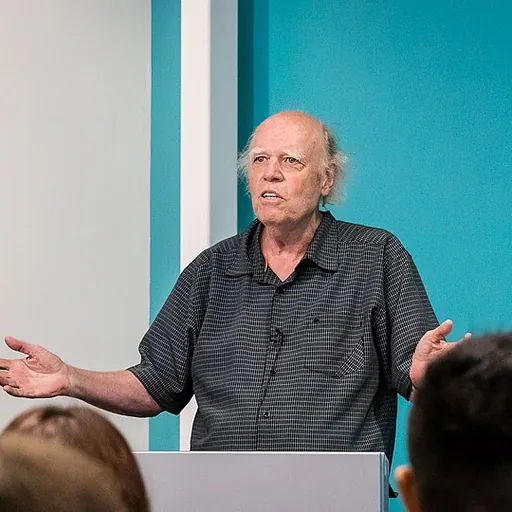
About James Paul Gee
Born 1948. James Paul Gee is an American linguist and university Professor.
James Gee (; born April 15, 1948) is a retired American researcher who has worked in psycholinguistics, discourse analysis, sociolinguistics, bilingual education, and literacy. Gee most recently held the position as the Mary Lou Fulton Presidential Professor of Literacy Studies at Arizona State University, originally appointed there in the Mary Lou Fulton Institute and Graduate School of Education. Gee has previously been a faculty affiliate of the Games, Learning, and Society group at the University of Wisconsin–Madison and is a member of the National Academy of Education.
Biography James Paul Gee was born in San Jose, California. He received his B.A. in philosophy from the University of California at Santa Barbara and both his M.A. and Ph.D in linguistics from Stanford University. He started his career in theoretical linguistics, working in syntactic and semantic theory, and taught initially at Stanford University and later in the School of Language and Communication at Hampshire College in Amherst, Massachusetts. After doing some research in psycholinguistics at Northeastern University in Boston and at the Max Planck Institute for Psycholinguistics in the Netherlands, Prof. Gee's research focus switched to studies on discourse analysis, sociolinguistics, and applications of linguistics to literacy and education. He went on to teach in the School of Education at Boston University, where he was the chair of the Department of Developmental Studies and Counseling, and later in the Linguistics Department at the University of Southern California. At Boston University he established new graduate programs centered around an integrated approach to language and literacy, combining programs in reading, writing, bilingual education, ESL, and applied linguistics. From 1993 to 1997 he held the Jacob Hiatt Chair in Education in the Hiatt Center for Urban Education at Clark University in Massachusetts. From 1997 until 2007, he held the Tashia Morgridge Professor of Reading at the University of Wisconsin–Madison. In 2007, Gee relocated to Arizona State University, where he was the Mary Lou Fulton Presidential Professor of Literacy Studies in the Department of Curriculum and Instruction.
In 2019, Gee retired.
Discourse/discourse In his work in social linguistics, Gee explored the concept of Discourse ("big D" Discourse). In Gee's work, discourse ("little d") refers to language-in-use. When discussing the combination of language with other social practices (behavior, values, ways of thinking, clothes, food, customs, perspectives) within a specific group, Gee refers to that as Discourse. Individuals may be part of many different Discourse communities, for example “when you ‘pull-off’ being a culturally specific sort of ‘everyday’ person, a ‘regular’ at the local bar...a teacher or a student of a certain sort, or any of a great many other ‘ways of being in the world’” (p. 7).
Discourse communities Furthermore, being able to function within a Discourse may carry advantages in different situations. For example, if a person is raised in a family of lawyers, the Discourses of politics or business may come very easily to that person. In the United States, those are all Discourses of power and they are closely related. Another person raised in a very different Discourse community might find himself or herself at a disadvantage when trying to move within the Discourse of business, trying to get a loan, for instance. One Discourse community is not inherently better than another; however, power within a society may be unequally represented within different Discourses.
Situated language In Gee's view, language is always used from a perspective and always occurs within a context. There is no 'neutral' use of language. Meaning is socially constructed within Discourse communities.
Discourse analysis Gee's 1999 text An Introduction to Discourse Analysis: Theory and Method is a foundational work in the field of discourse analysis.
New literacies According to Gee, In other words, according to which type of text we read there are different ways in which we read depending on the “rules” of how to read such a text. Literacy to Gee, even if it is the traditional print-based literacy, should be conceived as being multiple, or comprising different literacies, since we need different types of literacies to read different kinds of texts in ways that meet our particular purposes in reading them.
Furthermore, Gee also argues that reading and writing should be viewed as more than just “mental achievements” happening inside people's minds; they should also be seen as “social and cultural practices with economic, historical, and political implications”. So, in Gee's view, literacies are not only multiple but are inherently connected to social practices. In order to expand the traditional view of literacy as print literacy, Gee recommends that we think first of literacy in terms of semiotic domains. By this, he means “any set of practices that recruits one or more modalities (e.g., oral or written language, images, equations, symbols, sounds, gestures, graphs, artifacts, etc.) to communicate distinctive types of meanings”. There is a seemingly endless and varied range of semiotic domains, including (but certainly not limited to) cellular biology, first-person-shooter video games, rap music, or modernist painting. Most pundits would describe this conception of literacies as a key element in what has come to be known as the New Literacy Studies. In short, this theoretical and methodological orientation emphasizes studying language-in-use and literacies within their contexts of social practice. It includes work by colleagues such as Brian Street, Gunther Kress, David Barton, Mary Hamilton, Courtney Cazden, Ron Scollon, and Suzie Scollon, among others.
Gee's current work in the field of new literacies has seen him shift in his research focus somewhat from studying language-in-use to examining the D/iscourses of a range of new social practices—with a particular emphasis on video games and learning. Gee applies many key concepts from his previous research to studying video games. For example, Gee continues to argue that if we take reading to mean gaining understanding (instead of simply decoding letter sounds and words), one needs to be able to recognize or produce meanings inherent to any one semiotic domain in order to be literate in that domain. As such, and as Gee sets out in his text What Video Games Have to Teach Us About Learning and Literacy, one can be literate in the semiotic domain of video games if he or she “can recognize (the equivalent of “reading”) and/or produce (the equivalent of “writing”) meanings” in the video game domain. Video games, when they are successful, are very good at challenging players. They motivate players to persevere and simultaneously teach players how to play. Gee began his work in video games by identifying thirty-six learning principles that are present in - but not exclusive to - the design of good video games.
Good learning principles in video games Gee condenses and clusters these principles even more closely in an article following the publication of his video games and learning book. Gee believes good education involves “applying the fruitful principles of learning that good game designers have hit on, whether or not we use a game as a carrier of these principles" (p. 6). Thus, Gee organizes the condensed list of good learning principles in three student-centered, classroom-friendly clusters: “Empowered Learners; Problem Solving; Understanding" (p. 6). Gee talks of identity differences based on social and cultural views of identity and identifies four of these views, each of which are influenced by different forms of power, though they all have an effect on one another. Gee describes them as “four ways to formulate questions about how identity is functioning for a specific person (child or adult) in a given context or across a set of contexts” (p. 101).
The first of Gee's identity perspectives is what he calls “the nature perspective (or N-identities)” (p. 101). N-identity represents an identity people cannot control, one that comes from forces of nature. An example of this type of identity would be male or female. While the person has no control over the sex they were born with, this identity only means something because society and culture say this biological difference is important. Gee explains this idea further by stating, “N-identities must always gain their force as identities through the work of institutions, discourse and dialogue, or affinity groups, that is, the very forces that constitute our other perspectives on identity” (p. 102).
“he institutional perspective (or I-identities)” (p. 102) refers to identities set by authorities within an institution. An example of an I-identity is a student, whose identity is defined by the school as an institution with rules and traditions the student must follow. Gee claims these I-identities can be something imposed on a person, such as being a prisoner, or can be a calling for the person, such as being a college professor.
The third perspective Gee identifies is the “discursive perspective (or D-identities)” (p. 103). D-identity refers to an individual trait, such as caring. D-identities are a matter of social interaction that only become identities because “other people treat, talk about, and interact” with the person in ways that bring forth and reinforce the trait (p. 103). According to Gee “D-identities can be placed on a continuum in terms of how active or passive one is in ‘recruiting’ them, that is, in terms of how much such identities can be viewed as merely ascribed to a person versus an active achievement or accomplishment of that person” (p. 104).
The final identity perspective Gee identifies is the “affinity perspective (or A-identities)” (p. 105). A-identities are built by shared experiences as part of an affinity group, which according to Gee's definition is a group that share “allegiance to, access to, and participation in specific practices” (p. 105). Joining these groups must be something the person has chosen to do and feels a part of in order for the A-identity to be built. Gee explains this further by stating, “While I could force someone to engage in specific practices, I really cannot coerce anyone into seeing the particular experiences connected to those practices as constitutive (in part) of the ‘kind of person’ they are” (p. 106).
Selected works Gee. J. P. (1989). "Discourses, Socially-Culturally Situated Educational Theory, and the Failure Problem". Gee, J. P. (1990). Social linguistics and literacies: Ideology in discourses. London: Falmer Press. Gee, J. P. (1992). The social mind: Language, ideology, and social practice. Series in language and ideology. New York: Bergin & Garvey. Gee, J. P. (1999). An introduction to Discourse analysis: theory and method. London and New York: Routledge. Gee, J. P. (2000). Identity as an analytic lens for research in education. Review of Research in Education, 25, 99-125. Gee, J. P. (2003). What Video Games Have to Teach Us About Learning and Literacy. New York: Palgrave Macmillan. Gee. J. P. (2004). Situated language and learning: A critique of traditional schooling. London: Routledge. Gee. J. P. (2008). Policy Brief: Getting Over the Slump: Innovation Strategies to Promote Children's Learning. The Joan Ganz Cooney Center Gee. J. P. (2005). "Learning by Design: good video games as learning machines". E-Learning, Volume 2 (Number 1), p. 5-16 Gee, J. P. & Elisabeth Hayes. (2011). Language and Learning in the Digital Age. London and New York: Routledge.
Don’t just read it —
keep it.
Full-length biographies made to live with: read them, listen on the way to work, watch them tonight.
- E-book
- Audio
- Video
Instant download · yours to keep · every purchase keeps this site free
Important facts
People in James Paul Gee's life
Named in this biography and alive at the same time




Related people
Same field, nearest in time




Contemporaries
People whose lives overlapped James Paul Gee's


Frequently asked questions
Who is James Paul Gee?
American linguist
When was James Paul Gee born?
James Paul Gee was born on 15 April 1948 in San Jose.
What is James Paul Gee's occupation?
James Paul Gee is a linguist and university Professor.
What nationality is James Paul Gee?
James Paul Gee is American.
Sources & further reading
Cite this page
APA: Biography.guide. (2026). James Paul Gee. https://biography.guide/james-paul-gee/
MLA: "James Paul Gee." Biography.guide, https://biography.guide/james-paul-gee/.
Chicago: "James Paul Gee." Biography.guide. https://biography.guide/james-paul-gee/.
Data last updated: 2026-09-22 · Spot an error? Report a correction.
Portrait: Wikimedia Commons · author & licence
Page generated 2026-09-27 04:59 UTC